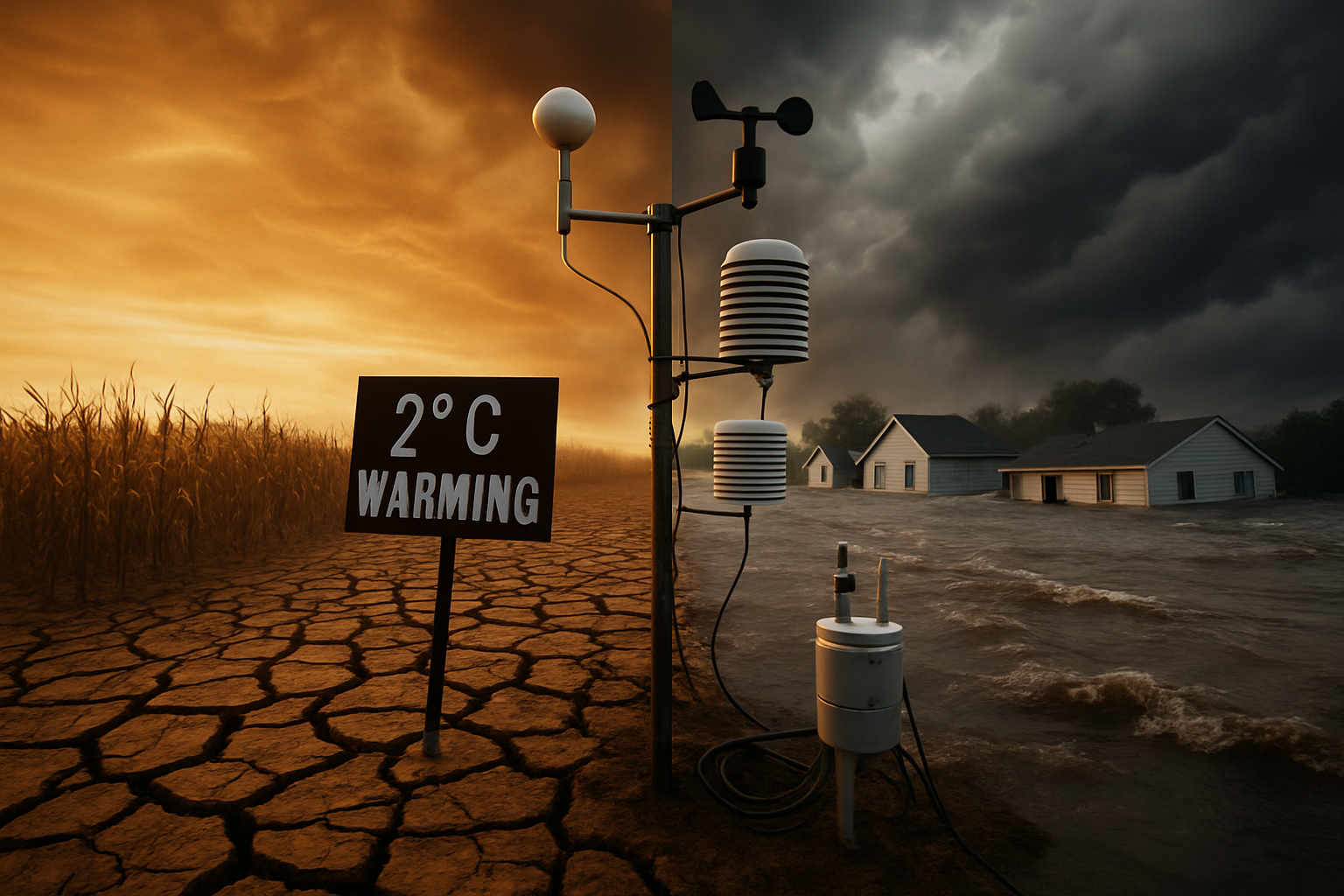
New climate impact research from Austria and Portugal is challenging long-held scientific assumptions about global warming thresholds, revealing that even a 2°C temperature increase could trigger extreme climate events previously expected only when temperatures rise by 3 or 4 degrees Celsius.
According to research highlighted by Austrian publication derStandard.at, even moderate warming scenarios cannot rule out extreme climate phenomena that scientists previously associated only with much higher temperature increases. The findings come as Portugal's PÚBLICO reported that a 2°C increase "already implies extreme risk and phenomena of droughts, floods and fires that may exceed projections associated with 3 and 4 degrees."
This research represents a fundamental shift in climate science understanding during a period when Earth has experienced unprecedented warming—January 2026 marked the hottest month ever recorded, extending a streak of 22 consecutive months exceeding the critical 1.5°C pre-industrial threshold.
The 2-Degree Threshold: A False Security Blanket
The Paris Climate Agreement's target of limiting warming to 2°C above pre-industrial levels has long been viewed as a manageable "safety margin." However, the new research suggests this threshold may offer far less protection than previously understood.
The Austrian study indicates that extreme weather events—including catastrophic droughts that devastate agricultural systems, flooding that overwhelms urban infrastructure, and wildfires that consume entire ecosystems—could occur with alarming frequency even at relatively modest temperature increases.
This revelation comes as climate scientists observe real-world impacts already exceeding many theoretical projections. The current warming streak has demonstrated what researchers call a "climate volatility paradox," where sustained global warming enables both record heat and devastating regional extremes through disrupted atmospheric circulation patterns.
Current Climate Reality Validates Concerns
The research findings align disturbingly with observed climate patterns throughout 2026. Emergency response systems worldwide have been pushed beyond capacity limits as traditional mutual aid mechanisms prove inadequate for simultaneous disasters affecting multiple continents.
From Australia's "apocalyptic rain" and cyclone conditions to Europe's devastating storm successions that claimed dozens of lives, the current climate demonstrates how moderate warming unleashes compound disasters that overwhelm human adaptive capacity.
Marine ecosystems provide stark evidence of these accelerated impacts. Research examining 33,990 fish populations across the Northern Hemisphere found that every 0.1°C of ocean warming per decade reduces fish populations by 7.2%—impacts cascading through entire food webs at rates far exceeding previous projections.
The Science Behind Accelerated Impacts
The mechanism driving these surprising impacts involves complex feedback loops and tipping points within Earth's climate system. As global temperatures rise, seemingly small increases can trigger disproportionately large responses in regional weather patterns.
Arctic ice loss accelerates as warming progresses, reducing the planet's ability to reflect solar radiation back to space. This creates additional warming that compounds the effects of greenhouse gas emissions. Similarly, permafrost thawing releases stored carbon dioxide and methane, further accelerating the warming process.
Ocean circulation patterns, which regulate weather systems across entire continents, become increasingly unstable as temperature differentials shift. The Gulf Stream's documented weakening demonstrates how relatively modest warming can fundamentally alter climate systems that have remained stable for millennia.
Regional Impacts Exceeding Projections
The Austrian and Portuguese research emerges from observations of climate impacts already manifesting across Europe and beyond. Finland has experienced its earliest tick season in recorded history, with dangerous disease vectors active in northern regions typically protected by extended winter freezing.
Mediterranean countries face unprecedented challenges as traditional climate patterns dissolve. Portugal has recorded wettest periods alternating with severe droughts, while Spain confronts agricultural disruptions that threaten centuries-old farming systems.
These regional impacts demonstrate how 2°C warming doesn't manifest as uniform temperature increases but as dramatic volatility that pushes ecosystems and human systems beyond their adaptive limits.
Infrastructure and Economic Implications
The research has profound implications for infrastructure planning and economic forecasting. Transportation networks, power grids, and communication systems designed for historical climate patterns repeatedly fail when confronted with extreme weather events now occurring within the 2°C warming scenario.
Agricultural systems face particular vulnerability, with traditional farming schedules no longer aligning with actual weather patterns. Recovery timelines from extreme events have shifted from weeks to months or years, requiring fundamental changes in economic planning and emergency preparedness.
Insurance industries report climate-related claims reaching unprecedented levels, with some regions becoming effectively uninsurable as extreme events occur with increasing frequency and intensity.
The Collapse of Climate Gradualism
Perhaps most significantly, the research challenges the assumption of climate gradualism—the idea that warming impacts increase proportionally with temperature rises. Instead, the findings suggest climate systems exhibit threshold behaviors where relatively small temperature increases can trigger abrupt, large-scale changes.
This non-linear relationship means that current climate models may systematically underestimate risks associated with seemingly moderate warming scenarios. The difference between 1.5°C and 2°C warming may be far more consequential than the seemingly small 0.5°C difference suggests.
International Response and Adaptation Urgency
The research findings arrive as international cooperation mechanisms struggle to address simultaneous climate disasters affecting multiple continents. Traditional mutual aid frameworks prove inadequate when stable regions that typically assist others face their own climate emergencies.
EU Civil Protection mechanisms have been repeatedly activated throughout 2026, with record assistance packages demonstrating both international solidarity and the inadequacy of existing response capabilities for the scale of current challenges.
The findings underscore the critical importance of proactive climate resilience building rather than reactive crisis management. Infrastructure systems require fundamental reassessment to account for climate volatility that makes traditional seasonal patterns unreliable planning frameworks.
Technology and Traditional Knowledge Integration
Successful climate adaptation increasingly requires sophisticated integration of cutting-edge technology with traditional ecological knowledge and community-based management systems. Advanced monitoring capabilities—including satellite surveillance, environmental DNA sampling, and AI-powered analysis—provide unprecedented insights into rapidly changing environmental conditions.
However, technology alone proves insufficient without community engagement and traditional knowledge systems developed over generations. The most effective climate responses demonstrate hybrid approaches that combine technological capabilities with local expertise and cultural understanding.
The Narrowing Window for Action
The Austrian and Portuguese research arrives at a critical juncture when the window for effective climate action continues narrowing. With 22 consecutive months exceeding the 1.5°C threshold, humanity faces the prospect that the 2°C "safety margin" offers little protection against catastrophic climate impacts.
Current conditions may preview routine circumstances of the 2030s without immediate, transformative climate action. The choice between reactive crisis management and proactive climate resilience building becomes increasingly critical as ecological systems approach thresholds that could trigger irreversible changes affecting global food security, climate stability, and human settlements.
The research findings suggest that comprehensive environmental protection and rapid decarbonization are not just climate policy priorities but essential infrastructure for human prosperity and planetary sustainability. The tools, knowledge, and cooperation frameworks exist for effective climate action, but success depends on unprecedented speed and coordination during what may be humanity's most environmentally challenging period in recorded history.