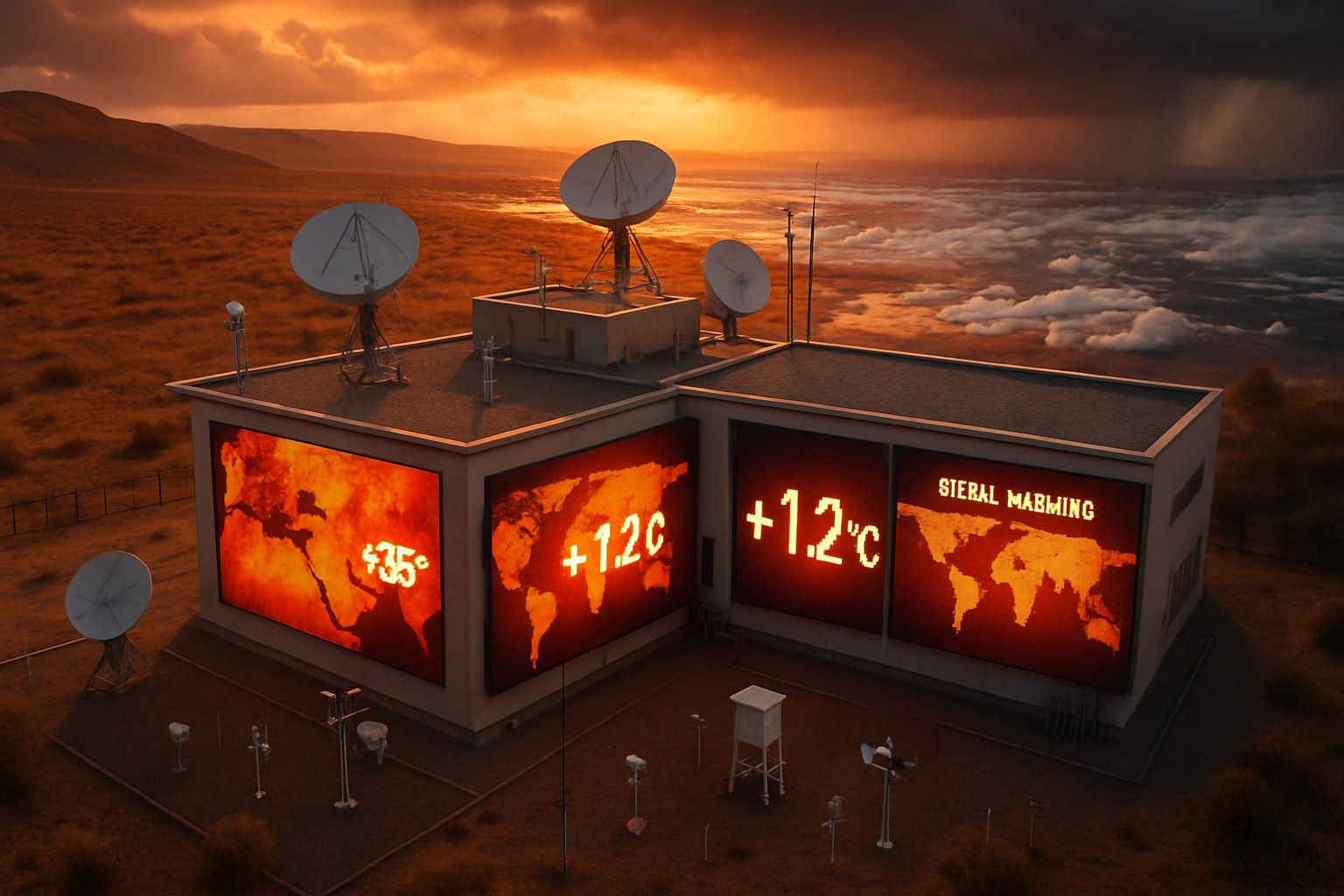
A landmark UN climate report has confirmed what scientists feared most: the past decade represents the hottest period in recorded human history, with global temperatures accelerating at rates that fundamentally challenge humanity's ability to adapt to our rapidly changing planet.
The World Meteorological Organization (WMO) released comprehensive findings showing the eleven warmest years on record occurred between 2015-2025, with 2025 ranking as the second or third hottest year at 1.43°C above the 1850-1900 baseline. January 2026 alone marked the hottest month ever recorded, extending an unprecedented streak of 22 consecutive months exceeding the critical 1.5°C threshold above pre-industrial levels.
Unprecedented Global Temperature Acceleration
The WMO's groundbreaking research reveals Earth has been warming at 0.35°C per decade since 2015 – a staggering 75% acceleration from the previous 1970-2015 average of 0.2°C per decade. This dramatic increase demonstrates that human-induced climate change has completely overridden natural climate variability, including La Niña cooling cycles that historically moderated global temperatures.
"Every key climate indicator is flashing red," declared UN Secretary-General António Guterres during the report's release, emphasizing this represents a "state of emergency" for the planet. The sustained warming has fundamentally altered atmospheric systems beyond natural recovery mechanisms, creating what scientists term a "climate volatility paradox" where global heat records coincide with devastating regional extremes.
Energy Imbalance Traps Earth in Heat Prison
For the first time, the WMO measured Earth's energy imbalance – the dangerous accumulation of heat as greenhouse gases reduce the planet's ability to release energy to space. This unprecedented finding reveals that Earth is effectively trapped in a heat prison that will persist for thousands of years even if emissions stopped immediately.
The implications are staggering. CO2 concentrations have reached their highest levels in over 2 million years according to Swedish research, while Antarctic ice loss equivalent to the area of Vienna occurs annually. The research shows 12,820 square kilometers of total ice retreat since 1996, contributing to accelerating sea-level rise that threatens coastal communities worldwide.
Marine Ecosystems in Collapse
Ocean warming has triggered catastrophic marine ecosystem decline, with research documenting a 7.2% fish population decrease for every 0.1°C of ocean warming per decade. Analysis of 33,990 fish populations across the Mediterranean, North Atlantic, and Northeast Pacific from 1993-2021 reveals a devastating 20% annual biomass reduction across entire ocean basins.
This marine crisis directly threatens global food security, as billions of people depend on marine protein sources. The warming seabed is driving unprecedented marine life reduction that affects entire food chains, agricultural systems, and tourism industries across multiple continents.
"The marine ecosystem collapse we're witnessing represents one of the most severe threats to global food security in human history. Every fraction of a degree matters."
— Dr. Sarah Martinez, Marine Climate Researcher
Emergency Response Systems Overwhelmed
The report highlights a critical breakdown in global emergency response capabilities. Traditional mutual aid systems designed for sequential regional disasters are failing as multiple continents face simultaneous climate emergencies. The EU Civil Protection mechanism has been repeatedly activated, with €246 million in Sweden-Denmark assistance representing the largest coordinated European climate response on record – yet still inadequate for the scale of simultaneous challenges.
Emergency services globally report operating at or beyond capacity limits, while transportation networks, power grids, and communication systems designed for historical climate patterns repeatedly fail under extreme conditions exceeding operational parameters. Recovery timelines have shifted from weeks to months or years, fundamentally changing disaster response planning.
Economic Cascade Effects Mounting
The climate crisis has triggered cascading economic effects across all sectors. Agricultural losses from extreme weather destroying crops and disrupting supply chains during critical growing seasons now reach billions annually. Tourism industries face extended cancellations and infrastructure damage during peak revenue periods, while families lose generational homes and businesses face extinction threats.
Infrastructure designed for historical climate conditions repeatedly fails as systems encounter unprecedented weather patterns. The concept of "building back better" with climate-resilient infrastructure has evolved from an optional enhancement to an essential survival strategy for communities worldwide.
Climate Tipping Points Approached
Scientists warn that current conditions preview what will become routine in the 2030s without immediate transformative climate action. Research indicates dangerous climate tipping points are increasingly probable – once triggered, stopping warming becomes exponentially more difficult.
The WMO projects a 50-60% probability of El Niño development during July-September 2026, which could drive temperatures into unprecedented territory by combining baseline warming with natural cycle amplification. This potential development occurring during an already record warming streak could push global climate systems past critical thresholds.
Technology and Traditional Knowledge Integration
Despite overwhelming challenges, the report identifies successful adaptation strategies that combine cutting-edge technology with traditional ecological knowledge. Estonia has achieved 88% renewable electricity and operates continental Europe's largest battery storage system capable of powering 90,000 households. However, supply chain vulnerabilities persist with China controlling 60-90% of critical materials for renewable infrastructure.
Effective climate responses require sophisticated synthesis of advanced monitoring systems, satellite tracking, environmental DNA sampling, and AI-powered analysis enhanced by generations of traditional environmental stewardship practices. This integration represents a fundamental evolution in environmental protection strategies.
International Cooperation at Breaking Point
The simultaneity of climate disasters is testing international cooperation mechanisms developed for assisting isolated emergencies. Traditional frameworks where stable regions assist others break down when multiple continents face simultaneous disasters requiring unprecedented cooperation and coordination.
Success depends on coordinated policy frameworks, shared monitoring systems, collaborative enforcement, and innovative financing recognizing ecosystem services as essential for economic stability and human prosperity. The diversity of regional approaches provides resilience against single-solution dependencies while offering multiple adaptation pathways for complex, interconnected challenges.
Critical Action Window Closing
March 2026 represents a critical juncture in global environmental protection – the choice between reactive crisis management and proactive ecosystem service management may determine whether conservation efforts can keep pace with accelerating environmental change during this decisive climate action decade.
The environmental action window is rapidly narrowing as ecological systems approach critical thresholds that could trigger irreversible changes affecting global food security, climate stability, and human settlements. Tools, knowledge, and cooperation frameworks exist for comprehensive protection, but success requires unprecedented speed and coordination through sustained international cooperation.
"We have the tools and knowledge for effective climate action, but we must organize and implement solutions rapidly enough to maintain planetary habitability during Earth's most environmentally challenging period in recorded history."
— UN Secretary-General António Guterres
Path Forward Requires Transformation
The report emphasizes that current conditions represent a watershed moment requiring fundamental societal response and reconsideration for a permanent climate volatility era. Additional weather systems developing across the Atlantic and Pacific have authorities on high alert globally, with crisis persistence potentially establishing a "new normal" of extreme weather frequency and intensity that permanently challenges traditional frameworks.
The convergence of extreme weather events, infrastructure vulnerabilities, and emergency response limitations underscores the urgent need for coordinated international action. Choices made in the coming months will be decisive for global climate resilience strategies affecting generations to come.
As the climate crisis accelerates beyond all predictions, the question is no longer whether transformative action is needed, but whether humanity can organize and implement solutions rapidly enough to maintain planetary habitability during Earth's most environmentally challenging period in recorded history.