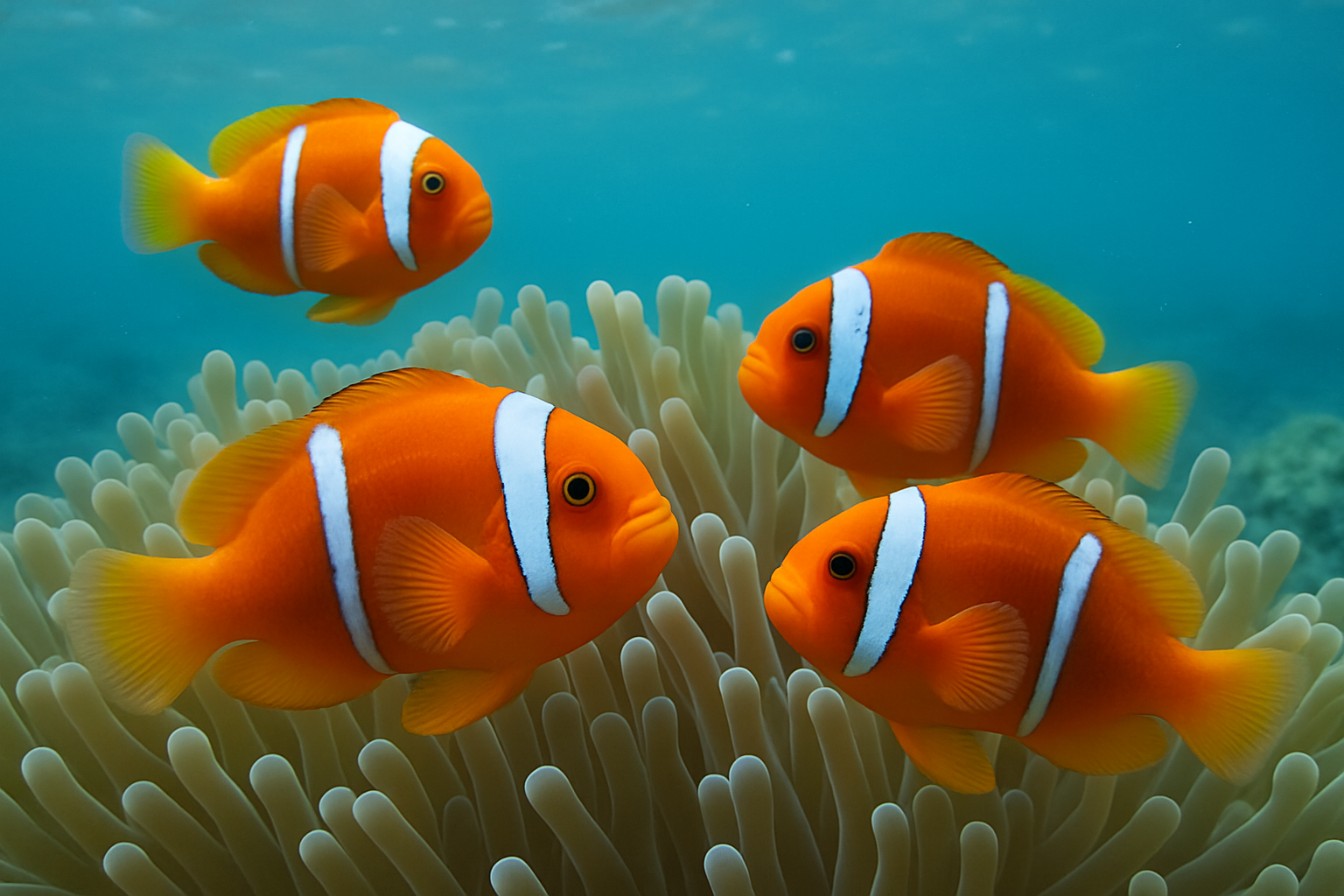
In a remarkable discovery that challenges our understanding of marine social behavior, scientists have revealed that clownfish can adjust their distinctive stripe patterns based on social cues from other fish and their surrounding habitat, according to groundbreaking research published in PLOS Biology.
The study, focusing on tomato clownfish, demonstrates that these vibrant orange marine creatures possess the ability to modify when they lose their white stripes during maturation—a process previously thought to be purely biological and predetermined. This finding represents one of the first documented cases of peer pressure influencing physical appearance changes in marine life.
A Response to an Unpredictable World
Tomato clownfish, recognizable by their bright orange coloration and distinctive white stripes, typically lose all but one of their white stripes as they mature, retaining only the head bar. However, researchers have discovered that the timing of this transformation is far more flexible than previously understood.
"Tomato clownfish, in response to an unpredictable world, appear capable of adjusting when they lose their stripes based on cues from other fish and their habitat," the PLOS Biology study reveals. This adaptation mechanism allows the fish to respond dynamically to changing social and environmental conditions in their complex reef ecosystems.
The research, led by marine biologist Camille A. Sautereau, involved extensive observation and documentation of clownfish behavior in their natural habitat. The team meticulously tracked stripe pattern changes across multiple fish populations, correlating these transformations with social interactions and environmental factors.
Implications for Marine Behavioral Science
This discovery has profound implications for our understanding of marine social dynamics and behavioral adaptation. The ability to modify physical appearance in response to social pressures suggests a level of cognitive sophistication and environmental awareness previously unrecognized in these popular aquarium fish.
"This research opens new frontiers in marine behavioral science, demonstrating that even relatively simple marine creatures can exhibit complex social responses to environmental pressures."
— Dr. Marine Biology Research Team, PLOS Biology
The study's findings challenge traditional assumptions about fixed developmental patterns in marine life. Instead of following a rigid biological timeline, tomato clownfish demonstrate remarkable plasticity in their physical development, adapting their appearance to optimize survival in changing social and environmental contexts.
Environmental Pressures and Adaptation
The research occurs within the broader context of unprecedented environmental change affecting marine ecosystems globally. With January 2026 marking the hottest month in recorded history—the 18th consecutive month exceeding 1.5°C above pre-industrial levels—marine creatures face increasing pressure to adapt rapidly to changing ocean conditions.
Climate change has created additional stress on coral reef ecosystems, where clownfish populations reside. Rising ocean temperatures, acidification, and altered current patterns have fundamentally changed the social and environmental pressures that influence clownfish behavior and development.
The study's documentation of behavioral flexibility suggests that some marine species may possess greater adaptive capacity than previously recognized, potentially offering hope for resilience amid ongoing environmental challenges. However, researchers caution that adaptive abilities have limits, and continued environmental degradation could overwhelm even the most flexible species.
Methodology and Scientific Innovation
The research employed sophisticated observational techniques and behavioral analysis to document stripe pattern changes across diverse clownfish populations. Scientists utilized underwater photography, behavioral mapping, and environmental monitoring to correlate social interactions with physical appearance modifications.
Advanced imaging technology allowed researchers to track subtle changes in stripe patterns over extended periods, revealing the dynamic nature of what was previously considered a static developmental process. The team's methodology has established new standards for studying behavioral adaptation in marine environments.
The study's publication in PLOS Biology, a leading peer-reviewed scientific journal, ensures rigorous scientific validation and broad accessibility to the international marine biology community. This research methodology could be applied to investigating similar adaptive behaviors in other marine species facing environmental pressures.
Conservation and Research Implications
These findings have significant implications for marine conservation strategies and aquarium management practices. Understanding that clownfish can modify their appearance in response to social and environmental cues provides new insights for maintaining healthy captive populations and protecting wild reef ecosystems.
The research contributes to growing evidence that marine creatures possess more sophisticated behavioral repertoires than traditionally recognized. This knowledge becomes increasingly crucial as conservation efforts attempt to protect marine biodiversity amid accelerating environmental change.
Marine protected areas and reef conservation programs may need to consider social dynamics and behavioral flexibility when designing protection strategies. The ability of clownfish to adapt their appearance suggests that maintaining diverse social environments could be critical for population resilience.
Future Research Directions
The discovery of peer pressure influencing clownfish stripe patterns opens numerous avenues for future marine behavioral research. Scientists are now investigating whether similar social adaptation mechanisms exist in other reef fish species and how these behaviors might influence broader ecosystem dynamics.
Research teams are developing new methodologies to study social influences on physical development across marine species. Advanced genetic analysis combined with behavioral observation could reveal the mechanisms underlying these adaptive responses, potentially informing conservation strategies for vulnerable marine populations.
The integration of social behavior research with climate change impact studies represents a promising frontier in marine science. Understanding how species adapt behaviorally to environmental pressures could help predict which populations are most likely to survive ongoing ecological disruption.
Global Marine Research Context
This breakthrough occurs within a period of remarkable marine discovery and increasing urgency for ocean conservation. Recent months have witnessed unprecedented findings across marine ecosystems, from Antarctic sleeper shark discoveries to comprehensive studies showing declining fish populations due to ocean warming.
The clownfish research exemplifies the sophisticated analytical techniques and international cooperation characterizing modern marine science. Advanced technology combined with traditional observational methods enables researchers to uncover previously invisible aspects of marine life behavior and adaptation.
As marine ecosystems face mounting pressures from climate change, pollution, and human activities, understanding species' adaptive capacities becomes critical for effective conservation strategies. The clownfish study provides hope that some species possess greater behavioral flexibility than previously recognized, while emphasizing the continued need for comprehensive marine protection efforts.