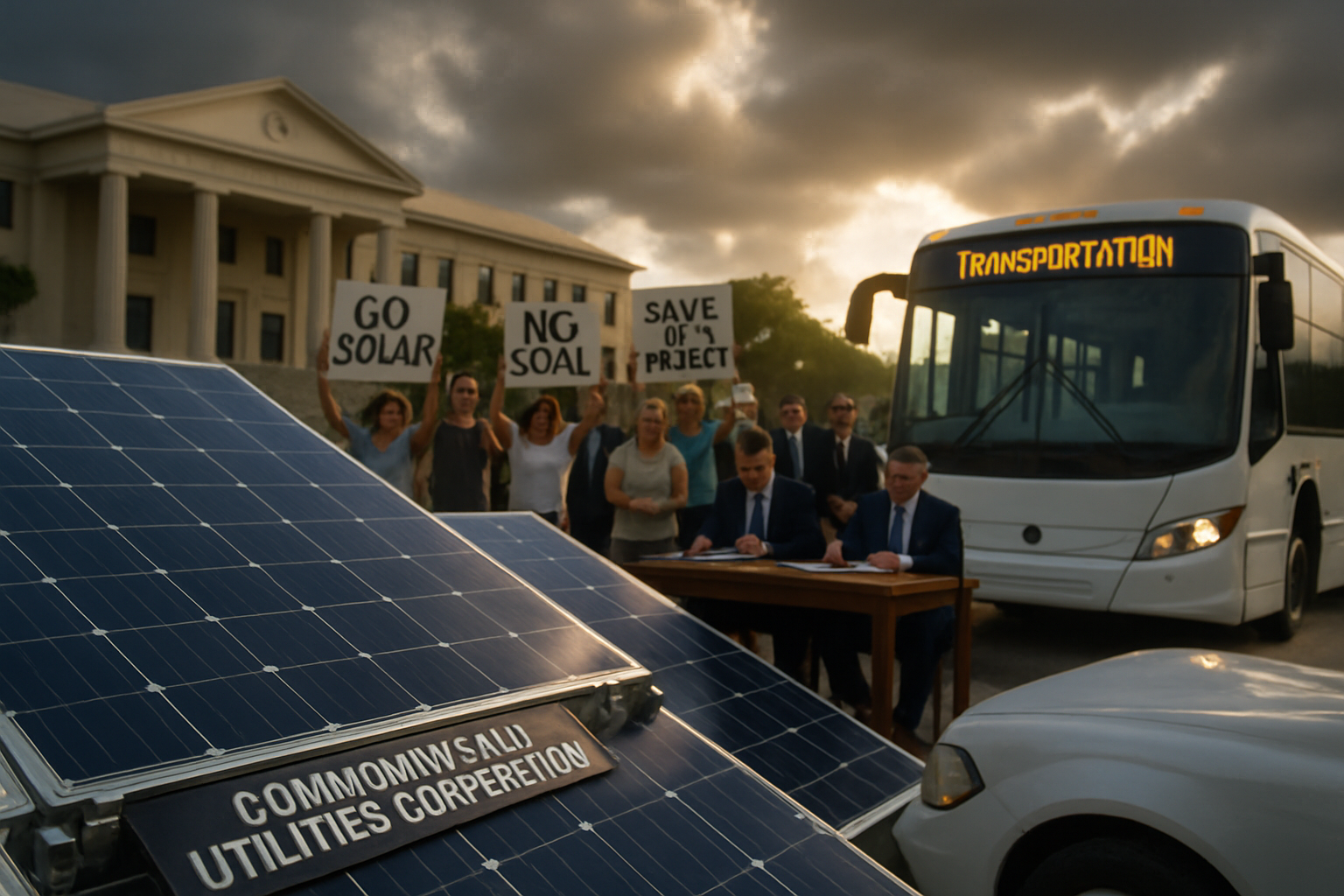
The Commonwealth of the Northern Mariana Islands faces a convergence of energy challenges and legal developments as protests threaten to disrupt Commonwealth Utilities Corporation's long-awaited solar power project, while Governor David M. Apatang signs crucial legislation to protect overdose responders and improve public transportation safety.
Solar Procurement Controversy Intensifies
Commonwealth Utilities Corporation (CUC) could face significant protests once the agency issues a notice of intent to award for its long-delayed solar power project, according to legal counsel who briefed regulators last week. The warning comes as the territory grapples with ongoing energy infrastructure challenges that have plagued the region for years.
The potential for civil unrest over energy procurement reflects deeper frustrations within the Pacific territory about transparency and efficiency in utility operations. CUC's solar initiative has faced multiple delays, creating uncertainty among residents who have endured unreliable power services and rising energy costs.
"Future protests over the Commonwealth Utilities Corp.'s long-delayed solar power project could arise once CUC issues a notice of intent to award," CUC's legal counsel informed regulators during recent proceedings. The warning suggests that stakeholders remain deeply divided over the procurement process and contractor selection.
Governor Signs Overdose Response Protection Act
In a significant legislative achievement, Governor Apatang signed House Bill 24-35 into law, establishing Public Law 24-25, which provides limited immunity from civil liability for individuals who administer reversal medication to opioid overdose victims. The legislation, authored by Representative Malcolm J. Omar, represents a critical expansion of the CNMI Good Samaritan Act.
"Every life saved through naloxone administration represents hope for families and communities across the Northern Mariana Islands."
— Representative Malcolm J. Omar, Author of H.B. 24-35
The new law encourages family members, friends, bystanders, and first responders—including emergency service employees, firefighters, police officers, emergency medical technicians, and paramedics—to administer opioid overdose reversal medication such as naloxone without fear of legal repercussions.
According to Representative Omar, the legislation expands access to naloxone by allowing it to be prescribed to people other than the person at risk of overdose, while removing requirements for individuals to see a prescriber before obtaining the life-saving medication. This approach recognizes the critical time-sensitive nature of overdose emergencies.
Transportation Safety Measures Enhanced
Governor Apatang also approved House Bill 24-11, strengthening the Commonwealth Transit Authority (COTA) to implement comprehensive safety measures on transit buses across the territory. The legislation addresses growing concerns about public transportation safety and operational standards.
The enhanced safety framework comes at a crucial time as the CNMI continues developing its transportation infrastructure. Recent developments include Philippine Airlines' resumption of direct Manila-Saipan service scheduled for March 29, 2026, which will restore vital connectivity for families, workers, and tourists in the Commonwealth Northern Mariana Islands.
Energy Infrastructure Challenges Persist
The solar procurement controversy occurs within a broader context of Pacific island energy challenges. Small island developing states across the region have implemented innovative renewable energy solutions, including distributed solar panels and battery storage systems that provide backup power during extreme weather events while reducing fossil fuel dependence.
The CNMI's energy situation reflects patterns seen throughout the Pacific, where aging infrastructure, supply chain vulnerabilities, and the need for climate-resilient systems create complex procurement and implementation challenges. The potential for protests suggests that community engagement and transparency remain critical factors in successful energy transition projects.
Legislative Progress Amid Regional Context
The territory's legislative achievements occur during a period of significant legal and policy developments across the Pacific region. The CNMI's approach to overdose response legislation aligns with broader public health initiatives while addressing the specific needs of island communities where medical evacuation options may be limited.
The legislation's focus on expanding naloxone access without complex procedural requirements reflects practical approaches suited to remote island territories where immediate medical intervention can mean the difference between life and death. The law represents a proactive approach to addressing opioid-related emergencies in communities where traditional medical infrastructure may be constrained.
Transportation and Energy Intersection
The simultaneous focus on energy infrastructure and transportation safety reflects the interconnected nature of critical services in island territories. Reliable energy systems support transportation networks, while efficient public transit reduces energy consumption and supports community resilience.
COTA's enhanced safety authority comes as the territory continues working to improve transportation connectivity, including airport infrastructure improvements and inter-island transportation services. The legislation provides the agency with tools to implement modern safety standards that meet contemporary requirements for public transportation operations.
Public Health and Safety Priorities
The overdose response legislation demonstrates the territory's commitment to evidence-based public health policy. The expansion of Good Samaritan protections recognizes that overdose emergencies require immediate intervention, often by non-medical personnel who happen to be present when crisis occurs.
By removing legal barriers to naloxone administration, the law acknowledges that overdose response is fundamentally a community issue requiring broad participation rather than relying exclusively on professional medical responders. This approach has proven effective in other jurisdictions facing similar public health challenges.
Looking Forward: Implementation Challenges
The success of these legislative initiatives will depend on effective implementation and community engagement. The solar procurement process will require careful navigation of stakeholder concerns to avoid protests that could further delay critical energy infrastructure improvements.
Similarly, the overdose response and transportation safety measures will need appropriate funding, training, and community education to achieve their intended public safety objectives. The legislation provides the framework, but successful outcomes require sustained commitment from government agencies, community organizations, and residents.
As the Northern Mariana Islands continues addressing energy, transportation, and public health challenges, these legislative developments represent important steps toward building more resilient and responsive public services. The territory's experience may provide valuable lessons for other Pacific island jurisdictions facing similar infrastructure and public safety priorities.
The convergence of energy controversy and legislative progress illustrates the complex policy environment facing Pacific territories as they work to balance community needs, regulatory requirements, and practical implementation challenges in serving island populations with unique geographic and economic constraints.