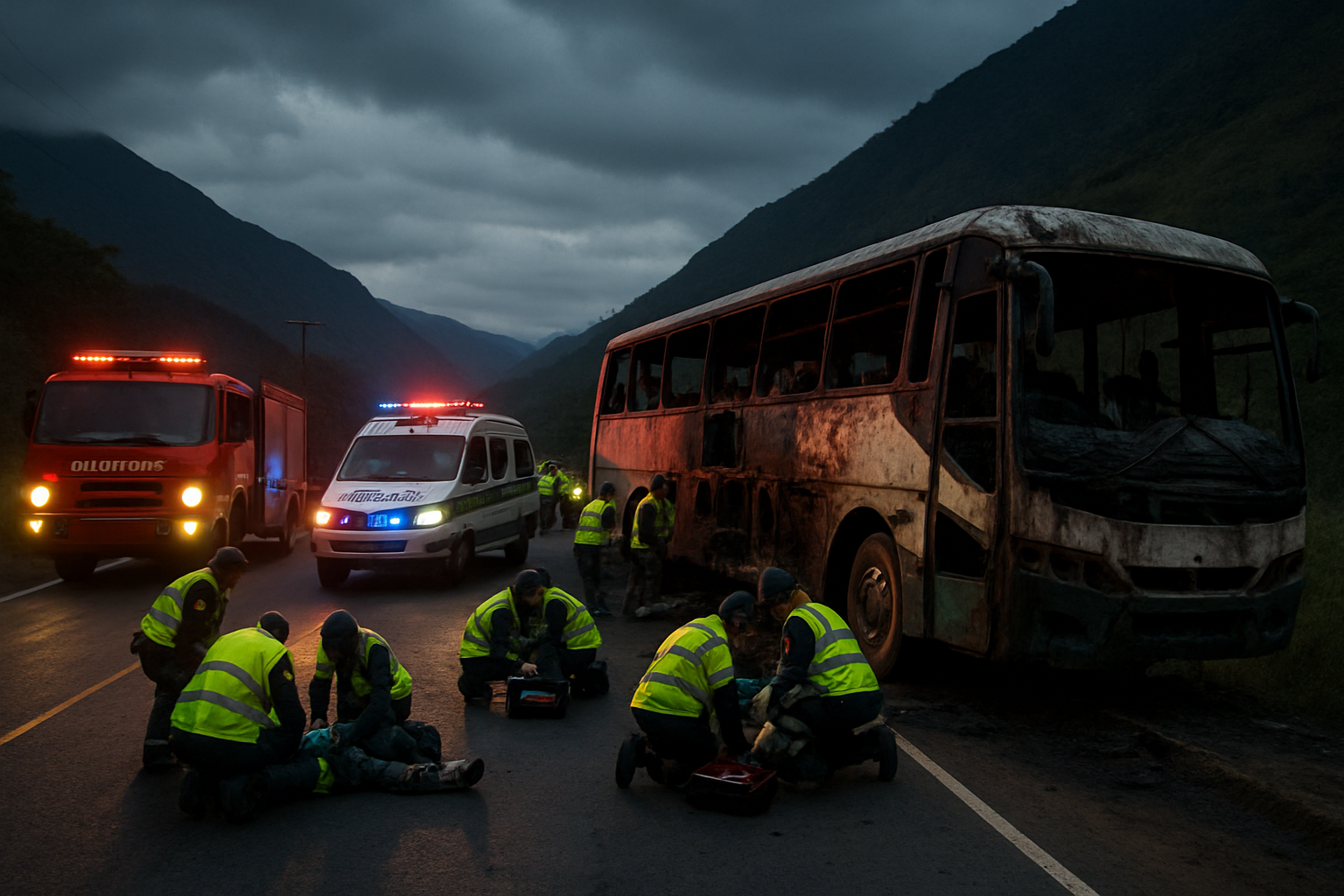
A deadly bombing attack in southwestern Colombia's Cauca province has killed at least 14 people, marking a dangerous escalation in terrorist violence just weeks before the country's crucial May 2026 presidential elections. The attack occurred when FARC dissidents detonated an explosive cylinder targeting a passenger bus in the municipality of Cajibío.
The bombing, which took place on the strategically important Pan-American Highway corridor, represents the latest in a series of coordinated attacks by illegal armed groups that have intensified as Colombia prepares for its democratic transition. Among the victims was Patricia Mosquera, a prominent community leader from El Patía who served on the Community Council of El Puro, highlighting the systematic targeting of social leaders by criminal organizations.
Unprecedented Terror Campaign Unfolds
According to Colombian authorities, the explosive device fell directly onto the bus traveling the critical Cali-Popayán transportation route, causing massive damage to the vehicle and injuring at least 24 additional passengers who have been transported to medical centers across Cauca province. The attack was part of what regional governors are calling an "unprecedented terrorist escalation" involving 11 coordinated attacks within a 24-hour period across the Cauca and Valle del Cauca departments.
The violence has overwhelmed regional hospital networks, with medical facilities operating at capacity limits as they struggle to treat the wounded. The systematic nature of the attacks demonstrates what security experts describe as "state-like capabilities" by criminal organizations that have evolved far beyond traditional drug trafficking operations.
"This represents a grave threat against life and tranquility of our communities"
— Governor of Cauca, condemning the attacks
Electoral Context Raises Democratic Concerns
The timing of these attacks has raised serious concerns among international observers about the potential for electoral violence as Colombia approaches its May 2026 presidential elections. The coordinated assault on civilian infrastructure during the pre-election period represents a direct challenge to democratic institutions and the peaceful transfer of power.
The attacks follow a troubling pattern of violence that has characterized 2026, including the February assassination attempt on President Gustavo Petro, where his helicopter was forced to remain airborne for four hours over the Caribbean Sea due to surface-to-air threats. The systematic targeting of democratic institutions, transportation infrastructure, and community leaders suggests a strategic campaign by illegal armed groups to create governance vacuums and undermine state authority.
Criminal Organizations Show Advanced Capabilities
The sophisticated coordination of these attacks demonstrates how criminal organizations in Colombia have evolved to possess what intelligence analysts describe as "state-like capabilities." These groups now demonstrate advanced surveillance networks capable of tracking government movements, encrypted communications systems that exceed law enforcement monitoring capabilities, and military-grade technology including drone warfare capabilities.
The use of explosive cylinders and coordinated timing across multiple departments shows a level of operational sophistication that challenges traditional law enforcement responses. Over 100 municipal ombudsmen have been declared targets by armed groups according to the Public Ministry in Cali, representing a systematic assault on democratic oversight and governance structures.
Regional Security Implications
The Pan-American Highway bombing has significant implications beyond the immediate casualties. This critical transportation corridor serves as a vital link for legitimate commerce while also being exploited by criminal networks for drug trafficking routes. The attack disrupts not only transportation but also the economic activities that depend on secure passage along this strategic route.
The violence affects thousands of citizens who have altered their travel patterns to avoid the Pan-American Highway during peak hours, creating economic ripple effects throughout the region. Educational and healthcare facilities continue to be systematically targeted, undermining basic services and creating psychological trauma that extends far beyond the direct victims to affect entire communities.
Government Response and International Cooperation
In response to the escalating violence, authorities have increased the reward for alias "Marlon," identified as one of the masterminds behind recent attacks in Cauca, from an undisclosed amount to 5 billion pesos (approximately $1.2 million USD). This unprecedented bounty reflects the government's recognition of the serious threat posed by these criminal leaders.
The Colombian government continues to work with international partners through the Shield of the Americas coalition, a 17-nation initiative that enables intelligence sharing and coordinated operations with Spanish police, Interpol, and regional security forces. Despite these enhanced cooperation efforts, the criminal networks have demonstrated remarkable adaptability and operational security that allows them to continue sophisticated operations.
Challenge to Total Peace Strategy
These attacks represent a fundamental challenge to President Petro's "Total Peace" strategy, which seeks to negotiate comprehensive agreements with illegal armed groups. The escalating violence suggests that certain FARC dissident factions have rejected dialogue in favor of territorial expansion and increased violence against state institutions.
The dual approach of maintaining peace negotiations while enhancing security measures faces mounting difficulties as criminal organizations demonstrate their willingness to target civilian infrastructure and democratic processes. The government's response effectiveness will be crucial in determining whether democratic institutions can maintain public safety while preserving the constitutional protections essential to democratic governance.
Community Impact and Resilience
The bombing has had devastating effects on local communities that depend on secure transportation for access to essential services, education, and healthcare. The death of community leader Patricia Mosquera represents not only a personal tragedy but also an attack on the social fabric that holds communities together during times of conflict.
Despite the violence, communities across the affected regions continue to demonstrate remarkable resilience, adapting their daily routines while maintaining their commitment to democratic participation. Local organizations have mobilized to provide psychological support and practical assistance to victims and their families, showing the strength of civil society even under extreme pressure.
Looking Ahead to Elections
As Colombia approaches its May 2026 presidential elections, the security situation remains a critical concern for electoral authorities and international observers. The systematic targeting of democratic institutions, combined with the technological sophistication of criminal organizations, creates unprecedented challenges for ensuring free and fair elections.
The successful conduct of elections under these circumstances will serve as a crucial test of Colombia's democratic resilience and institutional capacity. The international community continues to monitor developments closely, recognizing that Colombia's democratic consolidation has implications far beyond its borders for regional stability and the global fight against transnational organized crime.
The tragic loss of life in Cajibío serves as a stark reminder of the human cost of this conflict and the urgent need for comprehensive solutions that address both immediate security threats and the underlying conditions that enable criminal organizations to challenge democratic governance. The coming weeks will be critical in determining whether Colombia can successfully navigate this security crisis while maintaining its democratic trajectory.