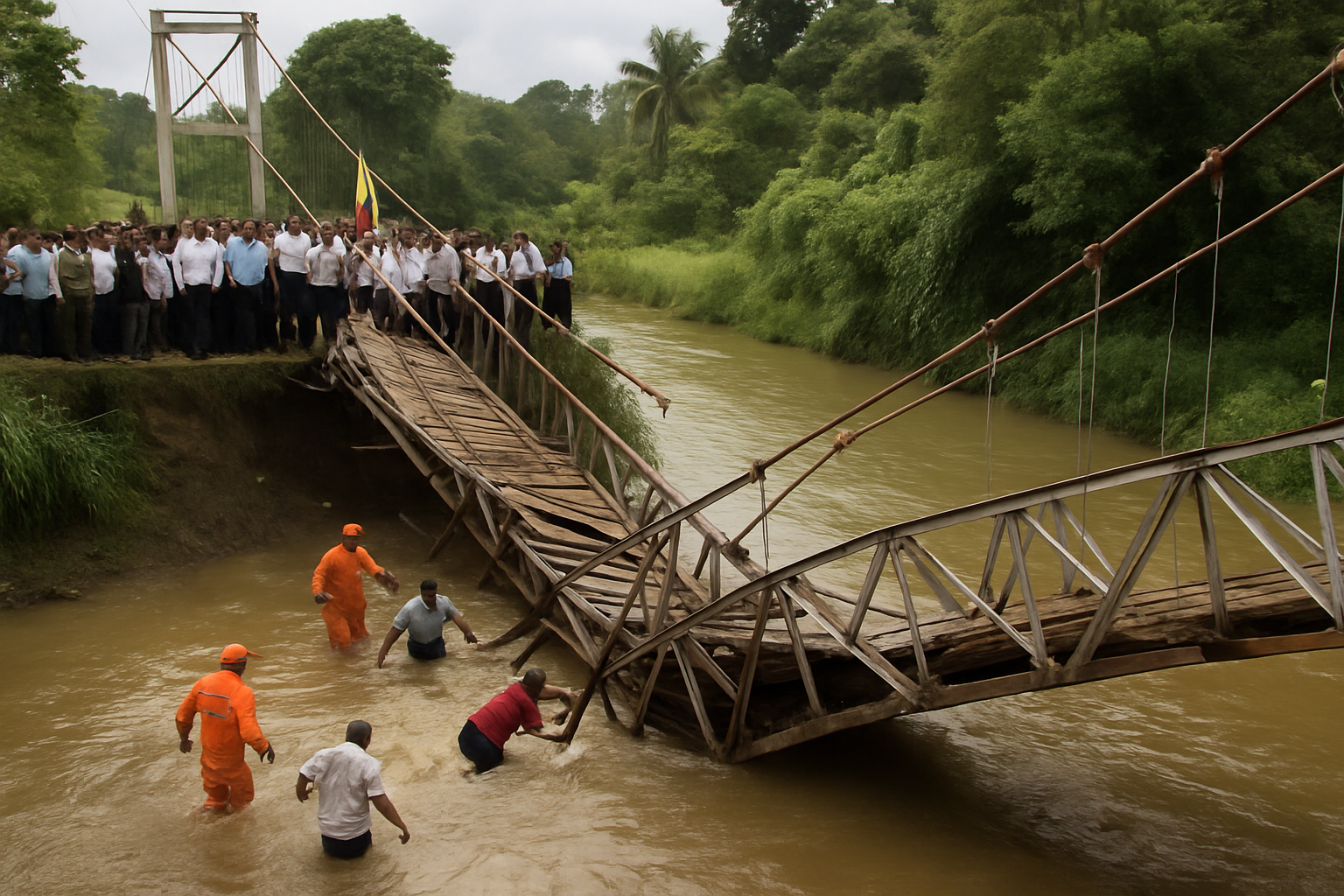
A newly constructed bridge in Bagadó, Chocó Province collapsed dramatically seconds after its official inauguration ceremony, plunging officials and citizens into the river below in a shocking failure that has raised urgent questions about Colombia's infrastructure oversight and construction standards.
The bridge structure failed to support the weight of attendees during the ceremonial event, according to reports from El Tiempo. Video footage captured the terrifying moment when the bridge gave way, leaving several people submerged in the river including local officials who had gathered to celebrate the infrastructure project.
Mayor present during the ceremony was among those who fell into the water when the structure collapsed. Witnesses described scenes of panic as attendees scrambled for safety while emergency responders rushed to assist those who had fallen into the water below.
Construction Irregularities Under Investigation
The Bagadó municipal government has pointed to suspected cable manipulation as a potential cause of the catastrophic failure, according to local authorities. The municipality has activated insurance policies against the contractor responsible for the project, signaling potential legal action following the dangerous incident.
This collapse comes amid mounting concerns about Colombia's infrastructure integrity, following a pattern of construction failures that have highlighted serious regulatory oversight gaps. The incident bears troubling similarities to previous bridge collapses in Colombia, including the documented February 2026 case in Boyacá's Moniquirá where official suspension orders were signed just one day before a catastrophic bridge failure.
"The structure simply couldn't support the weight during the event, causing several people to fall into the river."
— Local witness, according to El Tiempo
Part of Broader Infrastructure Crisis
The Chocó bridge collapse occurs within the context of Colombia's broader infrastructure challenges, which have been exacerbated by extreme weather events linked to climate change. Recent incidents include the dramatic February 2026 landslide that blocked the critical Medellín-Bogotá highway, requiring the removal of 60,000+ cubic meters of debris through 4,200+ truck trips.
Colombia's infrastructure faces mounting pressures from increasingly severe weather patterns, with January 2026 marking the 19th consecutive month of global temperatures exceeding 1.5°C above pre-industrial levels. These conditions create operational environments that existing infrastructure was never designed to handle.
The Chocó region, in particular, faces unique challenges due to its geographic isolation and limited transportation networks. The collapse of this newly constructed bridge represents not just a construction failure but a significant setback for connectivity in one of Colombia's most underserved regions.
Regulatory Response and Accountability
The incident has prompted immediate action from local authorities, with the municipal government activating insurance policies and launching investigations into potential contractor negligence. The suspected cable manipulation suggests possible construction shortcuts or materials fraud that compromised the bridge's structural integrity.
This case highlights broader issues with construction oversight in Colombia, where rapid infrastructure development has sometimes come at the expense of proper safety protocols. The February 2026 Boyacá bridge incident, where official suspension orders were issued one day before collapse, demonstrated similar failures in the regulatory oversight system.
Emergency services responded quickly to assist those who fell into the water, though the full extent of injuries remains unclear. The incident serves as a stark reminder of the human cost when infrastructure projects fail to meet basic safety standards.
Infrastructure Investment Challenges
Colombia's infrastructure challenges occur despite significant investment in connectivity projects nationwide. The country has been part of the unprecedented $570+ billion global infrastructure surge, with projects ranging from stadium modernizations in Barranquilla to major transportation improvements in Cali and Medellín.
However, the quality control and oversight mechanisms for these investments have proven inadequate in several high-profile cases. The integration of sophisticated technology in modern infrastructure projects - including real-time monitoring, predictive maintenance, and climate-resilient design - appears to have been insufficient in preventing this collapse.
The economic impact extends beyond the immediate construction costs, affecting regional connectivity, business operations, and public confidence in infrastructure projects. Each infrastructure failure creates ripple effects throughout the supply chain and regional economy, particularly in remote areas like Chocó where alternative routes may be limited.
Path Forward
The Bagadó bridge collapse represents a critical moment for Colombia's infrastructure development strategy. The incident demands comprehensive review of construction protocols, contractor accountability mechanisms, and regulatory oversight procedures to prevent similar failures.
Success in addressing these challenges will require enhanced coordination between national and local authorities, improved contractor vetting processes, and implementation of robust quality control measures throughout the construction process. The activation of insurance policies against the contractor indicates a commitment to holding responsible parties accountable for substandard work.
As Colombia continues to invest in essential infrastructure to connect isolated regions like Chocó, the lessons learned from this collapse must inform future construction practices. The safety of citizens and officials depends on ensuring that infrastructure projects meet rigorous standards before being opened to public use.