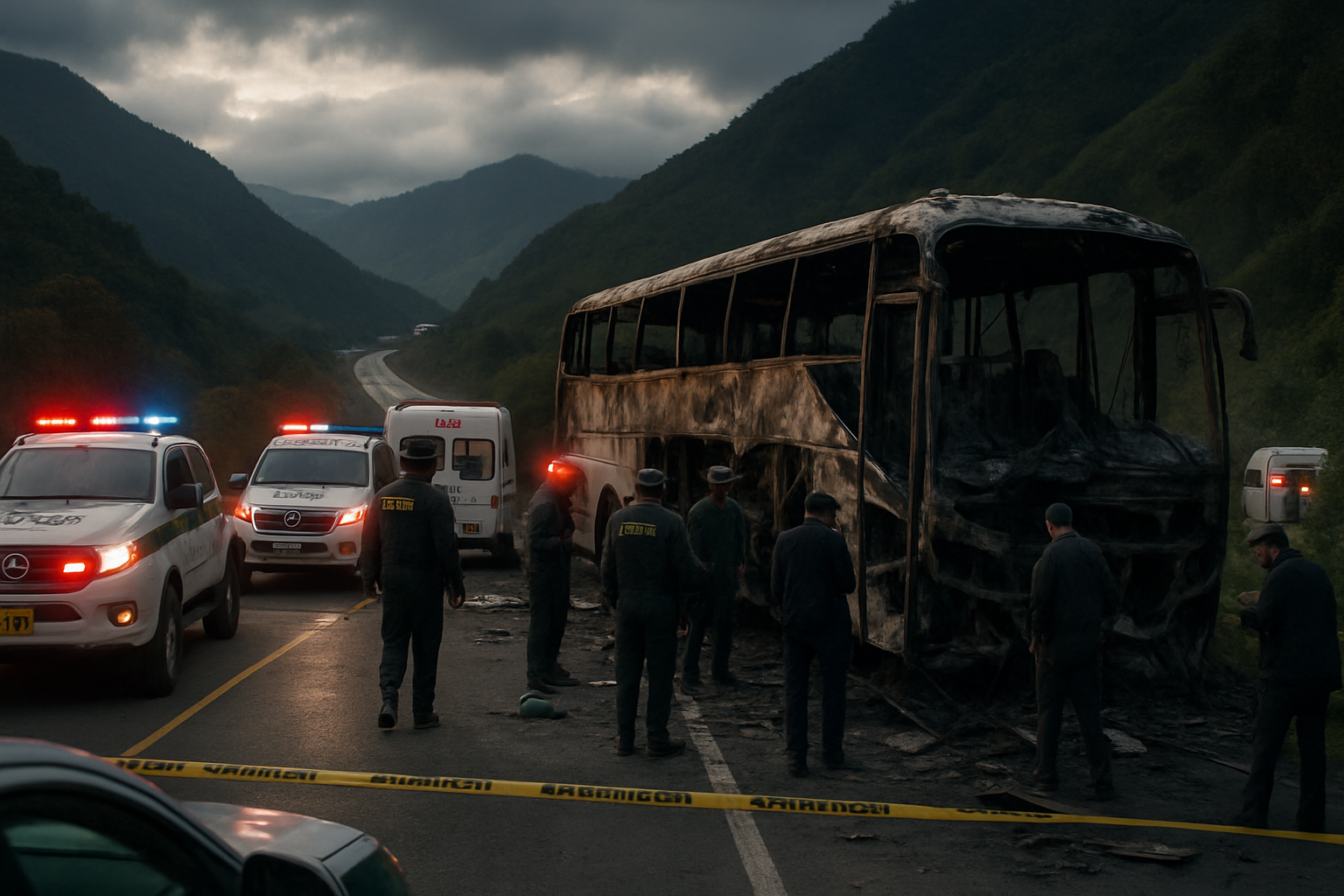
A devastating bomb attack on a passenger bus in southwestern Colombia killed 14 civilians and injured at least 38 others on Saturday, marking the deadliest incident in a coordinated terror campaign by FARC dissident forces targeting critical infrastructure ahead of the nation's upcoming elections.
The explosive device detonated on the Pan-American Highway in the El Túnel sector of Cajibío municipality, near Popayán in Cauca province, around 1:00 PM local time. The attack destroyed the passenger bus and severely damaged at least 15 other vehicles, creating a massive crater in Colombia's most vital transportation corridor.
Authorities immediately attributed the attack to the "Jaime Martínez" FARC dissident group, with the Colombian government increasing the bounty for the operation's alleged mastermind, known as alias "Marlon," to 5 billion pesos (approximately $1.2 million USD) – an unprecedented reward reflecting the severity of the threat.
Coordinated Terror Campaign Emerges
The bus bombing represents the most deadly incident in what Colombian officials describe as an unprecedented "terrorist escalation" by FARC dissidents, with authorities documenting 26 separate attacks within a 48-hour period across the departments of Cauca and Valle del Cauca.
The coordinated campaign included explosive drone attacks on military radar installations in Santana de Quebradasanta, armed assaults on police substations in Jamundí, and additional bus bombings along the critical Cali-Popayán transportation corridor. The sophistication and timing of these simultaneous operations demonstrate what security experts describe as "state-like capabilities" among criminal organizations.
"This represents the most serious assault on democratic institutions and civilian infrastructure we have witnessed in recent years," said Governor Dilian Francisca Toro of Valle del Cauca, who convened an emergency security council with Defense Minister Pedro Sánchez to coordinate the government's response.
Community Leader Among Victims
Among those killed in the bus bombing was Patricia Mosquera, a prominent community leader from El Patía and member of the Community Council of El Puro. Her death highlights the systematic targeting of social leaders by criminal organizations as part of their strategy to create governance vacuums and expand territorial control.
Medical facilities across Cauca province operated at capacity limits treating the wounded, with 24 people requiring immediate hospitalization. The attack's location on the Pan-American Highway, a crucial artery connecting Colombia's Pacific coast to the interior, has forced thousands to alter their travel patterns and disrupted legitimate commerce across the region.
Survivor accounts describe scenes of terror as the cylinder bomb struck the bus directly, with the explosion throwing victims "unos 20 metros" (approximately 20 meters) from the vehicle. The sophisticated nature of the explosive device and its precise targeting suggest extensive reconnaissance and planning by the perpetrators.
Electoral Context Amplifies Concerns
The timing of these attacks, occurring just weeks before Colombia's May 2026 presidential elections, has raised serious concerns among international observers about the systematic targeting of democratic processes. The violence represents a fundamental challenge to President Gustavo Petro's "Total Peace" strategy, which seeks to negotiate with armed groups rather than pursue purely military solutions.
The attacks follow a disturbing pattern of violence against Colombian institutions established throughout 2026, including the February assassination attempt against President Petro himself, when his helicopter was forced to remain airborne for four hours over the Caribbean Sea due to surface-to-air threats.
More than 100 municipal ombudsmen have been declared targets by armed groups according to the Public Ministry in Cali, representing a systematic assault on local governance and democratic oversight mechanisms.
Criminal Sophistication Challenges State Capacity
Security analysts note the unprecedented sophistication of the criminal organizations involved, which now possess advanced surveillance networks, encrypted communications systems, and military-grade drone technology that often exceeds law enforcement capabilities.
The coordinated nature of the recent attacks – spanning multiple departments and involving various types of explosive devices and delivery methods – suggests operational planning and intelligence-gathering capabilities traditionally associated with state actors rather than non-state criminal groups.
"These organizations have evolved far beyond traditional drug trafficking to become comprehensive criminal enterprises challenging state authority across multiple fronts," explained a senior Colombian security official who spoke on condition of anonymity due to the sensitivity of ongoing operations.
International Cooperation Intensifies
The escalating violence has prompted enhanced international cooperation through the Shield of the Americas coalition, a 17-nation initiative established in March 2026 to address transnational organized crime. The partnership enables real-time intelligence sharing with Spanish police, Interpol, and regional partners, though criminal adaptability continues to outpace law enforcement responses.
The attacks have also complicated Colombia's developing cooperation with the United States on counter-narcotics efforts, following the February meeting between Presidents Petro and Trump at the White House. The timing raises questions about potential retaliation for increased international cooperation against criminal networks.
Broader Impact on Colombian Society
Beyond the immediate human toll, the systematic targeting of transportation infrastructure affects Colombia's economic development and international reputation. The closure of tourism destinations like Tayrona National Park due to security threats demonstrates the criminal organizations' willingness to disrupt legitimate economic activities to maintain operational control.
Educational institutions and healthcare facilities have also become targets, undermining basic services essential for democratic governance and social development. The psychological trauma extends far beyond direct victims, affecting entire communities and forcing families to alter daily routines for safety.
The violence has created a complex challenge for the Colombian government, which must balance peace negotiations with criminal groups while protecting civilian populations and maintaining democratic institutions ahead of crucial elections.
Government Response and Security Measures
In response to the escalating attacks, the Colombian government has implemented enhanced security protocols for government officials and increased military presence in high-risk regions. However, the reactive nature of these measures highlights the ongoing challenge of preventing attacks by organizations with sophisticated intelligence capabilities.
The unprecedented bounty offered for alias "Marlon" reflects both the government's determination to capture those responsible and the serious threat posed by criminal leaders capable of coordinating complex operations across multiple departments.
Defense Minister Pedro Sánchez has emphasized the government's commitment to protecting civilian populations while maintaining the peace process, though the recent attacks represent a severe test of this dual approach.
Looking Ahead: Democratic Resilience Under Pressure
The bus bombing and coordinated terror campaign represent a critical juncture for Colombian democracy. The May 2026 elections will serve as a crucial test of the country's institutional resilience and ability to conduct democratic transitions under extreme security pressure.
Success in addressing these challenges requires not only enhanced security measures but also comprehensive approaches that address the underlying conditions enabling criminal recruitment: poverty, corruption, weak governance, and limited economic opportunities in peripheral regions.
As Colombia prepares for its democratic processes amid this violence, the international community watches closely, recognizing that the country's experience may provide crucial lessons for addressing 21st-century challenges to democratic governance posed by sophisticated transnational criminal organizations.
The stakes extend far beyond Colombia's borders, with the country's experience potentially serving as a template for how democratic institutions can maintain public safety and constitutional protections while adapting to unprecedented criminal sophistication in an interconnected but politically fragmented global environment.