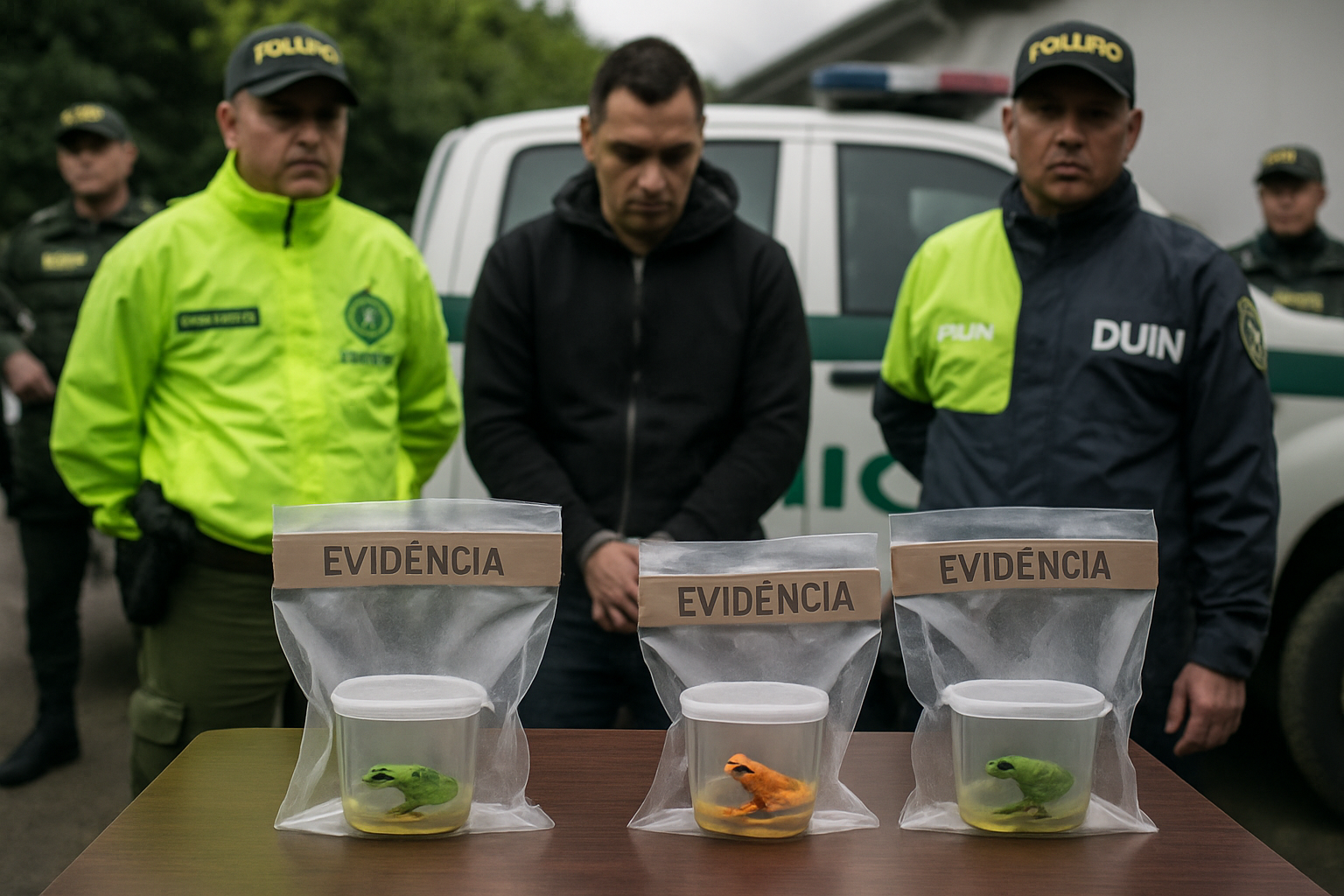
Colombian environmental authorities arrested a motorcyclist in the Valle del Cauca region carrying 17 specimens of one of the country's most critically endangered frog species, stored in separate jars under dangerously high temperatures during a routine inspection in Yumbo municipality.
The arrest represents the latest front in Colombia's intensifying battle against illegal wildlife trafficking, occurring as global conservation efforts face unprecedented challenges during the 22nd consecutive month of temperatures exceeding 1.5°C above pre-industrial levels—the longest sustained warming streak in recorded human history.
Critical Species Under Siege
The confiscated amphibians belong to one of Colombia's species at highest extinction risk, according to environmental protection agencies. Found stored in individual glass containers within a bag and subjected to extreme heat conditions, the frogs were discovered during a security checkpoint operation by Colombian authorities in Yumbo, a strategic transportation hub near Cali.
"The animals were found in jars separated and stored in a bag, under intense temperatures," confirmed environmental officials, highlighting the cruel conditions that often characterize illegal wildlife trafficking operations. Such extreme treatment significantly reduces survival rates and threatens the genetic viability of already vulnerable populations.
Colombia hosts extraordinary biodiversity, containing approximately 10% of global species despite covering less than 1% of Earth's surface. The nation's amphibians face particularly severe threats from habitat destruction, climate change, disease, and illegal collection for international trade markets.
Global Conservation Renaissance Under Pressure
The arrest occurs during what conservation scientists term a "global conservation renaissance"—an unprecedented surge of coordinated wildlife protection initiatives spanning multiple continents, yet operating under extreme environmental stress conditions.
"We are witnessing both the most sophisticated conservation technologies and community engagement in history, but also the most severe environmental pressures," noted Dr. Claudio Soto-Azat from Universidad Andrés Bello, whose team recently documented the first Darwin's frog sighting in over three decades.
— Dr. Claudio Soto-Azat, Universidad Andrés Bello
Recent conservation successes across Latin America include Ecuador's reintroduction of 158 Galápagos giant tortoises to Floreana Island and Zimbabwe's world-first DNA forensic prosecution of wildlife criminals. However, these victories occur against a backdrop of accelerating climate change and persistent trafficking networks.
Technology Meets Traditional Knowledge
Modern anti-trafficking efforts increasingly combine cutting-edge technology with traditional ecological knowledge. Colombian authorities now employ environmental DNA sampling, satellite monitoring, and AI-powered analysis alongside indigenous stewardship practices passed down through generations.
The integration represents a fundamental evolution in conservation methodology, moving beyond purely technological or traditional approaches toward comprehensive frameworks that respect cultural knowledge while leveraging global capabilities.
Advanced genetic screening programs can now track individual animals through national databases, enabling forensic prosecution similar to Zimbabwe's groundbreaking lion DNA case. Environmental DNA sampling allows scientists to monitor species presence without physical capture, while satellite systems track habitat changes in real-time.
Economic Drivers of Protection and Destruction
Wildlife trafficking generates estimated billions annually for criminal networks, making it one of the world's most profitable illegal trades alongside drugs and weapons. Rare amphibians command particularly high prices in international markets due to their unique biological properties and medical research applications.
However, environmental protection increasingly functions as an economic development strategy rather than merely regulatory burden. Colombia's biodiversity supports substantial eco-tourism revenue, research partnerships, and sustainable development initiatives worth hundreds of millions annually.
Countries implementing comprehensive wildlife protection consistently demonstrate greater economic resilience and attract sustainable investment across multiple sectors, from eco-tourism to environmental technology manufacturing.
International Cooperation Imperative
Wildlife trafficking networks operate across continental boundaries, exploiting jurisdictional limitations and weak enforcement mechanisms. Success requires unprecedented international cooperation as species migrations, ecosystem services, and criminal networks transcend political borders.
Colombia participates in regional initiatives including the Shield of the Americas coalition, enabling enhanced intelligence sharing and coordinated operations against transnational organized crime. The 17-nation framework launched in March 2026 represents evolution from reactive bilateral cooperation to proactive multilateral strategic planning.
Knowledge sharing between conservation programs creates global networks providing resilience against environmental challenges. Recent successes in pangolin rescue operations in Central Kalimantan and marine mammal protection in the Baltic Sea offer templates adaptable to Colombian conditions while respecting local cultural priorities.
Critical Action Window Narrowing
The arrest occurs during what environmental scientists describe as a critical juncture between reactive crisis management and proactive ecosystem service management. With ecological systems approaching potentially irreversible thresholds, the environmental action window narrows rapidly.
Climate change compounds traditional conservation threats through habitat alteration, disrupted food patterns, and increased human-wildlife conflict. The sustained warming streak creates additional ecosystem stress, forcing wildlife into closer human contact and creating new opportunities for illegal exploitation.
Community-Based Solutions
Successful conservation increasingly emphasizes community ownership and engagement, transparent governance frameworks, and economic incentives that make protection financially viable for local populations. Colombia's indigenous communities consistently maintain lower deforestation rates compared to commercial land management, highlighting traditional stewardship effectiveness.
The integration of traditional ecological knowledge with modern conservation science creates robust, culturally sensitive frameworks essential for long-term success. Community-based management programs provide alternative livelihoods reducing economic pressures that contribute to wildlife trafficking.
Future Implications
The Yumbo arrest represents more than individual law enforcement success—it exemplifies the complex challenges facing 21st-century conservation. Success requires sustained international cooperation, enhanced multi-sector coordination, and increased financial commitments recognizing environmental protection as essential infrastructure for human prosperity and planetary sustainability.
Tools, knowledge, and cooperation frameworks exist for comprehensive environmental protection, demonstrated by diverse international initiatives achieving remarkable results during Earth's most challenging environmental period. However, implementation requires unprecedented speed and coordination to match the pace of environmental change.
The convergence of advanced technology, traditional wisdom, community engagement, and international cooperation offers hope for maintaining planetary habitability. Yet the window for effective action continues narrowing, making every successful intervention—from individual arrests to international agreements—crucial for determining conservation approaches that will protect environmental systems upon which all life depends.