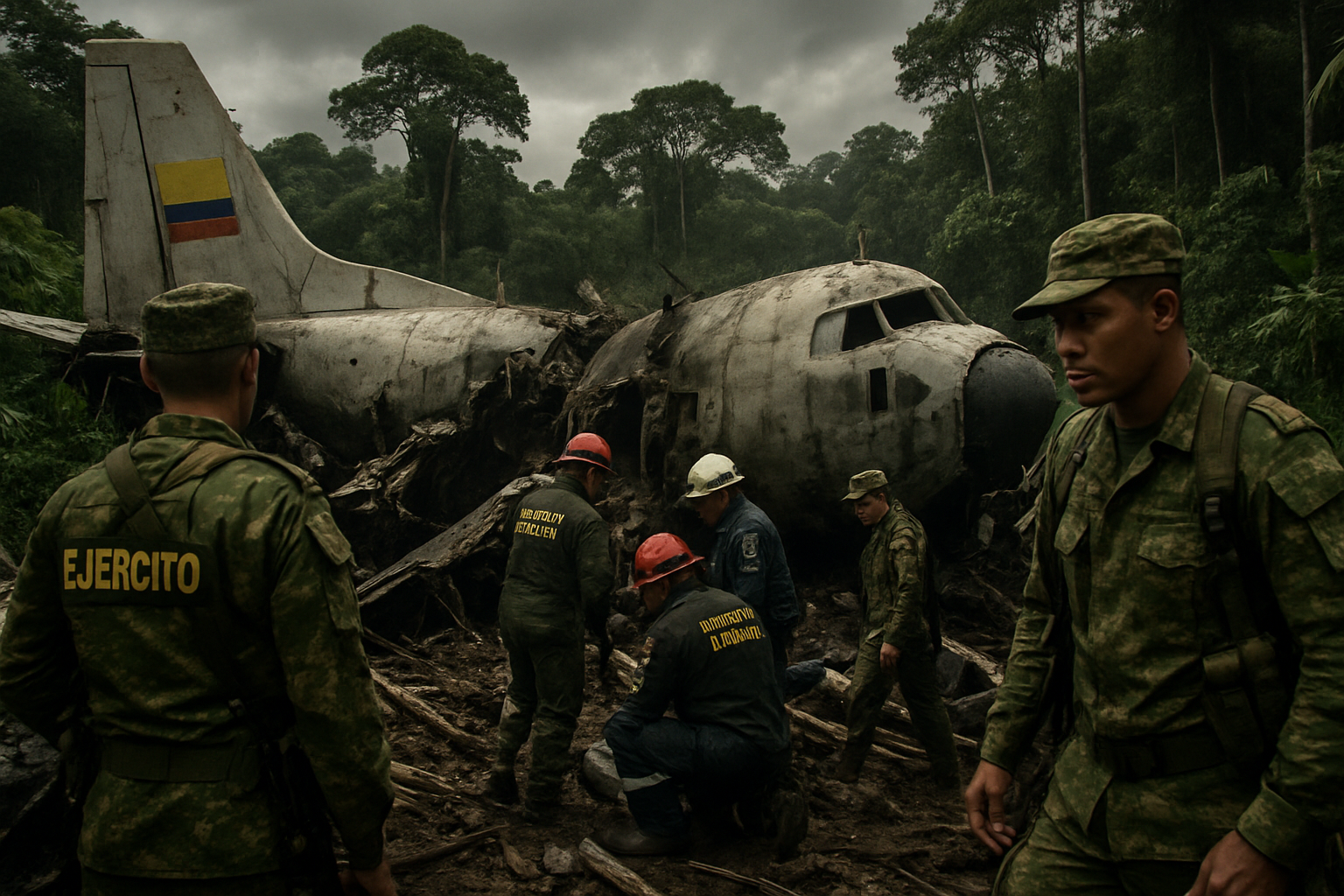
A Colombian military aircraft crashed during takeoff on Monday, killing 66 people and leaving dozens of survivors hospitalized after the deadliest military aviation disaster in the country's recent history.
The Lockheed Martin-built C-130 Hercules transport plane was carrying 128 people when it crashed at Puerto Leguízamo airport, on the border with Peru, according to Hugo Alejandro López, head of Colombia's armed forces. The aircraft was transporting 11 Air Force members, 115 army personnel, and two national police officers on what officials described as a routine military transport mission.
The death toll nearly doubled from initial reports as rescue operations continued throughout Monday and Tuesday. Defense Minister Pedro Sánchez confirmed the accident occurred as the plane was taking off from the remote airport in Putumayo province, a strategic location near Ecuador's border that serves as a crucial logistics hub for counter-narcotics operations.
Takeoff Disaster in Remote Amazon Region
The accident occurred around 10:00 AM local time (15:00 GMT) in the dense Amazon rainforest region. Initial reports suggest the aircraft suffered an impact near the end of the runway during takeoff, with firefighter Eduardo San Juan Callejas telling Caracol radio that a wing of the plane later clipped trees as it attempted to gain altitude.
The challenging terrain and remote location complicated immediate rescue efforts. However, emergency response teams, including military units, civil protection personnel, and medical staff, were deployed rapidly to the crash site. Multiple ambulances and rescue helicopters were dispatched to transport the injured to nearby hospitals.
Some passengers reportedly "jumped before collision," suggesting crew members may have attempted emergency evacuation procedures as the situation deteriorated, according to municipal official Carlos Claros.
Conflicting Casualty Reports Emerge
Initial reports from Colombian authorities suggested a lower death toll, with early estimates ranging from 8 to 34 fatalities. However, international news sources and later official confirmations established the final death toll at 66, with 58 survivors receiving medical treatment.
The discrepancy in casualty figures reflects the challenging conditions for rescue operations in the remote Amazon location and the ongoing nature of the emergency response. Putumayo Governor confirmed that multiple critically injured passengers required immediate medical evacuation to facilities in larger cities.
"This is a tragic accident that has deeply affected our armed forces and the families of those involved."
— Pedro Sánchez, Colombian Defense Minister
Strategic Importance of Puerto Leguízamo
Puerto Leguízamo airport serves as a vital military logistics link in a region where road transportation is often impractical or dangerous due to security conditions. The area near Ecuador's border has been the scene of heavy military activity in recent weeks as Colombian forces work to combat drug-running cartels and armed militias.
The airport's limitations and remote location have been noted by officials as factors that complicate both routine operations and emergency response efforts. The challenging Amazon environment, with high humidity, tropical conditions, and limited runway capacity, presents unique operational risks for military transport aircraft.
This region has significant strategic importance for Colombia's counter-narcotics efforts and territorial control operations, making regular military transport flights essential despite the challenging conditions.
Aircraft and Safety Context
The C-130 Hercules has served as a reliable military transport workhorse for over six decades, typically accommodating around 100 soldiers for troop transport, cargo delivery, and logistics operations in challenging environments. The four-engine turboprop aircraft maintains a strong overall safety record but faces unique risks when operating in remote areas with limited infrastructure support.
This incident represents the third major aviation accident in Colombia during 2026, highlighting persistent vulnerabilities in military aviation operations in the region. The pattern follows similar challenges faced across Latin America, where aging aircraft fleets operate in demanding geographic and climatic conditions.
The crash occurred just weeks after a similar C-130 Hercules accident in Bolivia that killed 22 people, demonstrating the broader challenges facing military aviation operations in South America's demanding operational environments.
Emergency Response and Investigation
President Gustavo Petro was immediately informed of the accident, and comprehensive emergency protocols were activated for victims and their families. The Defense Ministry has established support procedures to assist affected families during this difficult time.
The Colombian Air Force has established an Accident Investigation Board to examine mechanical systems, weather conditions, pilot procedures, and airport infrastructure. Air Force Commander Fernando Silva confirmed the comprehensive investigation is expected to continue for several months, similar to other major military aviation accidents in the region.
The investigation will be crucial for understanding the exact circumstances of the crash and implementing any necessary safety improvements for future operations in challenging environments like the Amazon region.
Regional Aviation Safety Concerns
This tragedy underscores persistent challenges in military aviation operations across developing regions, where aging equipment often operates in demanding tropical conditions with limited emergency response infrastructure. The combination of challenging geography, climatic conditions, and the need for regular military transport in remote areas creates unique operational risks.
Aviation experts note that while the C-130 Hercules maintains excellent reliability statistics globally, complex operations in remote Amazon locations present challenges that require enhanced safety measures, improved pilot training, and potentially fleet modernization discussions.
The findings from this investigation may influence Colombian military aviation protocols and could potentially affect regional military aviation safety standards throughout Latin America, where similar operational challenges exist.
Impact on Families and Armed Forces
The Colombian military has expressed its deepest condolences to the families of those killed and injured in this tragic accident. Support systems have been activated to provide assistance to affected families during the mourning process and recovery period.
The loss represents a significant blow to Colombia's armed forces, affecting personnel from multiple branches including the Air Force, Army, and National Police. The human cost of this tragedy extends beyond the immediate casualties to the broader military community and families across the country.
As rescue operations conclude and the investigation continues, this incident serves as a stark reminder of the risks faced by military personnel conducting essential operations in challenging environments to maintain national security and territorial control.