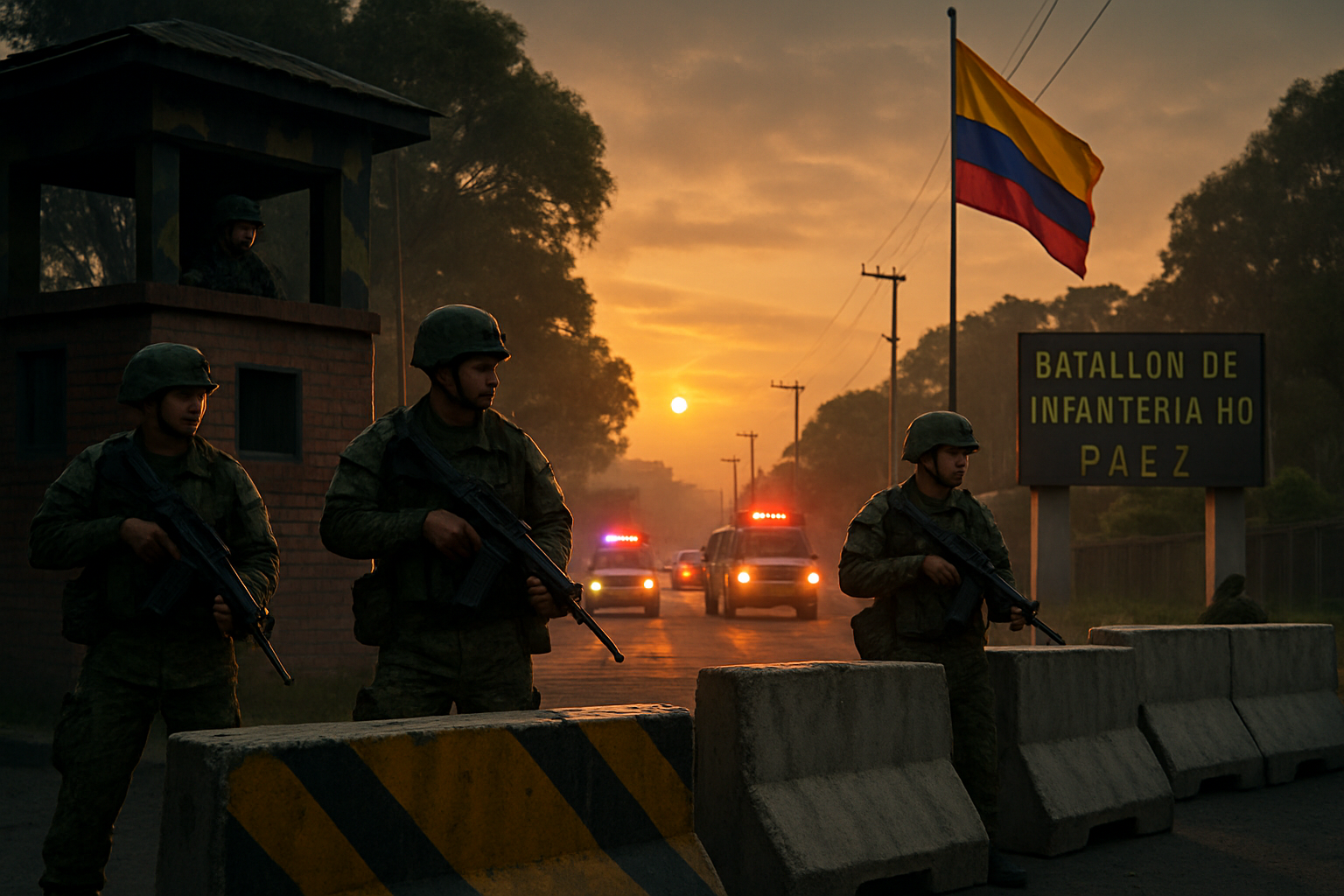
A car bomb explosion near the Agustín Codazzi military battalion in Palmira, Valle del Cauca, sent shockwaves through the region on Friday evening, marking another escalation in Colombia's deteriorating security situation as criminal organizations demonstrate increasingly sophisticated attack capabilities against state institutions.
The attack, which occurred in the evening hours of April 24, 2026, was captured on video by witnesses and quickly spread across social media platforms, showing the exact moment of the devastating blast. While initial reports indicated no immediate fatalities at the military installation, the explosion caused widespread panic among civilians in the surrounding areas and highlighted the persistent security vulnerabilities facing Colombian military forces.
Attack Details and Security Response
According to local sources, the explosive device was concealed within a vehicle that detonated in close proximity to the military battalion headquarters. The blast created a massive shockwave that was felt throughout several sectors of Palmira, with witnesses describing scenes of chaos as residents fled their homes and businesses seeking safety.
Emergency response teams were immediately dispatched to the scene, while military personnel at the Agustín Codazzi battalion implemented enhanced security protocols. The battalion, which serves as a key military installation in Valle del Cauca, has been a frequent target of criminal organizations operating in the region.
Video footage obtained by news outlets showed the intensity of the explosion, with a large fireball visible from several kilometers away. The attack demonstrated a level of planning and execution that security experts say reflects the growing sophistication of Colombia's criminal organizations.
Regional Context and Criminal Organization Activity
The Palmira attack comes amid a broader pattern of violence that has plagued Valle del Cauca and surrounding regions throughout 2026. The area has experienced more than 80 attacks involving car bombs, motorcycle bombs, and drone-delivered explosives over the past four years, with over 20 deaths recorded in terrorist actions attributed to FARC dissidents and ELN guerrillas.
Criminal organizations in the region, including the "Jaime Martínez" structure and Gulf Clan factions, have demonstrated what security analysts describe as "state-like capabilities." These groups possess advanced intelligence networks capable of tracking government movements, encrypted communications systems that exceed law enforcement monitoring capabilities, and access to military-grade drone technology.
The systematic targeting of democratic institutions has reached alarming proportions, with over 100 municipal ombudsmen declared targets by armed groups according to the Public Ministry in Cali. This represents a coordinated assault on Colombia's democratic institutions at the local level.
Government Response and Total Peace Strategy Challenges
The attack poses significant challenges to President Gustavo Petro's "Total Peace" strategy, which seeks to negotiate comprehensive agreements with various armed groups. However, criminal organizations have increasingly rejected dialogue in favor of territorial expansion and intensified violence against state institutions.
Defense Minister Pedro Sánchez has overseen enhanced security protocols following a series of high-profile attacks, including the February 2026 assassination attempt against President Petro, where his helicopter was forced to remain airborne for four hours over the Caribbean Sea due to surface-to-air missile threats.
The government has implemented a dual approach combining peace negotiations with enhanced security measures, but recent events suggest the limitations of reactive security responses against organizations with sophisticated intelligence and operational capabilities.
International Cooperation and Intelligence Sharing
Colombian authorities are working closely with international partners through the Shield of the Americas coalition, a 17-nation alliance established in March 2026 to combat transnational criminal networks. The cooperation includes intelligence sharing with Spanish police, Interpol, and regional security agencies to track criminal leaders and disrupt their operations.
Recent joint operations have successfully captured several high-profile criminal leaders, demonstrating the effectiveness of coordinated international efforts. However, the persistence of attacks like the one in Palmira highlights the ongoing challenges facing law enforcement agencies dealing with organizations that possess state-level resources and capabilities.
"These criminal organizations operate with a level of sophistication that rivals state intelligence agencies. Their ability to coordinate multi-regional attacks and target specific government installations represents a fundamental challenge to democratic governance."
— Security Expert, Colombian Institute for Peace
Economic and Social Impact
The ongoing violence has significant implications beyond immediate security concerns. Tourism confidence has been affected, with authorities forced to close major attractions like Tayrona National Park due to security threats. Educational and healthcare facilities have become targets, disrupting essential services and threatening long-term development prospects.
The psychological impact on communities throughout Valle del Cauca and neighboring regions has been profound. Families have altered their daily routines, businesses have implemented enhanced security protocols, and local leaders face constant threats that affect their ability to serve their communities effectively.
The systematic targeting of civilian infrastructure and democratic institutions represents a strategy designed to create governance vacuums that criminal organizations can exploit for territorial control and illicit economic activities.
Strategic Implications and Future Outlook
The Palmira attack underscores the evolving nature of Colombia's security challenges, where criminal organizations have transcended traditional drug trafficking to become sophisticated networks capable of challenging state authority. The ability of these groups to target military installations with precision-timed attacks demonstrates their intelligence-gathering capabilities and operational sophistication.
Security experts warn that without comprehensive approaches addressing root causes such as poverty, corruption, and weak governance, purely military responses may prove insufficient. The success of Colombia's democratic institutions in addressing these challenges while preserving constitutional protections will serve as a template for other nations facing similar threats from transnational criminal organizations.
The international community continues to monitor Colombia's institutional response as a critical test of democratic resilience against sophisticated criminal networks that possess capabilities traditionally associated with state actors. The outcome of this struggle will have implications for democratic governance throughout Latin America and beyond.