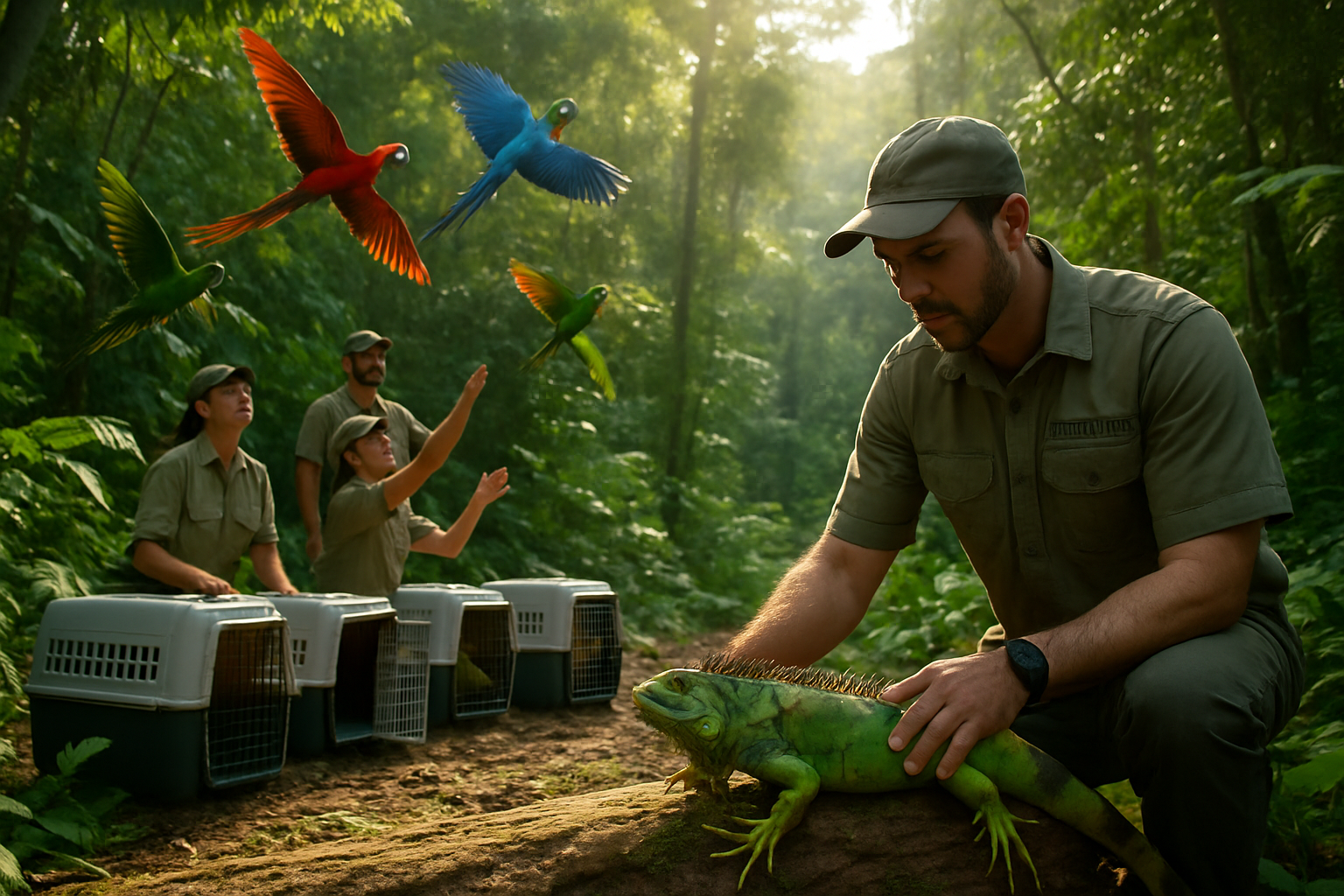
In a remarkable conservation victory, Colombian environmental authorities have successfully released over 100 animals confiscated from illegal trafficking operations back into their natural habitats in Puerto López, Meta province, representing one of the country's most significant wildlife rescue operations of 2026.
The released animals, including morrocoyes (yellow-footed tortoises), various parrot species, and iguanas, were previously confiscated during environmental enforcement operations and underwent extensive rehabilitation processes before being returned to the rainforests of Meta province. The operation demonstrates Colombia's growing commitment to combating the devastating illegal wildlife trade that threatens the country's extraordinary biodiversity.
A Critical Victory During Global Conservation Renaissance
This successful release occurs during what conservation experts are calling a "global conservation renaissance" - an unprecedented surge in coordinated wildlife protection efforts across multiple continents. The Colombia operation aligns with remarkable conservation achievements worldwide, including Ecuador's reintroduction of 158 giant tortoises to the Galápagos Islands after a 150-year absence and Zimbabwe's world-first DNA forensic prosecution of wildlife poachers.
The timing is particularly significant as January 2026 was confirmed as the hottest month in recorded history, marking the 20th consecutive month that global temperatures have exceeded 1.5°C above pre-industrial levels. This sustained warming is creating additional stress on wildlife populations and disrupting traditional conservation approaches, making successful rescue operations like Colombia's even more crucial.
"These animals represent more than individual rescues - they symbolize our commitment to protecting Colombia's irreplaceable biodiversity during one of the most challenging periods for global conservation."
— Environmental Protection Official
The Road to Recovery
Each animal underwent comprehensive rehabilitation processes before release, reflecting the sophisticated evolution of conservation medicine and wildlife care protocols. The morrocoyes, parrots, and iguanas received specialized veterinary attention to address injuries and behavioral issues resulting from their captivity and mistreatment in trafficking operations.
Colombia's approach represents a fundamental shift from reactive crisis management to proactive ecosystem service management. The country has emerged as a leader in integrating cutting-edge technology - including satellite monitoring, environmental DNA sampling, and digital tracking systems - with traditional ecological knowledge from indigenous communities who have stewarded these forests for generations.
Economic and Ecological Significance
The conservation effort extends beyond environmental protection to economic development strategy. Colombia's comprehensive wildlife protection demonstrates how environmental stewardship functions as an economic engine rather than a regulatory burden. The country's eco-tourism industry, worth hundreds of millions annually, depends directly on healthy ecosystems and abundant wildlife populations.
Countries implementing comprehensive wildlife protection consistently demonstrate greater economic resilience and attract sustainable investment across multiple sectors, from green technology manufacturing to nature-based tourism. The economic multiplier effects include improved public health outcomes, enhanced agricultural productivity through ecosystem services, and reduced infrastructure costs through natural disaster prevention.
Technology Meets Tradition
The success of Colombia's operation exemplifies the sophisticated synthesis of modern conservation technology with traditional ecological knowledge that has emerged as the most effective approach to environmental protection. Advanced monitoring systems enable precise tracking of released animals' adaptation to their natural habitats, while indigenous stewardship practices provide crucial insights into optimal release locations and seasonal timing.
This technology-tradition integration represents a fundamental evolution in conservation methodology, moving beyond purely technological or traditional approaches toward comprehensive, scientifically rigorous, and culturally sensitive frameworks that respect local knowledge systems while leveraging global technological capabilities.
International Cooperation and Scaling Success
Colombia's achievement highlights the critical importance of international cooperation in addressing transnational environmental challenges. Wildlife trafficking networks cross national boundaries, making coordinated responses essential. The success provides valuable knowledge-sharing opportunities for other Latin American nations facing similar challenges.
The diversity of conservation approaches being implemented globally provides resilience against single-solution dependencies, offering multiple adaptation pathways for addressing complex environmental challenges. From marine conservation in Thailand to forest protection in Kazakhstan, nations are demonstrating that effective environmental protection is achievable with proper planning, community engagement, and political commitment.
Looking Forward: Critical Action Window
March 2026 represents a critical juncture for global environmental protection, with experts emphasizing the choice between reactive crisis management and proactive ecosystem service management. The environmental action window is rapidly narrowing as ecological systems approach critical thresholds that could trigger potentially irreversible changes affecting global food security, climate stability, and human settlements.
However, Colombia's success - along with similar victories worldwide - demonstrates that the tools, knowledge, and cooperation frameworks exist for comprehensive environmental protection. Success depends on rapid scaling through enhanced international cooperation, sustained financial commitments, and recognition of environmental protection as essential infrastructure for human prosperity and planetary sustainability.
The release of these 100+ animals in Meta province may seem modest in global terms, but it represents something profound: proof that coordinated action can achieve extraordinary results even during Earth's most environmentally challenging period. As these rescued morrocoyes, parrots, and iguanas return to their forest homes, they carry with them the hope that humanity can still choose conservation over destruction, collaboration over conflict, and stewardship over exploitation.