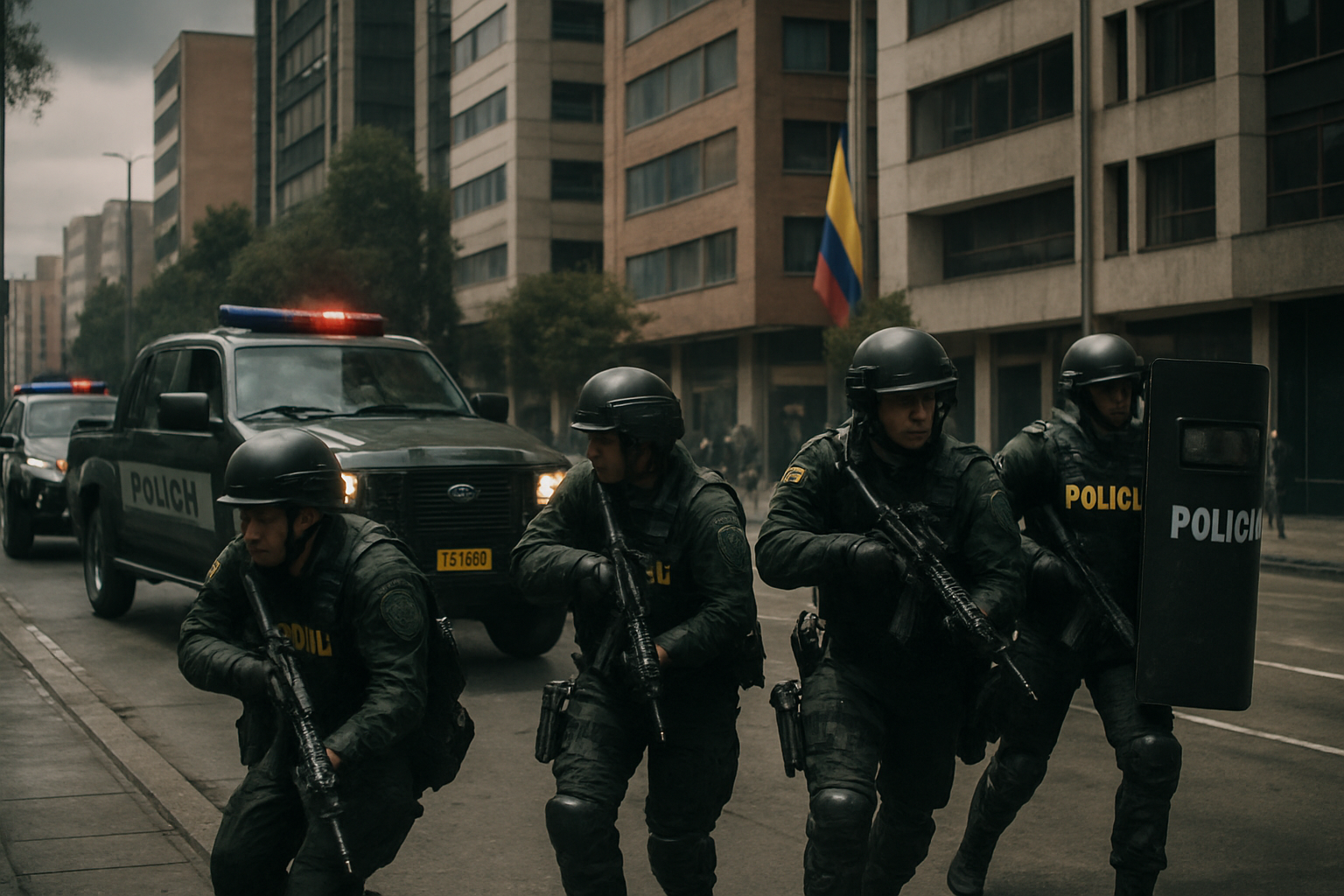
Colombia faces an escalating security crisis as brazen armed robberies, threats against elected officials, and targeted violence against social leaders spread across multiple departments, challenging the government's "Total Peace" strategy and highlighting the persistent influence of criminal organizations throughout the country.
Recent incidents across Boyacá, Antioquia, and Cauca provinces demonstrate the breadth of security challenges confronting Colombian authorities, from audacious daylight robberies to coordinated threats against democratic institutions and the systematic targeting of community leaders.
Brazen Daylight Robbery Shocks Chiquinquirá
In a stunning display of criminal boldness, armed men robbed an exclusive jewelry store in broad daylight in central Chiquinquirá, Boyacá, without attempting to conceal their identities. Security camera footage captured the unprecedented incident, showing the perpetrators violently assaulting employees before fleeing openly, mere meters from local authorities.
The robbery represents what experts describe as a concerning evolution in criminal tactics, with organized groups demonstrating increasing confidence in operating without fear of immediate law enforcement response. The incident occurred in one of Colombia's most visited religious tourism destinations, potentially affecting the region's economic stability.
"This level of brazenness indicates criminal organizations feel they can operate with impunity even in highly visible locations during peak hours."
— Security Analysis Expert
Political Officials Under Direct Threat
The security crisis extends to Colombia's democratic institutions, with Mayor of Briceño, Antioquia, receiving direct threats from the 36th Front of FARC dissidents (GAO-r 36). The criminal organization accused the mayor of allegedly placing the municipality "at the service of the Clan del Golfo," one of Colombia's most powerful drug trafficking organizations.
Governor of Antioquia responded to the threats by requesting military bombardments against alias 'Calarcá,' the dissident leader, highlighting the severity of the situation and the challenge criminal organizations pose to local governance. The incident demonstrates how criminal groups use intimidation tactics to influence political decisions and territorial control.
This threat follows a disturbing pattern of violence against Colombian officials that intensified in early February 2026, including the attempted assassination of President Gustavo Petro, whose helicopter was threatened for four hours over the Caribbean Sea, and the kidnapping and subsequent rescue of Senator Aida Quilcué in Cauca province.
Social Leader Assassinated in Cauca
The violence against civil society continued with the assassination of another social leader in Cauca province, found dead with signs of torture. The victim was identified as a campesino who had been defending territory from armed groups, according to reports from the Institute for Development and Peace Studies (Indepaz).
Indepaz issued urgent calls in response to early warnings from the Ombudsman's Office about Suárez municipality, citing "illegal governance forms by armed groups." The organization's concerns highlight how criminal organizations are establishing parallel governance structures that directly challenge state authority and terrorize local populations.
The assassination represents part of a broader pattern of violence against social leaders that has plagued Colombia despite the 2016 peace agreement with FARC. According to historical data, hundreds of social leaders, human rights defenders, and community organizers have been killed since the peace accord was signed, with many cases occurring in territories previously controlled by the guerrilla group.
Natural Disasters Compound Security Challenges
Colombia's security forces are simultaneously responding to natural emergencies, as severe flooding hit Cali following heavy rainfall on February 19. The storms caused fallen trees, including one that collapsed in the traditional San Antonio neighborhood in western Cali, along with flooding that trapped drivers and damaged homes.
These emergency responses stretch already limited security resources, creating opportunities for criminal organizations to operate in areas where official presence is temporarily reduced. The convergence of security threats and natural disasters presents complex challenges for Colombian authorities attempting to maintain order across diverse geographic regions.
Political Tensions Amid Security Crisis
The security challenges occur against a backdrop of political tensions between President Gustavo Petro and Medellín Mayor Federico Gutiérrez. Their disagreements over issues including the humanitarian crisis in Urabá, EPM utility company management, the Hidroituango dam project, and energy tariffs reflect broader disputes about security policy and resource allocation.
These political divisions came into sharp focus after revelations that the government rejected United States assistance for the humanitarian crisis in Urabá, a region significantly affected by armed group violence and displacement. The rejection of international aid during a security crisis highlights the complex political considerations influencing Colombia's response to violence.
Historical Context of Ongoing Violence
The current security crisis represents a continuation of challenges that have persisted despite significant diplomatic efforts, including historic meetings between Colombian and U.S. leadership. In February 2026, President Petro met with President Trump at the White House to establish counter-narcotics cooperation frameworks and discuss regional security coordination.
However, the implementation of these agreements faces persistent obstacles from criminal organizations that have adapted to law enforcement pressure through increased sophistication and territorial expansion. The Clan del Golfo, FARC dissidents, and other armed groups continue to challenge state authority through violence, intimidation, and territorial control.
Intelligence reports indicate these criminal organizations possess advanced surveillance capabilities, encrypted communications networks, and sophisticated operational planning that rivals state-level institutions. This technological and tactical evolution makes traditional law enforcement approaches increasingly insufficient.
Challenges to Peace Negotiations
The escalating violence directly undermines Colombia's "Total Peace" strategy, which seeks to negotiate comprehensive agreements with various armed groups. The threats against elected officials and assassination of social leaders demonstrate how criminal organizations use violence to maintain territorial control and resist state authority.
The systematic targeting of social leaders particularly affects peace implementation, as these individuals often serve as crucial intermediaries between communities and state institutions. Their elimination creates governance vacuums that criminal organizations exploit to establish parallel authority structures.
Regional experts note that successful peace processes require not only agreements with armed groups but also institutional capacity to protect civilian populations and provide alternative economic opportunities. The current security crisis suggests significant gaps remain in both areas.
Regional Security Implications
Colombia's security challenges extend beyond national borders, affecting regional stability through drug trafficking networks, refugee flows, and cross-border criminal operations. The country's strategic location makes it a crucial transit point for narcotics destined for North American and European markets.
The involvement of FARC dissidents in threatening elected officials demonstrates how groups that rejected the 2016 peace agreement continue to destabilize democratic institutions. These organizations maintain territorial control in strategic regions, particularly along borders with Venezuela and Ecuador, complicating regional cooperation efforts.
International observers monitor Colombia's institutional response to organized crime as a test case for democratic resilience in Latin America. Success or failure in addressing these challenges influences regional approaches to peace processes, criminal justice, and international cooperation frameworks.
Future Implications
The convergence of brazen criminal activity, political intimidation, social leader assassinations, and natural disasters presents unprecedented challenges for Colombian authorities. The government's ability to respond effectively will determine whether democratic institutions can maintain legitimacy amid persistent criminal pressure.
Enhanced security protocols have been implemented for government officials in high-risk regions, while specialized units continue operations against criminal organizations. However, the scope and sophistication of current threats suggest that comprehensive solutions require coordinated approaches addressing root causes beyond immediate security responses.
The coming months will prove critical for determining whether Colombia's democratic institutions can adapt to evolving criminal threats while maintaining peace negotiations and protecting civilian populations. The outcome will significantly influence both national stability and regional security architecture throughout Latin America.