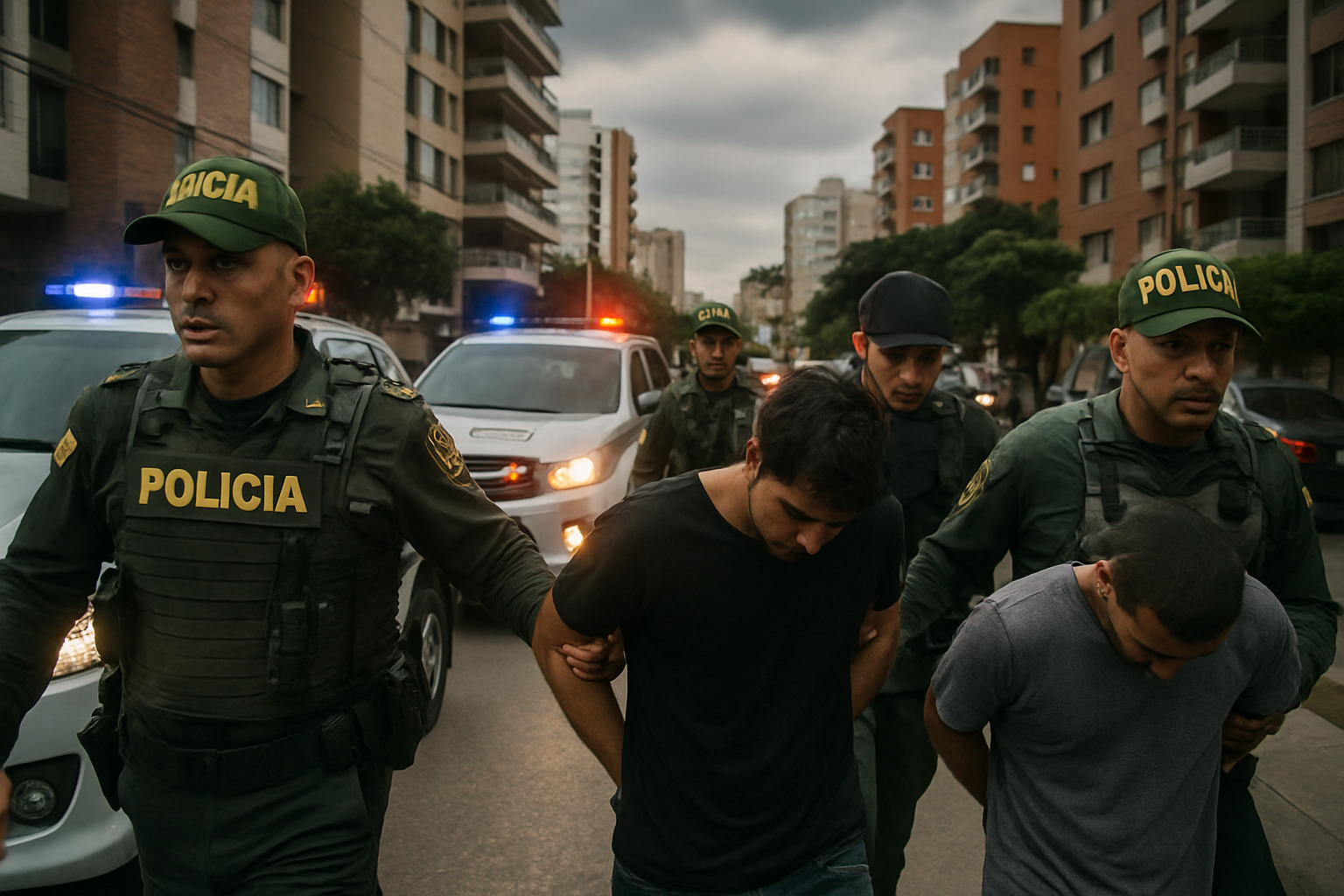
Colombian security forces have intensified operations against criminal networks with the arrest of seven individuals in Barranquilla connected to extortion activities affecting at least five neighborhoods, while authorities in Tolima increased reward money to 35 million pesos for information leading to six missing young people.
The dual developments on March 16, 2026, underscore Colombia's persistent struggle against organized crime as the country continues implementing its "Total Peace" strategy amid rising violence and criminal sophistication across multiple regions.
Barranquilla Extortion Network Dismantled
In Barranquilla, Colombia's fourth-largest city, police arrested seven suspects operating an extortion ring that had terrorized residents across at least five neighborhoods. According to El Tiempo, the arrested individuals have extensive criminal backgrounds including charges for illegal firearm possession, homicide, theft, and drug trafficking.
The operation represents a significant blow to criminal organizations that have increasingly targeted local businesses and residents with extortion schemes, a crime that has become endemic across Colombia's urban centers. One of the arrested individuals is a minor, highlighting the concerning trend of youth recruitment by criminal networks.
The arrests build upon a documented pattern of enhanced law enforcement operations in Barranquilla. Previous security initiatives have targeted various criminal activities, including the February arrest of an Interpol red circular suspect connected to a Spanish homicide case, demonstrating the international scope of criminal networks operating in the Caribbean coastal city.
Search Intensifies for Missing Tolima Youth
Meanwhile, in the central Colombian department of Tolima, authorities have escalated their search efforts for six young people who disappeared in January from Mariquita municipality. The reward for information about their whereabouts has been increased to 35 million pesos, reflecting the urgency and gravity of the case.
The missing persons case has captured national attention as families and community leaders press for answers about the fate of the six individuals, who were reportedly last seen in the Mariquita area. The substantial reward increase suggests authorities are seeking to incentivize community cooperation in what may be a complex investigation involving potential criminal network involvement.
Historical Context of Colombian Security Crisis
These operations occur against a backdrop of escalating security challenges documented throughout 2026. Colombian criminal organizations have demonstrated increasingly sophisticated capabilities, with advanced surveillance networks, encrypted communications, and territorial control that rivals state authority in some regions.
The February 2026 comprehensive security analysis revealed that criminal groups have systematically targeted mayors, ombudsmen, and local officials to create governance vacuums that facilitate their operations. Over 100 municipal ombudsmen have been declared targets by armed groups, representing a strategic assault on democratic institutions.
In Antioquia, the mayor of Briceño was declared a military target by FARC dissidents from the 36th Front, who accused him of complicity with the Gulf Clan. Such targeting of elected officials represents a fundamental challenge to Colombia's democratic governance, particularly at the local level where state presence is often limited.
Criminal Network Evolution
Security experts note that Colombian criminal organizations have evolved far beyond traditional drug trafficking operations. They now demonstrate state-like capabilities including:
- Advanced intelligence networks capable of tracking government officials' movements
- Sophisticated communication systems using encrypted platforms
- Hierarchical structures that survive individual leader captures
- International logistics networks spanning multiple countries
- Systematic corruption of local institutions
The Barranquilla extortion network exemplifies this evolution, with suspects having diverse criminal backgrounds suggesting multi-faceted operations rather than single-focus activities. The involvement of a minor also reflects criminal organizations' systematic recruitment of young people, exploiting Colombia's socioeconomic vulnerabilities.
International Cooperation and Regional Impact
Colombia's security challenges have increasingly required international cooperation, as demonstrated by successful joint operations with Spanish police and Interpol. The February capture of Diego 'Optra', heir to the powerful Bustamante drug clan, resulted from sustained Spanish police and Interpol tracking since 2025.
These criminal networks exploit Colombia's strategic position as a transit point between South American drug production and North American and European markets. The Caribbean coast, where Barranquilla is located, serves as a critical corridor for maritime drug trafficking operations that have grown increasingly sophisticated.
The closure of Tayrona National Park in February due to armed group threats against park staff illustrated how criminal territorial wars affect legitimate economic activities, including tourism, one of Colombia's key economic sectors.
Government Response and Total Peace Strategy
The Colombian government maintains its "Total Peace" negotiations while responding to escalating criminal activities through enhanced security protocols. However, criminal capabilities often outpace law enforcement responses, particularly in peripheral regions with limited state presence.
The March 2026 operations come amid broader questions about the effectiveness of the peace strategy as criminal organizations continue territorial expansion and institutional targeting. The systematic nature of threats against democratic officials suggests criminal groups view the current political moment as an opportunity to consolidate territorial control.
Enhanced police communications and coordination protocols have been implemented, but the scale and sophistication of criminal networks require sustained international cooperation and substantial resource commitments that test Colombia's institutional capacity.
Community Impact and Social Consequences
The extortion activities in Barranquilla's five affected neighborhoods have created climate of fear among residents and business owners. Such crimes undermine community cohesion and economic development, forcing families to alter daily routines and businesses to implement costly security measures.
In Tolima, the disappearance of six young people has traumatized the local community and raised questions about the safety of Colombia's youth. The substantial reward increase reflects both government commitment to resolving the case and the difficulty investigators have encountered in obtaining credible information.
These incidents contribute to broader social impacts documented across Colombia, including increased internal displacement, reduced investment in affected regions, and erosion of trust in state institutions' capacity to provide basic security.
Challenges Ahead
Colombia faces the complex challenge of addressing immediate security threats while implementing long-term strategies to prevent criminal recruitment and territorial control. The involvement of minors in criminal activities, as seen in the Barranquilla arrests, highlights the need for comprehensive social programs addressing underlying vulnerabilities.
The geographic distribution of current security challenges—from Caribbean coast extortion to central region disappearances—demonstrates the national scope of problems requiring coordinated responses across multiple levels of government and civil society.
Success will depend on sustained political commitment to institutional strengthening, adequate resources for law enforcement modernization, enhanced international cooperation, and comprehensive approaches addressing the root causes that enable criminal territorial control while maintaining Colombia's democratic peace process.
As Colombia continues navigating these security challenges, the March 16 operations represent both tactical successes against specific criminal networks and broader tests of the country's capacity to maintain democratic governance while confronting sophisticated transnational organized crime in an increasingly complex security environment.