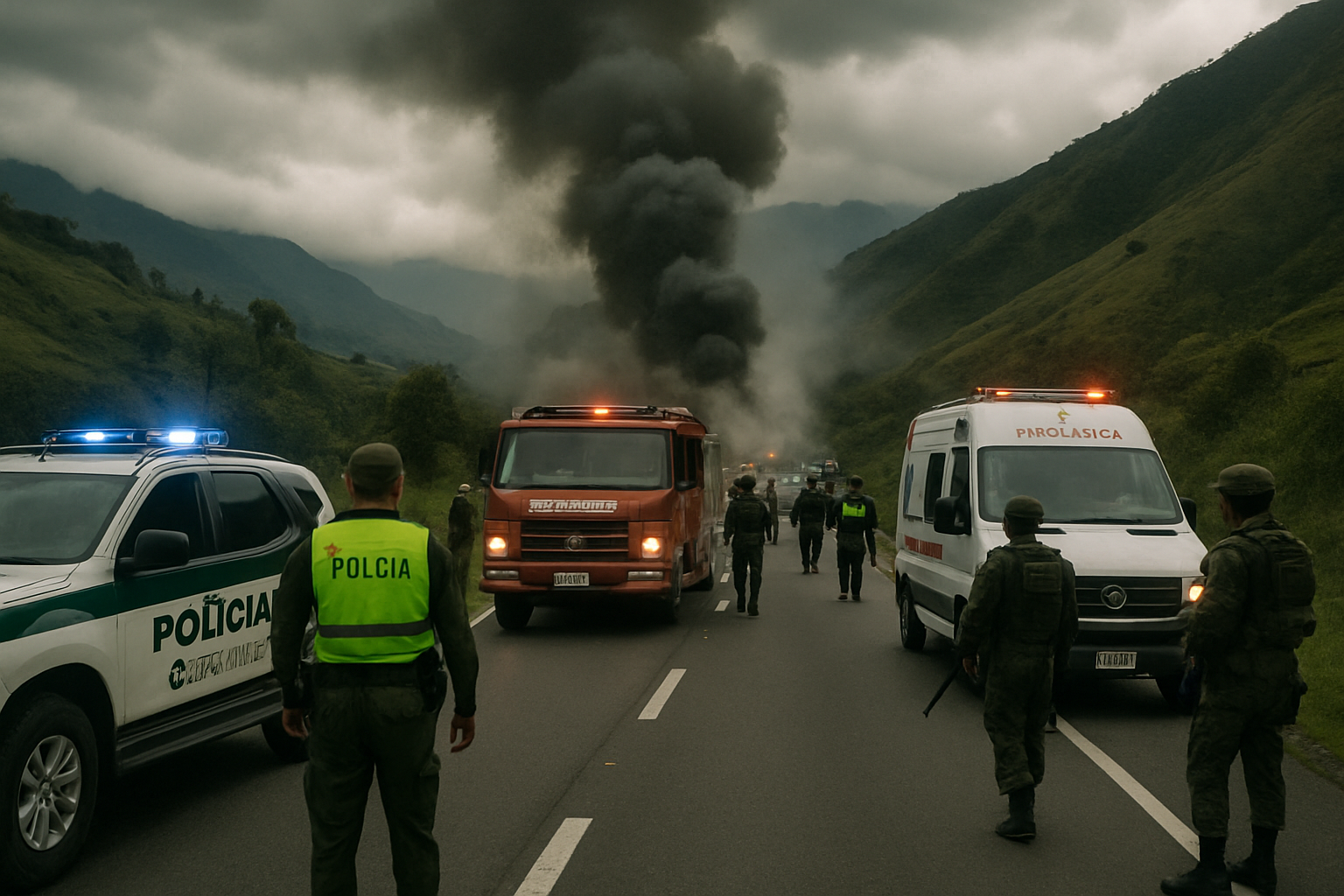
A devastating terrorist attack on Colombia's strategic Pan-American Highway has left at least seven people dead and more than 20 injured after guerrilla forces detonated an explosive cylinder that struck a passenger bus in the Cauca region on Saturday afternoon.
The attack occurred around 1:00 PM in the El Túnel sector near Cajibío, Cauca, when FARC dissident fighters launched what authorities describe as a coordinated assault using an improvised explosive device against civilian transportation. The cylinder bomb fell directly onto the bus, causing immediate casualties and severely damaging the critical transportation corridor between Cali and Popayán.
Coordinated Wave of Terror
Saturday's bus bombing was not an isolated incident but part of a coordinated terrorist campaign that has shaken southwestern Colombia. Authorities report eleven separate attacks occurred within a 24-hour period across Cauca and Valle del Cauca departments, representing what Governor officials describe as a "terrorist escalation" unprecedented in recent years.
The attacks targeted multiple locations including Mercaderes, El Tambo, Miranda, and Corinto. In a particularly concerning development, authorities successfully neutralized an explosive drone in Popayán, demonstrating the sophisticated military-grade capabilities now possessed by criminal organizations.
"This represents a grave threat against life and tranquility of our communities. The systematic targeting of civilian infrastructure shows the calculated nature of these attacks."
— Cauca Regional Governor
Strategic Impact on Critical Infrastructure
The Pan-American Highway bombing has generated significant disruptions to one of Colombia's most vital transportation corridors. The route serves as a crucial link for legitimate commerce while unfortunately also functioning as a strategic drug trafficking pathway, making it a contested zone between state forces and illegal armed groups.
Multiple vehicles sustained damage from the explosive blast, with emergency responders working to clear debris and restore traffic flow. The attack's timing and location suggest detailed intelligence gathering by the perpetrators, raising serious questions about the security of Colombia's transportation infrastructure.
Election Context and Political Ramifications
The timing of these attacks is particularly significant as Colombia approaches presidential elections scheduled for May 2026. International observers note a disturbing pattern of violence targeting democratic institutions and civilian infrastructure in the lead-up to the electoral process.
President Gustavo Petro's administration has faced mounting criticism over deteriorating security conditions, particularly following the February 2026 assassination attempt that forced his helicopter to remain airborne for four hours over the Caribbean Sea due to surface-to-air threats. The latest attacks further challenge his "Total Peace" strategy of negotiating with armed groups.
Danish media reports specifically highlight international concerns about the escalation of violence ahead of the elections, with multiple foreign governments monitoring the situation closely. The attacks represent a direct challenge to the democratic process and Colombia's institutional stability.
FARC Dissident Capabilities
Venezuelan news sources confirm that authorities attribute the attacks to FARC dissident groups who have rejected the 2016 peace agreement and continue operating with what security experts describe as "state-like capabilities." These organizations possess advanced surveillance systems, encrypted communications, and increasingly sophisticated weapons including military-grade drones.
The use of cylinder bombs and explosive drones represents a dangerous evolution in asymmetric warfare tactics, with criminal organizations adapting commercial technology for military-style operations against both state forces and civilian targets.
"The terrorists have crossed red lines with their systematic assault on democracy and civilian populations. We will respond with the full force of the state."
— Colombian Government Officials
Broader Security Crisis
Saturday's attacks continue a documented pattern of escalating violence that has affected Colombia throughout 2026. Recent incidents include multiple car bomb attacks in urban centers, systematic targeting of social leaders, and coordinated assaults on military installations that have killed senior officers including Lt. Col. Umar Farouq.
Over 100 municipal ombudsmen have been declared targets by armed groups according to the Public Ministry in Cali, representing a systematic assault on democratic institutions and local governance structures. The geographic spread of violence from traditional conflict zones to urban centers demonstrates the expanding capabilities and territorial ambitions of these criminal networks.
International Cooperation and Response
Colombian authorities continue to work within the framework of the Shield of the Americas coalition, established in March 2026 with 17 nations to combat transnational organized crime. The initiative has achieved some success with joint operations capturing high-value targets, but Saturday's attacks demonstrate the persistent challenges facing regional security cooperation.
Intelligence sharing protocols have been enhanced with international partners including Spanish police, Interpol, and regional law enforcement agencies. However, criminal organizations' technological sophistication and operational security continue to outpace traditional counter-terrorism measures.
Humanitarian Impact and Community Response
The attacks have forced thousands of residents to alter their daily routines and travel patterns, with many families avoiding the Pan-American Highway during peak hours. Local businesses report significant economic impacts due to transportation disruptions and security concerns affecting commercial activities.
Medical facilities in the region are treating wounded civilians while emergency responders work to ensure the safety of the affected transportation corridor. The psychological impact extends beyond direct victims, affecting entire communities that depend on secure transportation for access to essential services.
Looking Forward: Security Challenges
The April 25th attacks represent a critical juncture for Colombia's security strategy and democratic consolidation. The sophistication of the coordinated assault, combined with the proximity to presidential elections, creates unprecedented challenges for state institutions and international partners.
Success in addressing this crisis will require not only enhanced security measures but comprehensive approaches addressing the root causes that enable criminal recruitment: poverty, corruption, weak governance, and limited economic opportunities in peripheral regions.
As Colombia prepares for crucial elections while facing its most serious security challenges in years, the international community watches closely to see whether democratic institutions can maintain public safety while preserving the civil liberties and constitutional protections essential to democratic governance.