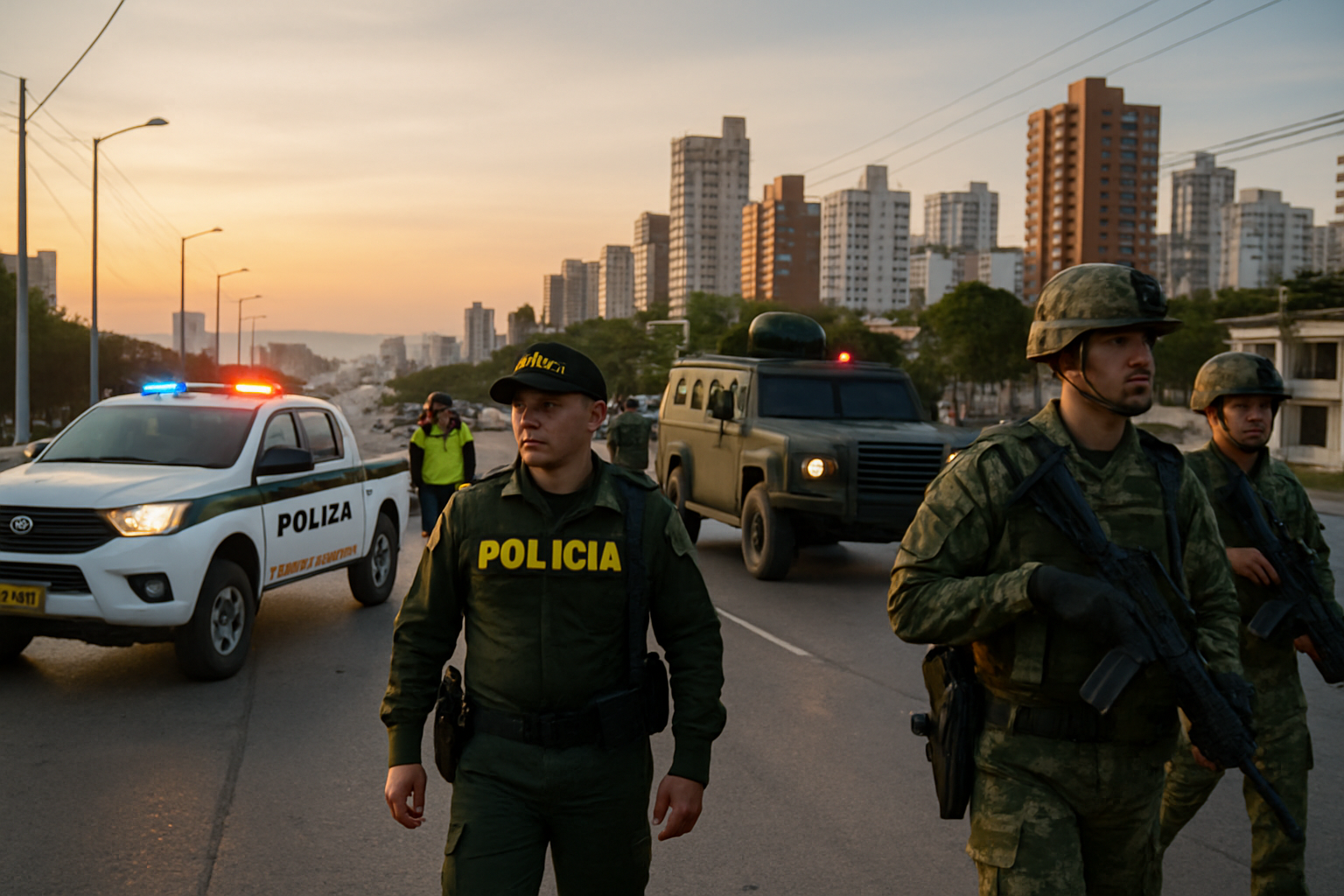
Colombia faces an unprecedented security crisis as multiple violent incidents on March 30, 2026, exposed the sophisticated capabilities of criminal organizations challenging state authority through child abandonment, targeted killings, and advanced drone warfare tactics.
The day's events in Barranquilla, Sucre, and other regions demonstrate how criminal networks have evolved beyond traditional drug trafficking to operate with state-like capabilities, systematically targeting vulnerable populations while exploiting technological advances for territorial control.
Child Abandonment Crisis Reveals Family Terror
In Barranquilla's Niño Jesús Hospital, authorities discovered a heartbreaking case that epitomizes the human cost of Colombia's security breakdown. A young girl was abandoned by her mother, who left behind a handwritten letter confessing she could no longer protect her daughter from sexual abuse by family members.
The manuscript reveals the desperate circumstances forcing Colombian families to make unthinkable choices. "The mother states that the minor could have been abused by family members and asked that they take care of her," according to hospital reports. This incident represents a broader pattern of criminal organizations infiltrating family structures and community networks, creating environments where even blood relatives cannot guarantee safety.
Child protection services report a 40% increase in abandonment cases since early 2026, with many citing fears of recruitment by criminal groups or inability to protect minors from abuse networks operating with apparent impunity in peripheral neighborhoods.
Mistaken Identity Execution Highlights Criminal Confusion
The discovery of a body in rural Galeras, Sucre, initially believed to be Gulf Clan leader Jobadis Ávila Villadiego, known as "Chiquito Malo," instead revealed another criminal operating under the same alias. This case of mistaken identity exposes the complex web of criminal organizations operating across Colombia's territory.
"The maximum leader of the Gulf Clan is Jobadis Ávila Villadiego and has that same alias, but the person in question did not have that same name," authorities confirmed after forensic examination. The incident demonstrates how criminal networks have become so extensive that even law enforcement initially struggles to distinguish between different organizations and their leadership structures.
The Gulf Clan, Colombia's largest criminal organization since the dismantling of the FARC, controls vast territories across the Caribbean coast and maintains sophisticated intelligence networks that often surpass state capabilities in remote regions. The confusion over identity reflects the organization's compartmentalized structure designed to protect leadership through multiple layers of operatives using shared aliases.
Football Star Assassination Shocks Community
The targeted killing of Juan Esteban Osorio, a promising young footballer in Barcelona, Quindío, represents criminal organizations' calculated strategy to terrorize communities through attacks on positive role models. Security footage captured the precise moment when sicarios murdered the athlete, demonstrating the brazen nature of contemporary criminal operations.
"The young footballer was identified as Juan Esteban Osorio, a young man who stood out in the local environment for his performance in sports," police reports confirmed. The public execution sends a clear message about criminal control over territories where even talented youth pursuing legitimate careers face systematic targeting.
Sports figures increasingly find themselves caught between rival criminal factions seeking to demonstrate territorial dominance. The assassination pattern reflects criminal organizations' understanding that eliminating community leaders and positive influences creates the social vacuum necessary for their operations to flourish without resistance.
Drone Warfare Escalation Against Security Forces
Perhaps most concerning is the deployment of explosive drones against civilian populations in Arenal del Sur, Bolívar, representing a dangerous technological escalation in criminal warfare capabilities. The attack injured civilians and destroyed multiple homes while apparently targeting a police station.
"After the detonations, National Army units based in Santa Rosa del Sur moved to Arenal to reinforce security," military sources confirmed. The use of drone technology marks a watershed moment in Colombia's security crisis, as criminal organizations now possess military-grade capabilities previously associated only with state actors or terrorist organizations.
The drone attacks follow a documented pattern of technological sophistication among Colombian criminal groups, including advanced surveillance systems, encrypted communications networks, and coordinated operations spanning multiple regions simultaneously. Security analysts describe this evolution as representing "state-like capabilities" that challenge traditional law enforcement approaches.
Historical Context: From Peace Process to Security Crisis
These incidents occur within the broader context of Colombia's deteriorating security situation since early 2026. The country has experienced systematic targeting of democratic institutions, including the February assassination attempt on President Gustavo Petro and the kidnapping of Senator Aida Quilcué.
Criminal organizations demonstrate unprecedented coordination and intelligence capabilities. The "Total Peace" negotiations, designed to bring remaining armed groups into legal political participation, face increasing challenges as some factions reject dialogue in favor of territorial expansion and criminal entrepreneurship.
The geographical distribution of March 30 incidents—spanning the Caribbean coast, Andean regions, and Pacific corridors—illustrates how criminal networks operate as parallel governance structures across Colombia's diverse territory. Each incident represents different aspects of their sophisticated operations: psychological warfare through child targeting, territorial disputes over drug routes, elimination of community leaders, and direct confrontation with state forces using advanced technology.
International Implications and Regional Security
Colombia's crisis extends beyond national boundaries, affecting regional stability and international cooperation frameworks. The country serves as a critical laboratory for understanding how democratic institutions respond to criminal organizations possessing state-like capabilities.
Recent international cooperation initiatives, including enhanced intelligence sharing with the United States and regional security partnerships, provide templates for addressing transnational organized crime. However, the sophistication demonstrated in March 30 incidents suggests that traditional law enforcement approaches require fundamental reassessment.
The use of drone technology by criminal organizations particularly concerns international security experts, as it represents a threshold crossing toward asymmetric warfare tactics that could influence criminal behavior globally. Commercial drone technology, readily available worldwide, becomes weaponized through modification techniques that circumvent traditional security protocols.
Government Response and Institutional Challenges
Colombian authorities face the complex challenge of maintaining democratic governance while responding to organizations that operate with military-grade capabilities. Enhanced security protocols have been implemented, but criminal evolution consistently outpaces institutional adaptation, particularly in peripheral regions with limited state presence.
The government maintains its commitment to peace negotiations while simultaneously implementing enhanced security measures. This dual approach reflects the complexity of addressing criminal organizations that emerge from different historical contexts—some connected to traditional armed conflict, others representing pure criminal entrepreneurship exploiting weak governance structures.
Success requires sustained political commitment, adequate specialized resources, and comprehensive strategies that address the root causes enabling criminal territorial control. International observers describe Colombia's institutional response as a critical test of democratic resilience against sophisticated transnational threats.
Looking Forward: Prevention and Community Impact
The human cost extends far beyond direct victims, affecting entire communities forced to alter daily routines, educational institutions implementing security protocols, and families reconsidering basic activities like children's sports participation. The psychological impact creates long-term trauma that criminal organizations exploit for territorial control through intimidation.
Prevention strategies require comprehensive approaches beyond reactive law enforcement: community engagement, educational programs, economic development opportunities, and early intervention addressing underlying conditions that enable criminal recruitment. Technology integration must balance enhanced enforcement capabilities with preservation of civil liberties and democratic oversight.
March 30, 2026, represents a critical juncture for Colombia's security strategy. The convergence of child abandonment, targeted assassinations, mistaken identity killings, and drone warfare within a single day illustrates the multifaceted nature of contemporary criminal challenges requiring coordinated responses that maintain democratic values while addressing unprecedented threats to public safety and institutional authority.