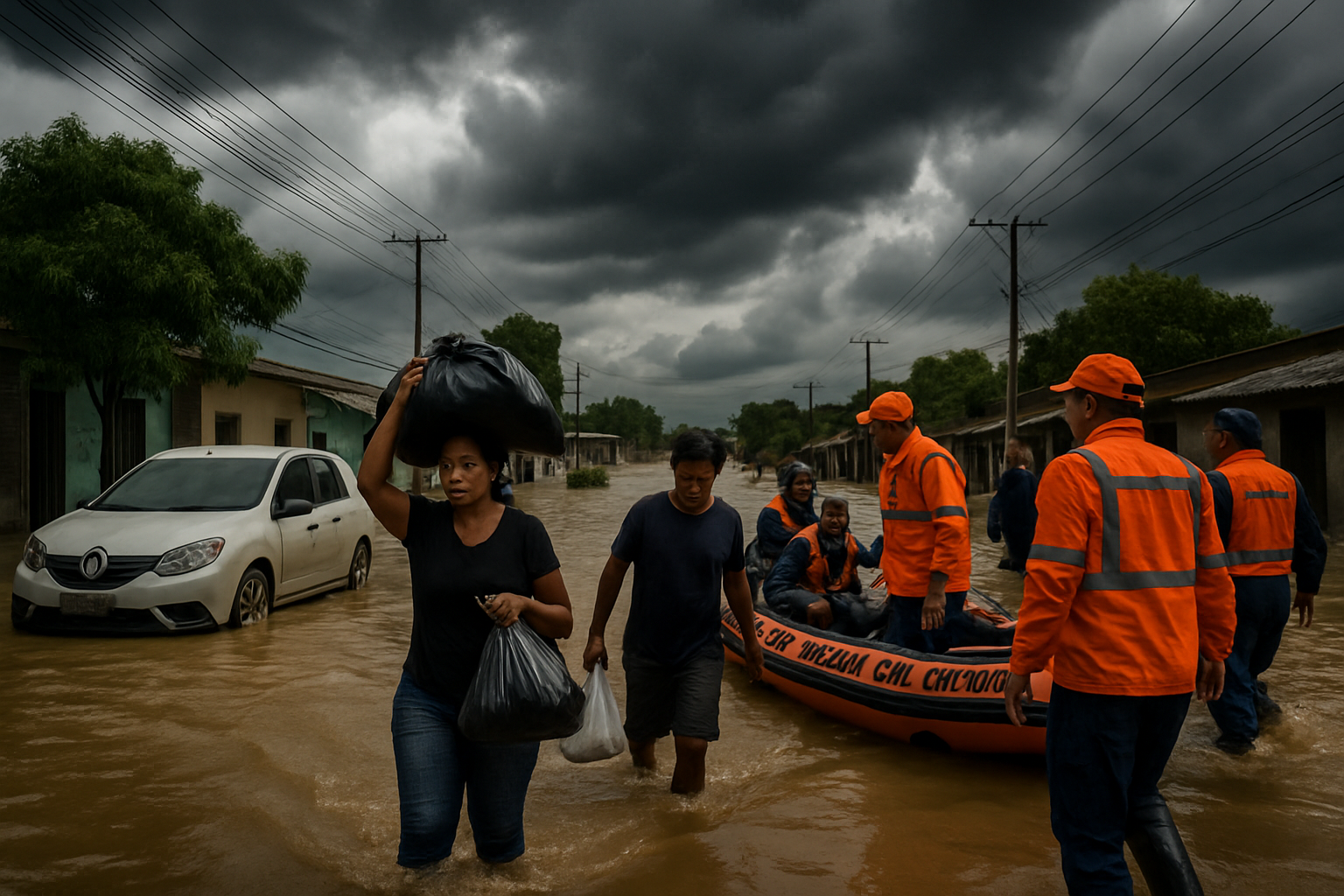
Colombia faces its most severe flooding crisis in recent memory as devastating rains in the Córdoba region have claimed at least 22 lives and affected more than 120,000 people, overwhelming emergency services and prompting desperate calls for enhanced government intervention.
The unprecedented flooding crisis, which has been developing since late January 2026, has transformed the Caribbean coastal region into a disaster zone, with over 77,000 families across 24 municipalities struggling to survive as water levels continue to rise throughout the department.
Emergency Response Under Strain
Emergency response officials are conducting mass assistance programs across three strategic points in Montería, the capital of Córdoba, as the scale of the disaster has overwhelmed local capabilities. The Colombian National Registry office has announced free identity document services for flood victims, hoping to provide essential documentation for those who have lost everything to the rising waters.
The human toll continues to mount as rescue operations struggle against the relentless flooding. Local officials report that many residents only evacuate "when they have water up to their necks," illustrating the desperate circumstances forcing families from their homes throughout the affected region.
Government Response and Criticism
The crisis has exposed significant tensions between local and national government response efforts, with Córdoba's risk management coordinator expressing visible frustration at the scale of devastation during emotional public appearances.
Carlos Carrillo, Director of the National Unit for Disaster Risk Management (UNGRD), has defended the national government's emergency response while acknowledging critical infrastructure failures. "Urrá must respond," Carrillo stated, pointing to the Urrá dam's role in exacerbating flooding conditions through water releases that have added 2,500 cubic meters per second to the Sinú River flow.
The Urrá hydroelectric dam has become a focal point of controversy, with authorities confirming discharge rates of 1,600 cubic meters per second into the already swollen Sinú River system. This has led to declarations of public calamity across Córdoba as mass evacuations continue throughout the affected areas.
Presidential Response Under Scrutiny
Questions surrounding President Gustavo Petro's presence during the crisis have intensified public frustration. The emergency occurred just days after Petro's historic February 3 meeting with U.S. President Donald Trump, where the two leaders discussed counter-narcotics cooperation and regional security challenges.
The timing has drawn criticism from opposition voices questioning the government's emergency preparedness and response coordination, particularly given the scale of the humanitarian disaster unfolding in one of Colombia's most vulnerable regions.
Infrastructure and Historical Context
The current flooding crisis builds upon Colombia's ongoing struggle with extreme weather events that have repeatedly devastated Caribbean coastal regions. The disaster occurs within the broader context of unprecedented global climate conditions, with January 2026 confirmed as one of the hottest months in recorded history.
Previous flooding events in the region killed 14 people and destroyed approximately 9,000 homes, affecting around 50,000 families across Córdoba and neighboring Sucre departments. The recurring nature of these disasters has highlighted critical infrastructure vulnerabilities and the urgent need for comprehensive flood management systems.
The Mulatos River bridge collapse in early February, caused by sudden flooding between the Urabá and Montería corridor, demonstrates the cascading infrastructure failures that compound emergency response challenges throughout the region.
Regional Government Support
Valle del Cauca Governor Dilian Francisca Toro has proposed using unexecuted national budget resources to address the mounting crisis, suggesting administrative solutions that could accelerate emergency response funding during this critical period.
Her proposal reflects growing pressure on the national government to utilize all available fiscal mechanisms to address the humanitarian emergency, as traditional disaster response funding appears insufficient for the scale of the current crisis.
Humanitarian Impact
The flooding has created a massive displacement crisis, with entire communities forced to abandon their homes as water levels continue rising throughout the region. Emergency shelters are operating at capacity while rescue teams work around the clock to evacuate trapped residents from isolated areas.
Essential services including electricity, water supply, and communications networks have been severely disrupted across the affected municipalities. Transportation infrastructure has collapsed, hampering both rescue operations and the delivery of humanitarian aid to the most affected communities.
The agricultural sector, which forms the backbone of Córdoba's economy, faces devastating losses with crops destroyed and livestock operations severely impacted by the prolonged flooding.
Climate Change Context
The crisis unfolds against the backdrop of extreme global weather patterns that have characterized early 2026. January was confirmed as the hottest month in recorded history, with 18 of the past 19 months exceeding 1.5°C above pre-industrial levels, demonstrating how global warming is intensifying regional weather extremes.
Colombia's Caribbean coast has experienced a pattern of increasingly severe flooding events, with climate scientists warning that warming ocean temperatures and disrupted atmospheric patterns are creating conditions for more frequent and intense precipitation events in the region.
Recovery and Future Challenges
Recovery efforts are expected to require months of coordinated intervention, with billions of pesos needed for infrastructure reconstruction and community rehabilitation. The repeated nature of flooding disasters in the region has raised urgent questions about long-term adaptation strategies and the need for enhanced flood defense systems.
Emergency response officials acknowledge that current disaster management capabilities are being tested to their limits, highlighting the need for significant investment in both immediate response capacity and long-term climate resilience infrastructure.
The crisis provides a stark illustration of Colombia's vulnerability to climate-related disasters and the urgent need for comprehensive adaptation strategies that address both immediate emergency response and long-term community resilience in the face of increasingly volatile weather patterns.
As rescue operations continue and the full scope of the disaster becomes clear, the Colombian government faces mounting pressure to demonstrate effective crisis management while developing sustainable solutions for a region that has repeatedly borne the brunt of extreme weather events.