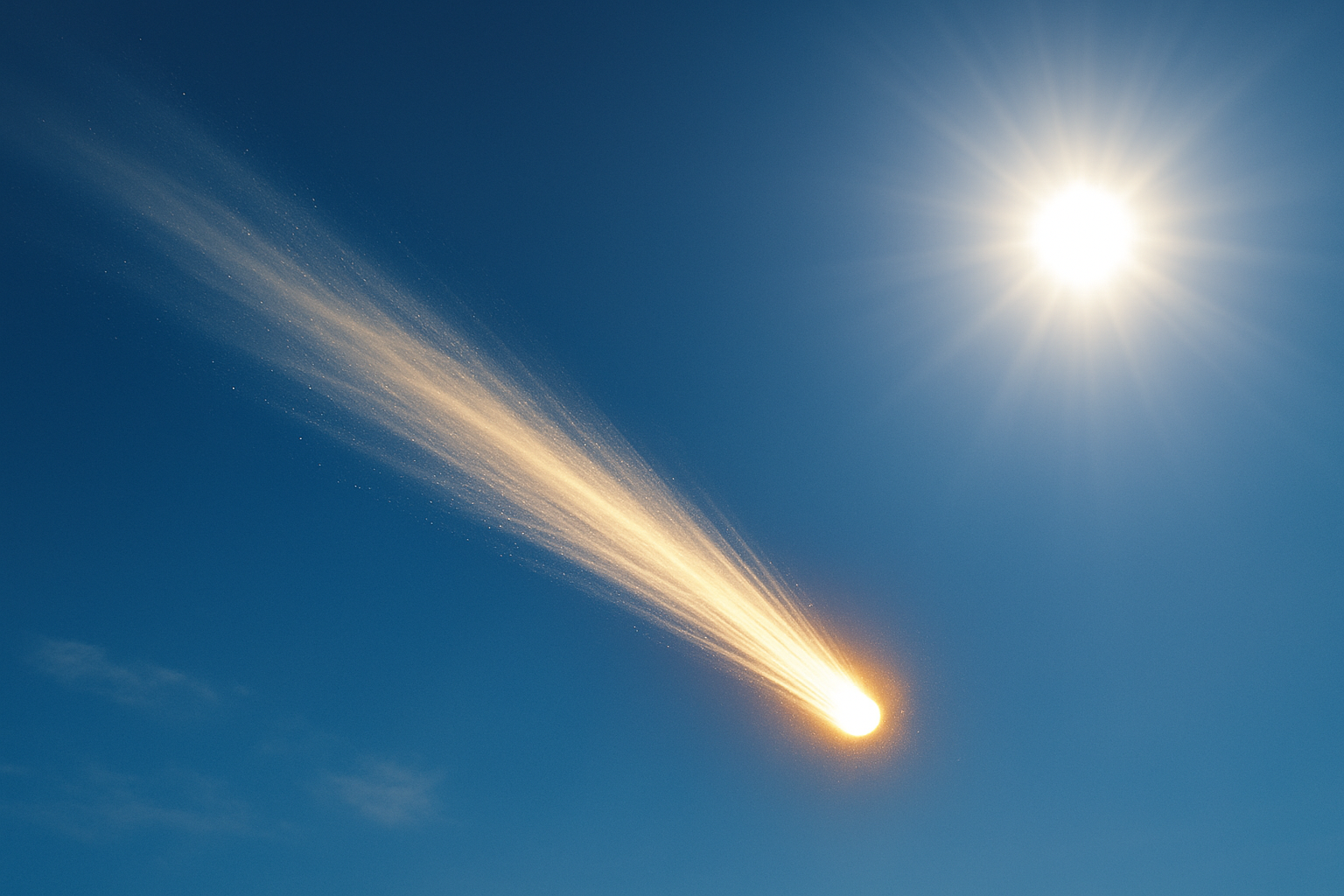
A rare comet designated C/2026 A1 (MAPS) is generating unprecedented excitement among astronomers and skywatchers worldwide as it approaches what may be a spectacular finale - potential visibility in broad daylight before plunging into the Sun on April 4, 2026.
Scientists from the Space Research Institute of the Russian Academy of Sciences and the Institute of Solar-Terrestrial Physics of the Siberian Branch of the Russian Academy of Sciences have confirmed that this exceptional celestial visitor may become visible to the naked eye several days before its ultimate solar encounter, possibly even during daytime hours - a phenomenon that occurs only with the brightest comets in astronomical history.
A Member of the Elite Kreutz Sungrazer Family
Comet C/2026 A1, carrying the designation "MAPS," belongs to the rare and dramatic Kreutz sungrazer family - a group of comets that follow collision courses with the Sun rather than traditional elliptical orbits. These ancient visitors represent some of the most spectacular astronomical events observable from Earth, combining scientific intrigue with breathtaking visual displays.
As the comet approaches its perihelion (closest point to the Sun), the intense solar radiation will trigger accelerated sublimation of its nucleus, creating the characteristic glowing coma and potentially visible tail that makes naked-eye observation possible. Unlike typical comets that maintain safe distances from our star, sungrazers venture into the Sun's outer atmosphere, creating extraordinary brightness levels that can rival or even exceed the brightest stars.
Historical Context of Daytime Comet Visibility
The potential for daytime visibility places C/2026 A1 among the most distinguished comets in recorded history. The most famous precedent remains Comet Ikeya-Seki in 1965, which became so brilliant that it was clearly visible in broad daylight, captivating millions of observers worldwide and providing valuable scientific data about comet composition and behavior under extreme solar conditions.
Such events are extraordinarily rare, typically occurring only once every few decades or even centuries. The combination of the comet's trajectory, composition, and timing creates a perfect storm of conditions necessary for this remarkable phenomenon. Historical records show that daytime-visible comets have often been interpreted as significant omens across cultures, though modern science allows us to appreciate them purely for their astronomical significance.
Scientific Research Opportunities
The approach of C/2026 A1 occurs during what astronomers are calling the "golden age of space observation," characterized by unprecedented international cooperation and advanced technological capabilities. The James Webb Space Telescope, ground-based observatories worldwide, and sophisticated spectroscopic analysis equipment are being coordinated to capture comprehensive data about this sungrazer's final journey.
Research teams are particularly interested in studying the comet's composition and behavior as it encounters extreme solar radiation and solar wind interactions. These conditions provide unique insights into early solar system formation processes and the dynamic relationship between ancient outer solar system objects and stellar radiation. The data collected will contribute significantly to our understanding of planetary body development and cosmic evolution over billions of years.
Optimal Viewing Conditions and Public Accessibility
For potential observers, the viewing window will be limited but potentially spectacular. Naked-eye visibility is expected to develop as the comet's nucleus becomes increasingly active, developing a bright coma and potentially visible tail structure. The intensity of the display will depend on the comet's composition, size, and the exact trajectory of its solar approach.
Optimal viewing conditions will require clear skies and, for the brightest phases, may not require the complete darkness typically necessary for comet observation. Rural areas with minimal light pollution will provide the best viewing opportunities, though the potential daytime visibility means urban observers may also witness this rare phenomenon.
The democratization of astronomical observation through consumer technology represents another remarkable aspect of this event. NASA has recently certified smartphones for astronomical photography, and advanced mobile applications provide precise timing and location guidance for optimal viewing. This technological accessibility means that C/2026 A1 could become the most thoroughly documented comet in history through worldwide citizen scientist participation.
International Cooperation and Technological Integration
The scientific response to C/2026 A1 exemplifies the marriage of cutting-edge professional instruments with grassroots observation efforts. Professional astronomers are coordinating observations across multiple time zones and wavelengths, while astronomy enthusiasts worldwide are preparing to document the event using everything from traditional telescopes to smartphone cameras.
This integration of professional and citizen science reflects the broader transformation occurring in astronomy, where advanced technology enables global participation in cosmic discovery. The event provides an opportunity to engage millions of people in direct astronomical observation while contributing to legitimate scientific research through coordinated data collection.
The Broader Context of 2026's Astronomical Renaissance
C/2026 A1's approach occurs during an extraordinary period of cosmic discovery and space exploration advancement. The year 2026 has already featured remarkable astronomical events, including February's six-planet alignment, March's total lunar eclipse, and numerous groundbreaking discoveries about stellar formation, planetary systems, and cosmic chemistry.
This convergence of natural cosmic phenomena with advanced human observation capabilities represents a unique moment in astronomical history. The combination of predictable celestial mechanics with cutting-edge technology and international cooperation establishes 2026 as a watershed year for both professional astronomy and public engagement with space science.
Safety and Observation Guidelines
Unlike solar eclipses, comet observation is completely safe for direct viewing with the naked eye throughout all phases of visibility. No special equipment or protective measures are required, making the event accessible to observers of all ages and experience levels. Enhanced viewing is possible with binoculars or small telescopes, which can reveal surface details and color variations not visible to the unaided eye.
Weather preparation will be crucial for the limited viewing window, particularly given the unpredictability of spring conditions in many regions. Astronomers recommend identifying multiple potential viewing locations and monitoring weather forecasts closely as the peak visibility period approaches.
Scientific Legacy and Future Implications
The scientific knowledge gained from observing C/2026 A1's final journey will contribute to ongoing understanding of these ancient messengers from the outer reaches of our solar system. The comprehensive data collection effort validates international cooperation frameworks and demonstrates the successful integration of traditional astronomical methods with cutting-edge technology.
Research findings will inform future comet studies, enhance our understanding of solar system dynamics, and contribute to the broader search for life-supporting conditions throughout the cosmos. The event also provides practical experience in coordinating global astronomical observation campaigns, skills that will prove valuable for future cosmic phenomena and potential planetary defense scenarios.
A Celestial Finale Approaching
As C/2026 A1 continues its inexorable journey toward the Sun, astronomers and skywatchers worldwide are preparing for what may be one of the most spectacular astronomical events in recent memory. The potential for daytime visibility transforms this from a specialized astronomical event into a shared human experience that could inspire millions to look up and contemplate our place in the cosmic order.
Whether C/2026 A1 achieves the ultimate brightness necessary for daytime visibility remains to be confirmed through continued observation. However, the comet's classification as a Kreutz sungrazer and its current trajectory suggest that April 2026 may provide one of those rare moments when the cosmos offers a truly unforgettable celestial spectacle visible to anyone with clear skies and the knowledge to look up at the right moment.
For astronomy enthusiasts and casual observers alike, C/2026 A1 represents more than just a scientific curiosity - it embodies the continuing wonder and unpredictability of our cosmic neighborhood, reminding us that despite our technological advancement, we remain witnesses to ancient celestial dramas that have been unfolding for billions of years across the vast theater of space.