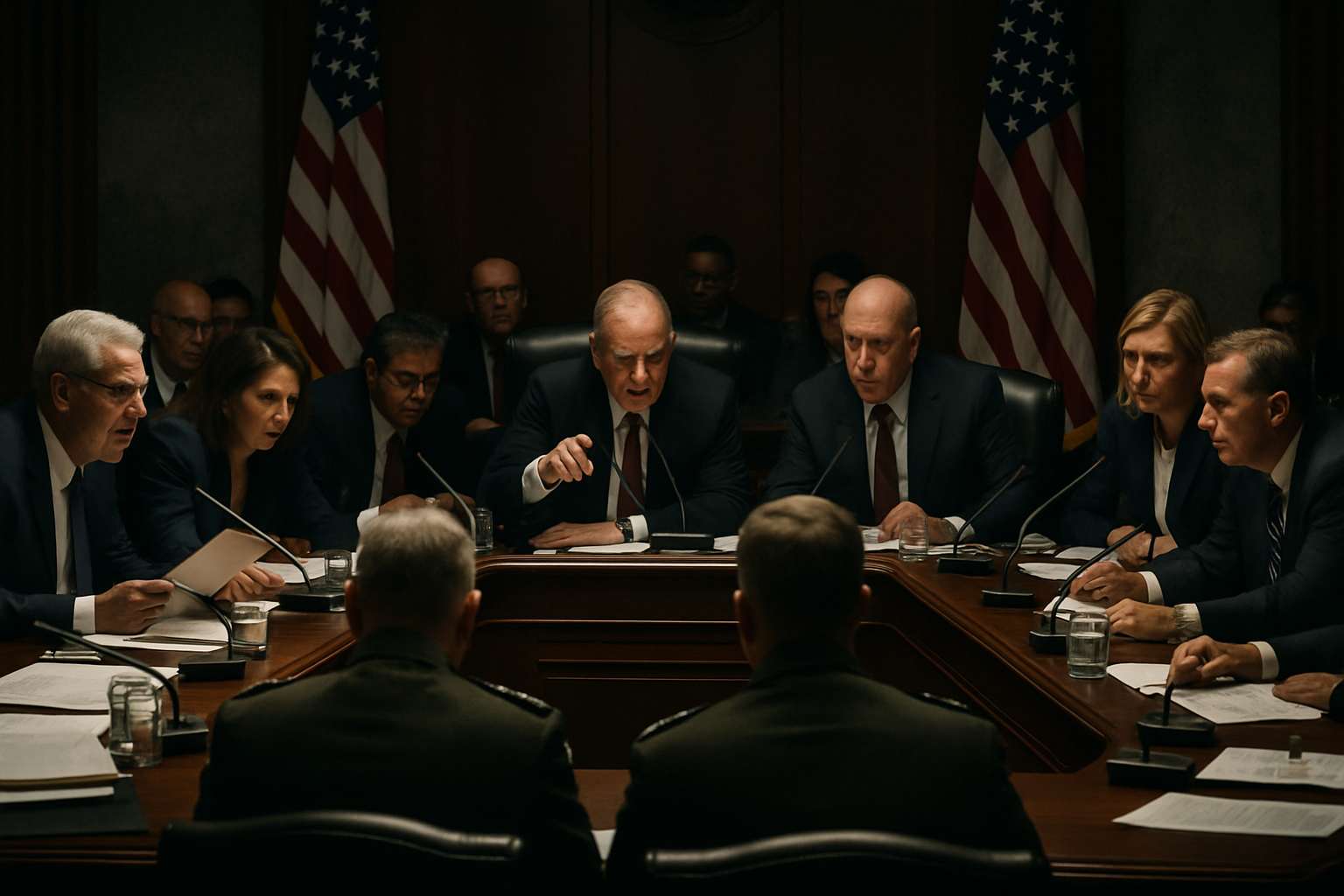
Congressional leaders from both parties are demanding immediate answers about President Trump's Iran war strategy and its escalating costs, as tensions flare over the administration's shifting justifications for military action that has already claimed American lives and disrupted global energy markets.
The intense congressional scrutiny comes as Trump's "Operation Epic Fury" - the largest coordinated US-Israeli military operation since the 2003 Iraq invasion - has fundamentally transformed Middle Eastern geopolitics following the confirmed death of Iran's Supreme Leader Ali Khamenei and triggered massive Iranian retaliation across the region.
Bipartisan Congressional Concerns Mount
Democratic senators voiced alarm after classified briefings on the US-Israeli war with Iran, with multiple lawmakers expressing fears about potential "boots on the ground" deployment. Senator Richard Blumenthal stated he was "more concerned than ever" following closed-door administration briefings about the conflict's trajectory.
The questioning intensified as Trump officials made their case at the Capitol during a second day of closed-door briefings, with lawmakers demanding clarity on the administration's exit strategy, cost projections, and the risk of expanded military commitment.
"Even in the most controversial wars, like Iraq, when the war initiates, people tend to rally around the flag... this is remarkable that at the very beginning of the war there's overwhelming opposition not only from liberals and the left, but much of Trump's base as well."
— Stephen Zunes, Professor of Politics, University of San Francisco
The unpopularity of the Iran conflict has proven "almost unprecedented" this early in military operations, according to Middle East experts, with opposition spanning traditional political divisions.
Financial Markets as Ultimate Constraint
The Trump administration has repeatedly pointed to financial market success when challenged on various policy fronts, from inflation and tariffs to immigration. However, analysts suggest markets could serve as the "ultimate constraint" on the Iran conflict as global aviation disruptions and energy security concerns mount.
Oil prices have surged over $80 per barrel - a 10% increase - as Iran effectively shut down the Strait of Hormuz, the critical shipping route handling 40% of global oil transit. The energy crisis has caused natural gas prices to spike 24% in Europe and 78% in the United States, with widespread supply chain disruptions extending far beyond the Middle East.
Operation Epic Fury: Scale and Consequences
The military operation, utilizing an unprecedented dual-carrier deployment of the USS Gerald R. Ford and USS Abraham Lincoln - representing approximately one-third of the active US Navy fleet - has achieved significant tactical objectives while triggering severe regional retaliation.
Confirmed Iranian leadership casualties include Defense Minister Nasirzadeh, IRGC Chief Pakpour, senior aide Shamkhani, and over 40 high-ranking officials. The operation also resulted in family casualties, including Khamenei's daughter, son-in-law, and granddaughter, marking a significant escalation in targeting leadership circles.
However, Iranian retaliation through "Operation True Promise 4" has caused civilian casualties across Gulf allies, including one civilian killed in Abu Dhabi, injuries at Kuwait Airport from drone strikes, and eight wounded in Qatar despite successful missile interceptions.
Domestic Political Tensions
The administration faces internal scrutiny as well, with notably intense criticism directed at Secretary of Homeland Security Kristi Noem during Senate hearings. Republican Senator Thom Tillis demanded Noem's resignation over what he described as "disastrous leadership," threatening to bring the Trump agenda to a halt over wrongful detentions by Immigration and Customs Enforcement.
Vice President JD Vance maintained unusual silence during the 48-hour Operation Epic Fury period - a notable absence in an administration where praising leadership is typically mandatory, creating internal political speculation about operation support.
Global Diplomatic Consequences
The conflict has severely strained international relationships, with Trump warning Spain over its refusal to support the Iran war. Spanish Prime Minister Pedro Sanchez rejected the joint military action, arguing it "contributes to a more uncertain and hostile international order." Trump threatened to "cut off all trade with Spain" while also calling the UK "a reluctant partner."
Canadian Prime Minister Mark Carney stated his support for the US attack "comes amid a failure of the international order" but emphasized it was "not a blank cheque," reflecting international allies' conditional backing.
Nuclear Diplomacy Collapse
The military escalation followed the complete breakdown of nuclear negotiations despite achieving what Iranian Foreign Minister Abbas Araghchi called "broad agreement on guiding principles" - the most significant diplomatic progress since the JCPOA collapse in 2018.
The fundamental scope disagreement proved insurmountable: Iran excluded ballistic missiles and regional proxies as "red lines" from nuclear-only talks, while US Secretary of State Marco Rubio insisted on comprehensive agreements addressing missiles, armed groups, and human rights.
Iran continued enriching uranium at 60% purity - approaching the 90% weapons-grade threshold - with intelligence confirming sufficient material for multiple weapons if weaponized.
Humanitarian Crisis and War Crimes Concerns
International human rights organizations are demanding Geneva Conventions investigations following the tragic strike on Minab elementary school that killed between 53-85 students and staff during regular school hours. Images of children's backpacks and schoolbooks in rubble have become symbols of the diplomatic failure's human cost.
Iranian President Pezeshkian condemned what he termed a "barbaric crime," while international legal experts raise questions about targeting civilian infrastructure during military operations.
Economic and Energy Security Implications
The global aviation crisis has proven unprecedented, with Iran, Iraq, Israel, UAE, Qatar, Syria, Kuwait, and Bahrain simultaneously closing airspace, resulting in over 18,000 flight cancellations worldwide - the most extensive disruption since COVID-19.
Major international carriers including Emirates, Air France-KLM, Wizz Air, and Bulgaria Air have suspended Middle East operations, severely compromising the region's role as a critical Europe-Asia connecting hub and affecting hundreds of thousands of passengers globally.
Constitutional Succession Crisis in Iran
Following Khamenei's confirmed death, Iran has activated a three-member transitional council comprising President Pezeshkian, judiciary head Mohseni Ejei, and a Guardian Council jurist, as mandated by the constitution. The Assembly of Experts - 88 clerics - will select a permanent successor under wartime conditions.
CIA assessments suggest a Revolutionary Guards member is likely to be chosen as the next Supreme Leader, indicating potential hardline military influence in Iran's future governance structure.
International Governance Crisis Context
The Iran crisis occurs amid broader nuclear governance challenges, including the February 5 expiration of the New START treaty - the first time in over 50 years without US-Russia nuclear constraints - and China's nuclear expansion program.
UN Secretary-General António Guterres has warned that nuclear risks are at their "highest in decades," with the Iran conflict representing a template-setting moment for 21st-century diplomacy versus military confrontation approaches.
Congressional Oversight Intensifies
Lawmakers are now demanding comprehensive briefings on the administration's long-term strategy, cost projections, and exit plans. Questions mount over whether the initial military success can translate into sustainable political outcomes without significant ground troop deployment.
The administration's shifting rationale for the conflict - from nuclear threat prevention to explicit regime change advocacy - has created additional scrutiny over mission scope and objectives.
As Trump declared the situation represents the "single greatest chance for the Iranian people to take back their country," Congress faces the critical task of overseeing an operation that has fundamentally altered Middle Eastern geopolitics while raising profound questions about the limits of executive military authority.
The coming weeks will prove decisive as lawmakers demand accountability for decisions that have transformed regional security architecture and created global economic disruptions extending far beyond the immediate theater of operations.