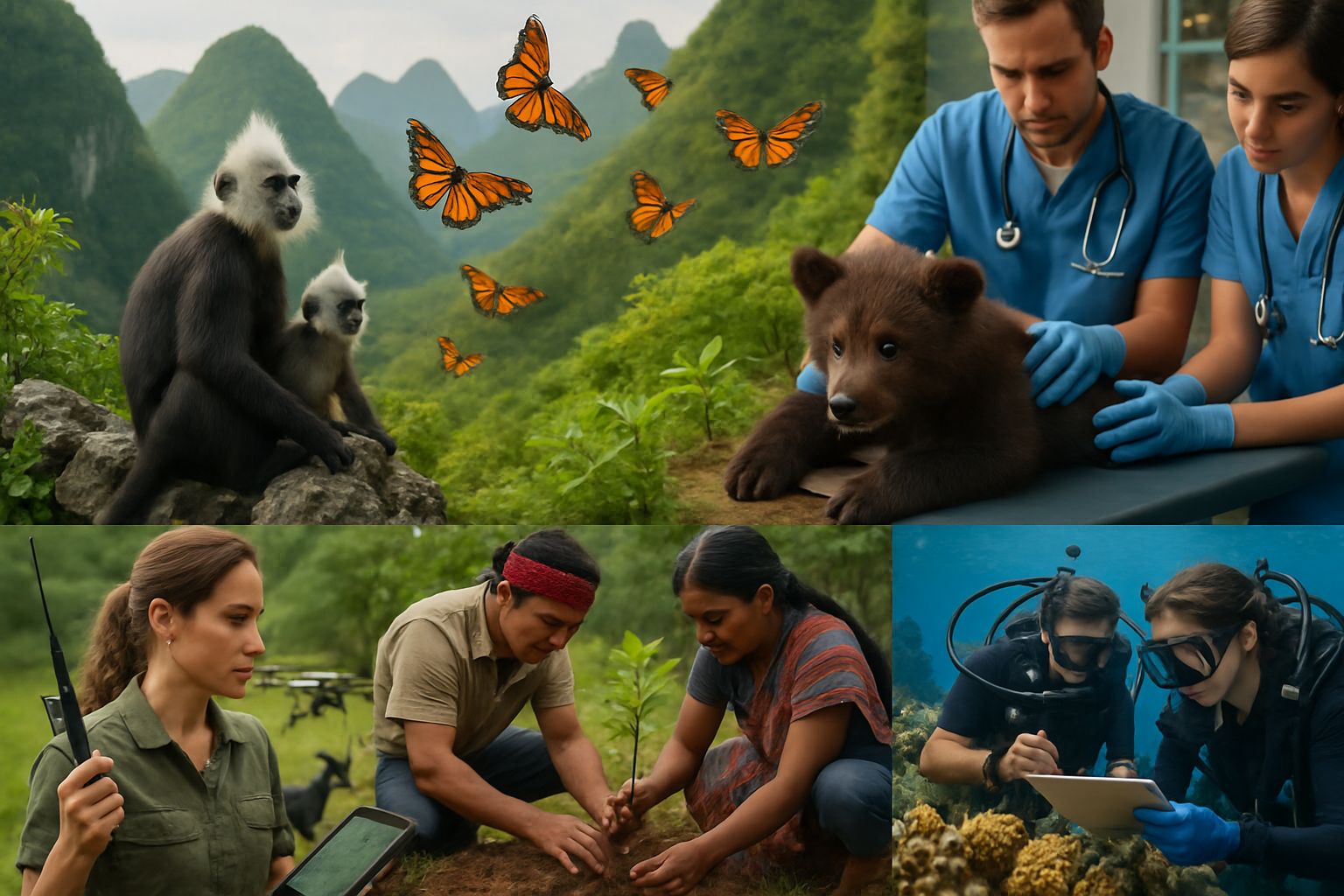
A global conservation renaissance is transforming wildlife protection efforts worldwide as breakthrough species recovery programs demonstrate unprecedented success amid mounting climate pressures, with remarkable achievements spanning from Chinese mountain forests to North American butterfly migrations and Canadian wildlife refuges.
Three groundbreaking conservation initiatives across Canada, Qatar, and Slovenia showcase the evolution of modern wildlife protection, combining cutting-edge technology with traditional ecological knowledge to achieve extraordinary results during the 21st consecutive month of global temperatures exceeding 1.5°C above pre-industrial levels.
China's White-Headed Langur Recovery Miracle
In one of the most successful primate conservation programs in recent history, the critically endangered white-headed langur population has increased from just over 300 individuals in the 1980s to more than 1,400 across 130 groups today through decades of careful conservation efforts in China's Guangxi Chongzuo White-headed Langur National Nature Reserve.
This remarkable recovery exemplifies the sophisticated integration of modern technology with environmental stewardship. An AI-powered monitoring system now covers more than 20 stations throughout the reserve, logging 37,200 detections of langur activity that provide critical data for research and conservation decisions. To date, conservationists have restored 77.6 hectares of habitat, built 2 drinking water sources and 18 water points for the langurs, and constructed 2 ecological corridors to support population movement and genetic diversity.
"The white-headed langur recovery represents a fundamental shift from reactive crisis management to proactive ecosystem service management," explains Dr. Chen Wei, a primatologist studying the species. "We're not just counting animals – we're rebuilding entire forest ecosystems."
Monarch Butterfly Population Surge Defies Predictions
In a stunning reversal of decades-long decline, Mexico's monarch butterfly population surged 64 percent this winter, providing hope for one of North America's most iconic migratory species. The dramatic increase comes as conservationists worldwide implement innovative habitat restoration programs and migration corridor protection initiatives.
Environmental scientists attribute the population surge to coordinated international conservation efforts spanning the monarchs' entire migration route from Canada to Mexico, including enhanced habitat protection in overwintering sites and restoration of milkweed breeding areas throughout the United States. The recovery demonstrates how comprehensive, landscape-scale conservation approaches can yield remarkable results even for species facing multiple threats.
"This monarch butterfly recovery shows what's possible when we think beyond borders and work together across the entire lifecycle of a species."
— Dr. María González, Monarch Conservation Alliance
Canada's Bear Cub Rescue Showcases Community Conservation
The Northern Lights Wildlife Society in British Columbia continues its vital work rescuing and rehabilitating orphaned wildlife, recently saving an abandoned bear cub near Kamloops. Co-founder Angelika Langen describes the moment of rescue as emblematic of the broader conservation movement, where community-based wildlife protection provides critical safety nets for vulnerable animals.
The rescue operation demonstrates the evolution of wildlife conservation from government-led initiatives to comprehensive community engagement programs. Advanced veterinary protocols, specialized nutrition programs, and behavioral conditioning prepare rescued animals for successful return to wild habitats.
Technology-Tradition Integration Drives Success
These conservation victories share a common thread: the sophisticated integration of cutting-edge technology with traditional ecological knowledge and community-based management. Environmental DNA sampling, satellite monitoring, AI-powered threat detection, and GPS tracking systems provide unprecedented capabilities for species monitoring and habitat assessment.
However, maximum effectiveness is achieved when these technological tools are combined with generations of traditional knowledge and community stewardship practices. Indigenous communities, local conservation groups, and traditional ecological practitioners provide crucial insights that guide successful protection strategies.

Conservation as Economic Development Strategy
These conservation programs increasingly demonstrate that environmental protection functions as an economic development strategy rather than a regulatory burden. Countries and regions implementing comprehensive wildlife protection show greater economic resilience and attract sustainable investment across multiple sectors.
Economic benefits extend far beyond direct eco-tourism revenue. Ecosystem services provided by protected wildlife and habitats – including water purification, carbon sequestration, and climate regulation – support agricultural productivity, reduce infrastructure costs through natural disaster prevention, and enhance international competitiveness through environmental credentials.
- China's langur conservation supports regional eco-tourism and attracts international research partnerships
- Monarch butterfly protection generates substantial nature-based tourism revenue across North America
- Canadian wildlife rehabilitation programs create specialized employment and veterinary training opportunities
Climate Crisis Context and Adaptive Management
These conservation successes emerge during an unprecedented period of environmental stress. January 2026 was confirmed as the hottest month in recorded history, extending a streak of 21 consecutive months with temperatures exceeding critical thresholds. This sustained warming has completely overridden natural climate variability, including La Niña cooling effects.
The climate crisis creates compound environmental effects that traditional conservation approaches struggle to address: rising sea levels threaten coastal ecosystems, changing precipitation patterns affect forest regeneration, increased extreme weather disrupts marine food chains, and wildlife migration patterns developed over millennia are being fundamentally altered.
Successful conservation programs now emphasize adaptive management approaches that can respond rapidly to changing baseline environmental conditions while maintaining long-term sustainability goals.
International Cooperation Framework
These conservation achievements highlight the critical importance of unprecedented international cooperation. Environmental challenges transcend boundaries as ocean currents, atmospheric systems, and species migrations connect ecosystems globally, making unilateral conservation efforts insufficient.
Success depends on coordinated policy frameworks, shared monitoring systems, collaborative enforcement mechanisms, and innovative financing that recognizes the economic value of ecosystem services. Knowledge sharing between conservation programs creates global networks that provide resilience against single-solution dependencies.
"We're seeing a fundamental evolution from North-South aid toward peer-to-peer cooperation, with developing nations emerging as environmental solution providers."
— Dr. James Thompson, International Conservation Union
Implementation Challenges and Solutions
Despite remarkable successes, significant challenges remain for scaling conservation efforts globally. Funding sustainability proves difficult for developing nations where immediate economic pressures often override long-term environmental considerations. Technical capacity building requires sustained investment in education, training, and institutional development.
Climate change compounds these challenges by disrupting project timelines and requiring adaptive management approaches for rapidly changing conditions. However, opportunities include enhanced international partnerships that accelerate technology transfer and innovative financing mechanisms that create economic incentives for protection.
Success Factors for Conservation Programs
Analysis of successful conservation programs reveals consistent factors that enable remarkable results:
- Community ownership and engagement: Local stakeholders must be central partners in conservation planning and implementation
- Transparent governance: Clear accountability mechanisms ensure effective resource allocation and stakeholder trust
- Economic viability: Protection programs must create sustainable economic opportunities for local communities
- Traditional-modern knowledge integration: Combining scientific innovation with cultural wisdom creates robust, culturally sensitive frameworks
Critical Action Window for Global Conservation
March 2026 represents a critical juncture in global environmental protection, with the choice between reactive crisis management and proactive ecosystem service management potentially determining whether conservation efforts can keep pace with accelerating environmental change during this decisive climate action decade.
Environmental scientists warn that the action window for effective conservation is narrowing rapidly as ecological systems approach critical thresholds that could trigger potentially irreversible changes affecting global food security, climate stability, and human settlements.
However, the tools, knowledge, and cooperation frameworks for comprehensive environmental protection already exist, as demonstrated by these diverse international conservation initiatives. Success depends on rapid scaling through enhanced international cooperation, sustained financial commitments, and recognition of environmental protection as essential infrastructure for human prosperity and planetary sustainability.
Future Implications and Scaling Potential
These conservation achievements provide practical templates for scaling environmental protection globally. The white-headed langur recovery offers methodologies for primate conservation across Asia, monarch butterfly programs provide frameworks for protecting migratory species worldwide, and Canadian wildlife rehabilitation creates models for community-based animal care.
Most importantly, these programs demonstrate that effective conservation requires comprehensive approaches addressing multiple challenges simultaneously while building local capacity and fostering international cooperation. The integration of traditional ecological knowledge with modern conservation science creates adaptable frameworks that respect cultural diversity while leveraging global technological capabilities.
"The conservation renaissance of 2026 may prove decisive in determining conservation approaches for decades ahead, potentially marking the turning point where humanity demonstrates its adaptive capacity for protecting the environmental systems that life depends upon."
— Dr. Sarah Mitchell, Global Conservation Alliance
As these remarkable conservation victories demonstrate, the convergence of scientific innovation, community engagement, technological advancement, and international cooperation offers genuine hope for maintaining planetary habitability during Earth's most environmentally challenging period. The window for effective environmental action may be narrowing, but human ingenuity, traditional wisdom, and unprecedented global coordination provide pathways for protecting and restoring the natural systems essential for a sustainable future.