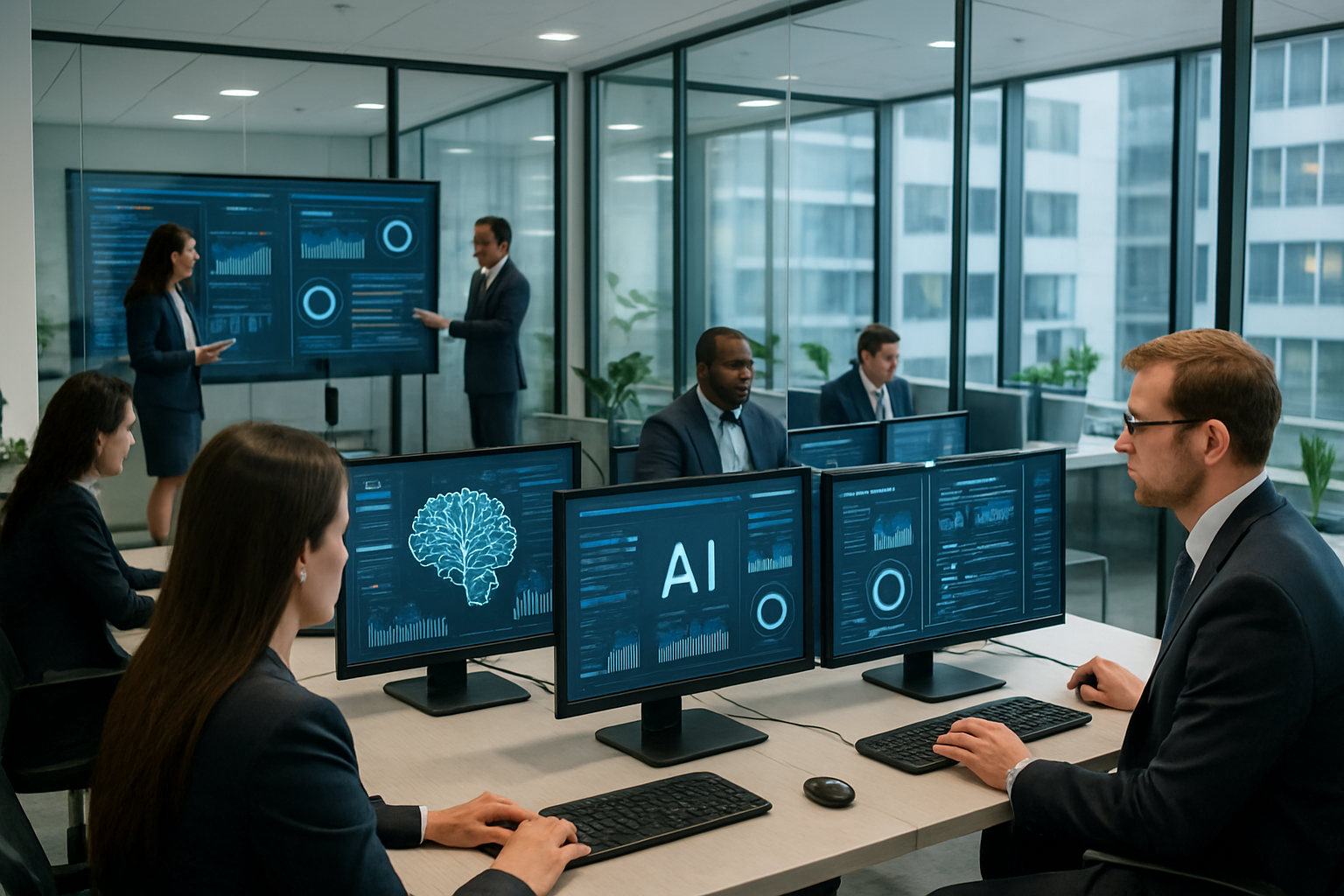
Technology giants including Google, Meta, and major European firms are implementing unprecedented company-wide mandates requiring employees to demonstrate AI proficiency, marking a watershed moment in corporate digital transformation as artificial intelligence transitions from experimental tool to essential workplace infrastructure.
The Austrian news outlet Der Standard reports that this new corporate "AI compulsion" is creating significant pressure across the technology sector, with companies enforcing AI usage throughout operations under the stark directive: "Wer nicht promptet, fliegt" - those who don't prompt, get fired. This development signals a fundamental shift in how major corporations view AI capabilities, moving from optional enhancement to mandatory job requirement.
Government Agencies Pioneer AI-First Operations
The transformation extends beyond private sector companies, with government agencies also embracing comprehensive AI integration. The Netherlands is launching a pioneering initiative with four government agencies and research institute TNO set to trial GPT-NL, a domestically developed AI model created through collaboration between SURF, the Netherlands Forensic Institute (NFI), and TNO.
This Dutch initiative represents a significant step toward AI sovereignty in government operations, demonstrating how public sector organizations are moving to integrate artificial intelligence into critical decision-making processes while maintaining data security and national control over sensitive information systems.
The Scale of Corporate AI Transformation
The scope of this transformation is unprecedented in corporate history. Based on comprehensive analysis from multiple sources documenting the global AI revolution throughout 2026, major technology companies are implementing AI-first policies that affect every aspect of business operations:
- Universal Skills Requirements: All employees, regardless of role, must demonstrate competency with AI tools and workflows
- Operational Integration: AI systems are being embedded into core business processes from customer service to strategic planning
- Performance Metrics: Employee evaluations increasingly include AI utilization and effectiveness measures
- Training Mandates: Companies are investing billions in comprehensive AI education programs for existing workforce
Infrastructure Investment and Market Transformation
The corporate push for AI skills comes amid massive infrastructure investments that underscore the seriousness of this transformation. Alphabet has committed a historic $185 billion for AI infrastructure in 2026 - the largest single-year technology investment in corporate history. Amazon follows with plans exceeding $1 trillion in AI development initiatives.
However, this transformation faces significant challenges. The global semiconductor crisis has driven memory chip prices up sixfold, affecting major manufacturers including Samsung, SK Hynix, and Micron. Consumer electronics costs have increased 20-30% over the past year, with supply shortages expected to persist until 2027 when new fabrication facilities come online.
"The industry is experiencing a fundamental shift from experimental AI applications to essential infrastructure requirements. Companies that fail to adapt risk obsolescence."
— Industry Analysis, Technology Sector Report 2026
The "SaaSpocalypse" and Employment Implications
This corporate AI mandate occurs during what industry analysts term the "SaaSpocalypse" - the elimination of hundreds of billions in market value from traditional software companies as AI systems directly replace conventional software functions. This transformation is creating both opportunities and challenges for the global workforce.
Microsoft's Chief AI Officer Mustafa Suleyman has predicted that AI could replace the majority of office workers within two years, with lawyers and auditors facing automation within 18 months. These predictions underscore why companies are prioritizing AI skills development over traditional software training.
Despite these warnings, successful integration models demonstrate that thoughtful AI implementation can enhance rather than replace human capabilities. Canadian universities have successfully implemented AI teaching assistants while maintaining critical thinking standards. Malaysia operates the world's first AI-integrated Islamic school, combining artificial intelligence with traditional learning approaches.
Regional Variations and Global Competition
The implementation of corporate AI mandates varies significantly across regions, reflecting different approaches to technological transformation and workforce development:
European Approach
European companies are emphasizing regulatory compliance and ethical AI implementation alongside skills development. The Dutch government's GPT-NL initiative exemplifies this approach, prioritizing data sovereignty and security while advancing AI capabilities.
Asian Innovation Models
Asian technology companies are demonstrating alternative approaches to workforce AI integration. Indian IT giants including Infosys, Wipro, and HCL Technologies are managing the transition through comprehensive retraining programs rather than mass layoffs, showing how companies can adapt existing talent rather than replacing workers entirely.
Regulatory Framework Development
The corporate AI transformation is occurring amid intensifying global regulatory oversight. Spain has implemented the world's first criminal executive liability framework for social media platforms, while France has conducted cybercrime raids on AI companies. The United Nations has established an Independent International Scientific Panel with 40 experts to provide the first fully independent global AI impact assessment.
Success Factors for Corporate AI Integration
Analysis of successful AI integration initiatives reveals several critical factors that determine whether corporate AI mandates enhance productivity or create operational disruption:
- Comprehensive Training: Successful companies invest heavily in education programs that build genuine AI literacy rather than superficial familiarity
- Cultural Adaptation: Organizations must adapt AI tools to their specific industry needs and corporate culture rather than implementing generic solutions
- Human-AI Collaboration: The most successful implementations focus on enhancing human capabilities rather than replacing human judgment
- Gradual Implementation: Phased rollouts allow organizations to identify and address challenges while building employee confidence with AI systems
Infrastructure Challenges and Solutions
The global semiconductor shortage presents significant challenges for companies implementing AI-first operations. With memory chip prices having increased sixfold, organizations are developing innovative approaches to maximize AI capabilities within infrastructure constraints:
- Memory-efficient algorithm development
- Cloud-based AI services to reduce local hardware requirements
- Prioritized AI applications focusing on highest-impact use cases
- Strategic partnerships to share infrastructure costs and capabilities
The World Bank projects that AI systems will require 4.2-6.6 billion cubic meters of water annually by 2027 for data center cooling - equivalent to 4-6 times Denmark's annual water consumption. These environmental considerations are driving companies to develop more sustainable AI implementation strategies.
Future Workforce Implications
The enforcement of AI skills as standard employment requirements represents a fundamental shift in workplace expectations. This transformation affects multiple dimensions of professional development:
New Core Competencies
Traditional job descriptions are being rewritten to include AI literacy as a basic requirement. Professionals across industries must now demonstrate competency in:
- AI tool utilization for their specific field
- Understanding AI output quality and limitations
- Integrating AI insights with human judgment
- Continuous learning as AI capabilities evolve
Career Development Pathways
Companies are establishing new career advancement criteria that heavily weight AI proficiency. This shift is creating opportunities for professionals who embrace AI tools while potentially marginalizing those who resist technological adaptation.
Global Economic Impact
The corporate AI skills mandate is contributing to broader economic transformation patterns. China's logistics industry has achieved record efficiency, with total social logistics costs falling to 13.9% of GDP - the lowest on record - largely attributed to rapid AI adoption including delivery drones, supply chain optimization, and predictive analytics.
This productivity gain demonstrates the potential economic benefits of comprehensive AI integration, while also highlighting the competitive pressures facing companies and nations that lag in AI adoption.
Critical Decision Point for Organizations
The year 2026 represents a critical inflection point for corporate AI adoption. Organizations face a fundamental choice between proactive AI integration and reactive adaptation as competitive pressures intensify. The companies implementing comprehensive AI skills mandates today are positioning themselves for sustained competitive advantage, while those delaying risk market obsolescence.
The success of these initiatives depends on balancing innovation acceleration with responsible implementation, ensuring that AI enhances rather than diminishes human creativity and critical thinking. As the technology sector continues its transformation from experimental AI applications to essential infrastructure, the ability to effectively integrate artificial intelligence capabilities throughout organizations will likely determine which companies thrive in the coming decade.
The corporate AI revolution is no longer a future possibility but a present reality reshaping how businesses operate, compete, and grow. For professionals and organizations worldwide, developing AI competency has become not just advantageous but essential for continued relevance in an increasingly AI-powered global economy.