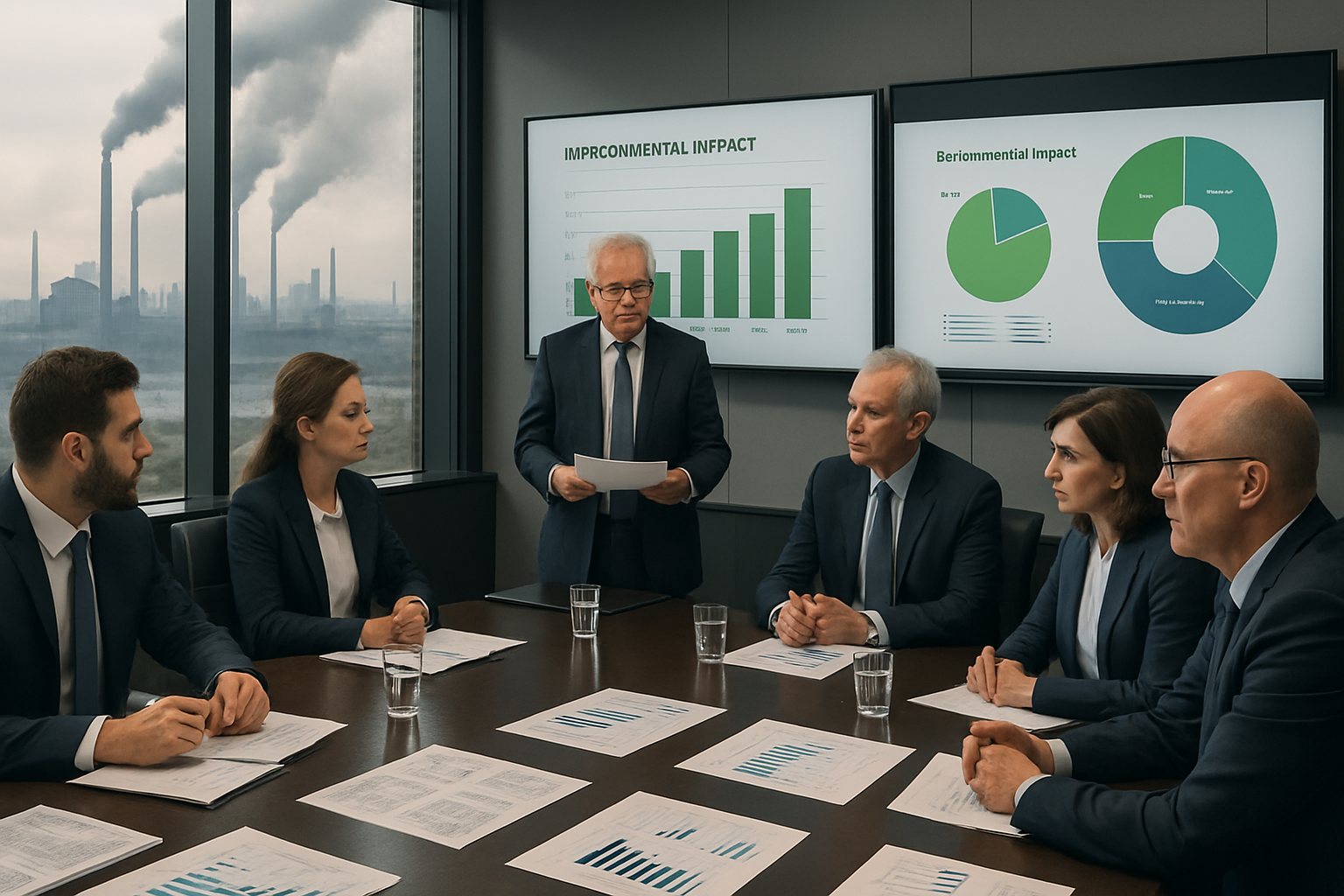
A groundbreaking report from Zero Carbon Analytics reveals that companies are beginning to face significant financial consequences for ecosystem destruction, as environmental accountability reaches a critical tipping point worldwide.
The excessive use of natural resources and high dependence on ecosystems has already begun to generate substantial economic impacts on various companies globally, according to a comprehensive study published by Zero Carbon Analytics (ZCA). This marks a fundamental shift from environmental concerns being treated as external costs to becoming central financial risks that can threaten corporate survival.
The Financial Reality of Environmental Destruction
The ZCA report warns that companies dependent on natural resources face mounting financial pressures as ecosystem degradation accelerates. This trend represents the convergence of several critical factors: increasing regulatory oversight, growing investor scrutiny of environmental, social, and governance (ESG) performance, and the rising costs of climate adaptation.
Environmental degradation costs often exceed the investments required for proactive environmental protection, making conservation increasingly recognized as an economic development strategy rather than merely a regulatory burden. Countries and corporations implementing comprehensive environmental protection demonstrate greater economic resilience and attract sustainable investment across multiple sectors.
Global Context: Record-Breaking Climate Crisis
The financial consequences for ecosystem destruction are emerging during an unprecedented period of environmental stress. January 2026 was confirmed as the hottest month in recorded history, marking the 18th consecutive month of temperatures exceeding 1.5°C above pre-industrial levels. This sustained warming has overridden natural climate variability, including La Niña cooling effects, demonstrating that human-induced climate change has fundamentally altered Earth's atmospheric systems beyond natural recovery mechanisms.
This climate context creates compound environmental effects that traditional corporate risk management struggles to address. Ghana's illegal galamsey mining has systematically poisoned major rivers, turning waters brown with toxic contamination affecting millions. Meanwhile, Mexico City faces extended air quality emergencies affecting over 21 million residents, highlighting how environmental degradation creates cascading economic consequences through healthcare expenses, reduced productivity, and decreased quality of life.
Corporate Accountability Revolution
The financial sector is increasingly recognizing environmental protection as essential infrastructure for human prosperity and planetary sustainability. ShareAction, a responsible investment campaign group, is preparing to challenge bank leadership through shareholder activism targeting financial institutions that retreat from climate commitments. The campaign calls on institutional shareholders to vote against re-election of bank chairs who "water down lenders' climate commitments."
"The challenge for 2026 is not to identify the problem, but to assume responsibility for solving it."
— Environmental Analyst Luís R. Vieira, PÚBLICO
This represents a sophisticated approach using financial market mechanisms to hold corporate leadership responsible for environmental backtracking. Countries across Africa, from Burkina Faso's record gold production to Zimbabwe's growing mining sector, are demonstrating that environmental protection can function as an economic development engine while maintaining strict accountability standards.
Technology and Traditional Knowledge Integration
Successful environmental protection requires sophisticated synthesis of cutting-edge technology with traditional ecological knowledge and community-based management. Advanced monitoring systems, including satellite tracking, environmental DNA sampling, and AI-powered analysis, provide real-time data supporting strategic planning. However, technology alone is insufficient without community engagement and traditional knowledge systems that have sustained environmental management for generations.
The Netherlands deployed the most sophisticated polar climate monitoring network ever created, designed for extreme conditions with equipment capable of operating in -70°C temperatures and 200+ km/h winds. This advanced monitoring provides real-time data transmission essential for tracking ecosystem changes and their economic implications for businesses dependent on environmental stability.
Economic Implications and Market Transformation
The economic implications of ecosystem destruction extend far beyond immediate cleanup costs. Environmental degradation threatens tourism revenues, agricultural productivity, public health expenditures, and infrastructure stability. Conversely, successful conservation demonstrates environmental protection as an economic development strategy through sustainable employment, enhanced investor confidence, and resilience building.
Portugal's insurance industry faced €750 million in climate-related claims, demonstrating that environmental protection is becoming an economic necessity rather than an optional corporate responsibility. Companies implementing comprehensive environmental protection show greater economic resilience and attract sustainable investment across green technology manufacturing, eco-tourism, and environmental services.
International Cooperation and Supply Chain Vulnerabilities
The European Union auditors warn that climate goals are threatened by China's dominance in critical materials, controlling 60% of production and 90% of refining of lithium, cobalt, and rare earth elements. This supply chain vulnerability highlights how environmental challenges demand unprecedented international cooperation, as ecosystem services and environmental risks cross political boundaries.
The US-EU-Japan Critical Minerals Partnership, involving 55 countries including seven African alternative suppliers, represents a strategic response to these vulnerabilities. This diversification strategy combines climate action with geopolitical resilience, demonstrating how environmental protection and economic security have become inseparable.
Implementation Challenges and Success Factors
Despite growing awareness, significant implementation challenges remain. Funding sustainability is particularly difficult for developing nations, where immediate economic pressures often override long-term environmental considerations. Technical capacity building requires sustained investment in education, training, and institutional development, while climate change disrupts project timelines, demanding adaptive management approaches.
Success factors consistently include community ownership and engagement, transparent governance frameworks, economic incentives that make protection financially viable, and integration of traditional knowledge with modern science. The diversity of approaches provides resilience against single-solution dependencies, offering multiple adaptation pathways for addressing complex environmental challenges.
The Financial Future of Environmental Accountability
As environmental action windows narrow during this critical climate action decade, the choice between reactive crisis management and proactive ecosystem service management becomes increasingly decisive. Companies face a fundamental decision: continue with short-term economic gains at the expense of long-term environmental sustainability, or invest in comprehensive environmental protection that demonstrates both ethical responsibility and economic wisdom.
The tools, knowledge, and cooperation frameworks exist for effective environmental protection, but success depends on rapid scaling through international cooperation, enhanced coordination across sectors and scales, and increased financial commitments that recognize environmental protection as essential infrastructure for both human prosperity and planetary sustainability.
Looking Ahead: A New Era of Corporate Responsibility
February and March 2026 represent a critical juncture for global environmental protection. The convergence of unprecedented climate conditions, growing financial accountability, and innovative technological solutions creates both urgent challenges and unprecedented opportunities for corporate transformation.
Companies that embrace this transformation early, integrating environmental protection into their core business strategies, are likely to emerge as leaders in the new economy. Those that continue to treat ecosystem destruction as an acceptable externality will find themselves increasingly isolated financially, legally, and reputationally in a world where environmental accountability has become not just a moral imperative, but an economic necessity.
The era of consequence-free environmental destruction is ending, replaced by a new paradigm where corporate survival depends on environmental stewardship. This transformation represents perhaps the most significant shift in business responsibility since the industrial revolution, with implications that will reshape the global economy for generations to come.