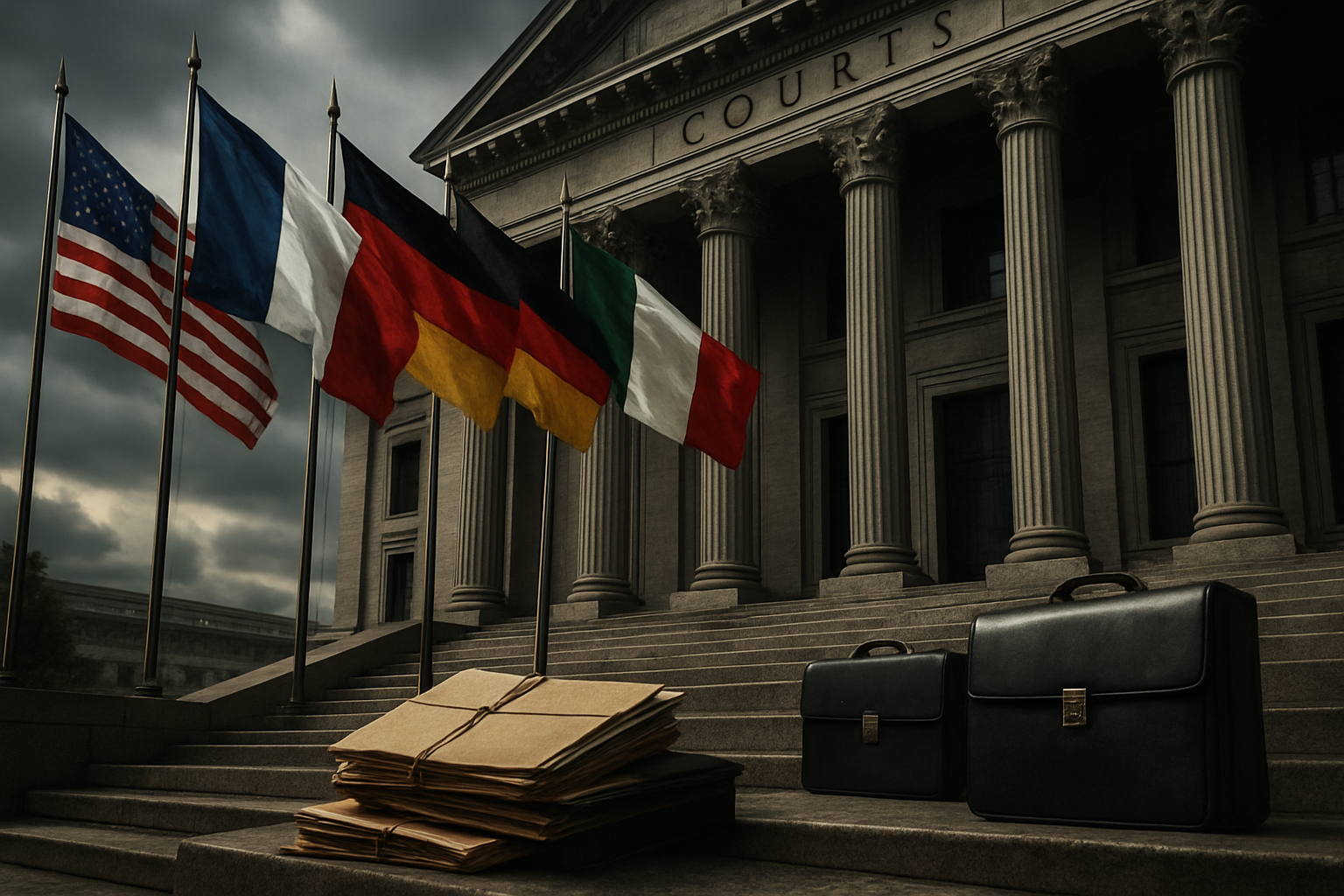
A sweeping wave of corruption investigations across eight countries is putting unprecedented pressure on democratic institutions as courts from Yerevan to Bratislava grapple with high-profile cases involving former ministers, senior officials, and judicial figures.
The simultaneous legal proceedings span Armenia, Austria, Ireland, Romania, and Slovakia, revealing the international scope of corruption challenges facing modern democracies. These cases represent a critical test of judicial independence and institutional resilience at a time when public trust in government institutions faces mounting pressure.
Armenia: Former Labor Minister and PM Advisor Arrested
In Armenia, the Anti-Corruption Committee has arrested a former Labor Minister and a Prime Ministerial advisor in what officials describe as part of an ongoing criminal investigation. Marina Ohanjanyan, the Anti-Corruption Committee Press Secretary, confirmed the arrests but stated that specific details of the investigation cannot be disclosed at this time.
The arrests signal Armenia's continued commitment to rooting out corruption within its government ranks, building on previous anti-corruption efforts that have targeted officials across various ministries and agencies.
Austria: Controversial Investigations and Judicial Procedures
Austria faces complex legal proceedings involving the controversial Pilnacek case, which has raised questions about political influence on judicial investigations. The case involves circumstances surrounding the death of a high-ranking prosecutor and has become a focal point for debates about judicial independence.
A parliamentary investigation committee is examining the handling of evidence, including a laptop that reached investigative authorities under "strange circumstances." An IT technician testified about the challenges of accessing password-protected devices, highlighting the technical complexities involved in modern criminal investigations.
"What am I supposed to crack without a password?"
— IT Technician, Austrian Parliamentary Committee
Austrian officials have emphasized that there should be "no political influence on investigative work," but the case continues to generate significant public attention and parliamentary scrutiny.
Ireland: Organized Crime and Police Corruption Investigations
Ireland is processing multiple high-profile cases that span organized crime and police corruption. A Gerry Hutch associate has been arrested in Spain as part of an organized crime investigation, with the individual expected to appear before a Spanish high court in the coming days.
More significantly, a retired Garda superintendent has been charged with corruption and facilitating a criminal organization. Separately, a co-accused Garda has been charged with supplying confidential information, raising serious questions about the integrity of law enforcement institutions.
These cases highlight the ongoing challenges faced by Irish authorities in combating organized crime networks that have increasingly sophisticated methods of operation and infiltration of legitimate institutions.
Romania: Prosecutorial Salary Disputes and Institutional Tensions
Romania's legal system faces internal tensions as prosecutors receive salary adjustments amid ongoing anti-corruption efforts. An order signed by prosecutor Ionuț Ciprian Spiridon provides for updating prosecutors' salaries with inflation indices plus legal penalty interest for most of 2018.
While seemingly administrative, these salary adjustments occur against the backdrop of Romania's intensive anti-corruption drive and highlight the complex relationship between maintaining judicial independence and ensuring adequate compensation for legal professionals handling sensitive corruption cases.
Slovakia: Charges Dropped and Cases Reconsidered
Slovakia presents a complex picture of justice in action, with prosecutors both dropping and reconsidering charges against high-profile figures. The prosecution has twice cancelled charges against former minister Ján Budaj, describing the accusations as "premature" while investigations continue. Police must now re-examine the case involving alleged damages of 570,000 euros.
In another significant development, charges against key witness Petra Petrov in a major corruption case have been dropped, with prosecutors questioning the basis for the original charges. This development mirrors similar scenarios involving members of the National Anti-Crime Agency (NAKA), suggesting systematic issues in how corruption cases are being built and prosecuted.
Technology and Modern Corruption Investigations
These cases collectively illustrate the evolving nature of corruption investigations in the digital age. From password-protected laptops in Austria to complex financial documentation in Armenia, investigators must navigate increasingly sophisticated evidence gathering and analysis.
The challenges extend beyond technical capabilities to questions of institutional capacity, with courts worldwide experiencing unprecedented pressure from case backlogs, resource constraints, and the complexity of modern financial crimes that often span multiple jurisdictions.
International Cooperation and Democratic Resilience
The simultaneous nature of these investigations across multiple European countries reflects enhanced international cooperation in anti-corruption efforts. European law enforcement coordination has reached new levels of sophistication, with specialized courts and information-sharing protocols enabling more effective responses to transnational criminal networks.
However, these cases also demonstrate the ongoing challenges democratic institutions face in maintaining public trust while pursuing accountability. The careful balance between transparency and operational security, between swift justice and due process, remains delicate across all jurisdictions.
Legal experts emphasize that the success of these investigations will influence public confidence in democratic institutions more broadly. Professor Dr. James Martinez, a constitutional law expert, notes that these cases represent "a fundamental test of whether democratic institutions can prosecute corruption fairly while maintaining their integrity under pressure."
Looking Forward: Institutional Reform and Public Trust
The current wave of corruption investigations across these eight countries occurs at a critical juncture for European democracy. Public demand for accountability has never been higher, while the sophistication of modern corruption networks presents unprecedented challenges for traditional law enforcement approaches.
Success in these cases requires not only effective prosecution but also comprehensive institutional reforms that address underlying vulnerabilities. This includes enhanced transparency requirements, strengthened oversight mechanisms, and improved international coordination to match the global nature of modern corruption networks.
The outcomes of these investigations will establish crucial precedents for how democratic institutions respond to 21st-century corruption challenges while preserving the civil liberties and constitutional principles that define democratic societies.
As these cases proceed through their respective judicial systems, they serve as a real-time test of democratic resilience and the rule of law. The international community will be watching closely as courts from Yerevan to Dublin demonstrate whether democratic institutions can adapt to contemporary challenges while maintaining their essential protective functions for civil society.