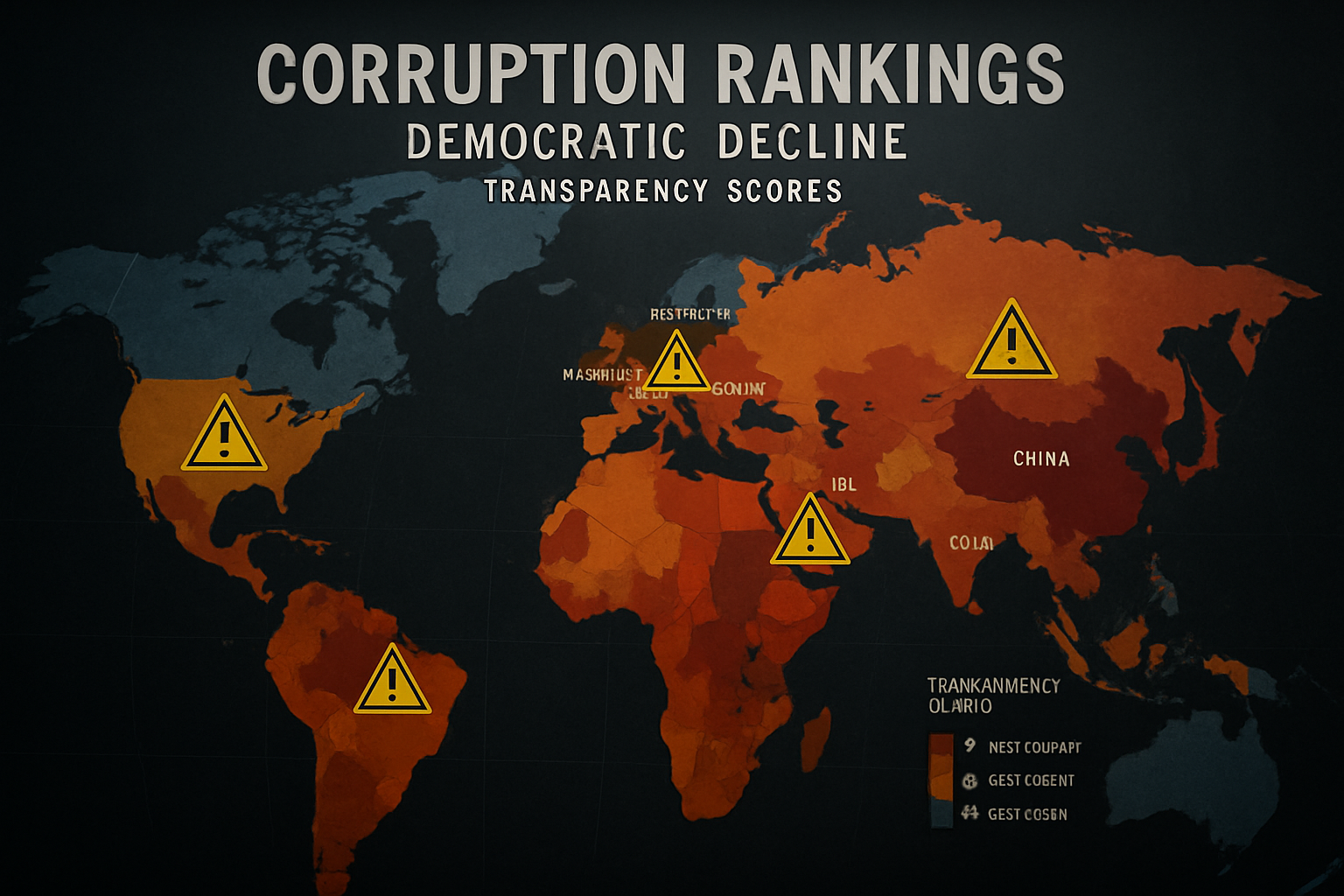
The United States has plummeted to its lowest-ever score in Transparency International's 2025 Corruption Perceptions Index, marking a historic low point in what the anti-graft watchdog describes as a "worrying decline" in democratic governance worldwide.
Released on February 11, 2026, the comprehensive global ranking of 182 countries reveals that corruption perceptions are worsening across established democracies, with the US joining a troubling pattern of institutional deterioration that spans continents and challenges fundamental assumptions about democratic resilience.
United States: A Historic Fall
According to Transparency International, the United States has fallen to 29th position globally, tied with the Bahamas and trailing behind Uruguay and Lithuania. This represents the worst ranking in the index's history for a nation that once positioned itself as a global leader in governance standards.
The decline reflects what analysts describe as "weakening oversight, political interference, and growing tolerance for unethical conduct" within American institutions. The deterioration comes despite previous efforts to strengthen anti-corruption frameworks and occurs alongside similar declines in traditional democratic strongholds.
Global Democratic Crisis
The 2025 index reveals a broader crisis affecting democratic institutions worldwide. Traditional strong performers including Canada, the United Kingdom, and several European countries have all recorded declining scores, indicating what Transparency International characterizes as systematic democratic backsliding.
"This represents the most significant challenge to global governance integrity in recent memory," a senior Transparency International official stated. "The patterns we're seeing suggest institutional vulnerabilities that transcend individual political systems."
— Transparency International spokesperson
The organization warns that corruption is not merely a governance issue but a fundamental threat to democratic legitimacy, with declining public trust in institutions creating cascading effects across political and economic systems.
Regional Variations Tell Complex Story
While established democracies struggle, the index reveals striking regional variations. Several countries have demonstrated remarkable progress, challenging assumptions about corruption as an inevitable feature of developing economies.
Rwanda's Historic Achievement: Rwanda recorded its highest-ever score in the 2025 index, demonstrating that sustained anti-corruption efforts can produce measurable results. The East African nation's performance stands in stark contrast to declining Western democracies.
Madagascar's Setback: Conversely, Madagascar fell to 148th position with a score of 25 out of 100, reflecting what Transparency International Madagascar described as "persistent challenges in governance, transparency and public integrity." The nation's decline underscores how corruption can undermine development efforts.
Haiti's Continued Struggle: Haiti ranks 169th out of 182 countries with a score of just 16 out of 100, representing stagnation compared to previous years despite ongoing international assistance efforts.
Mixed Results Across Continents
The index reveals complex patterns defying simple regional categorization:
- Zimbabwe: Scored 21 out of 100, placing 158th globally, among the world's most corrupt countries according to Transparency International Zimbabwe
- Poland: European coverage emphasized the US decline, with Polish media highlighting America's fall as part of broader democratic concerns
- Ukraine: Despite ongoing conflict challenges, Ukraine showed progress in the global rankings, though Transparency International noted "continued high-level corruption risks" particularly in procurement and defense sectors
Economic and Geopolitical Implications
The correlation between corruption perceptions and economic development remains stark. Countries with transparent governance continue to attract larger foreign investments, while those with poor governance face capital flight and reduced international confidence.
The 2025 index results have immediate implications for international relations, trade partnerships, and multilateral cooperation. Nations experiencing declining scores may find their diplomatic influence diminished and their participation in global initiatives questioned.
Methodology and Scope
The Corruption Perceptions Index draws from 13 independent data sources, measuring expert and business perceptions of public sector corruption across 182 countries and territories. The scale runs from 0 (highly corrupt) to 100 (very clean), providing a standardized measure for international comparison.
This year's assessment reflects perceptions of corruption levels throughout 2025, capturing a period of significant global political and economic turbulence that appears to have strained institutional resilience across multiple democracies.
Civil Society Under Pressure
A concerning trend identified in the 2025 index involves the increasing targeting of transparency advocates, journalists, and civil society activists. Countries showing declining scores often correlate with restrictions on press freedom and limitations on civil society operations.
This pattern suggests that corruption and authoritarian tendencies reinforce each other, creating cycles where reduced transparency enables further institutional deterioration.
Technology's Double-Edged Role
The report highlights technology's complex relationship with anti-corruption efforts. While digital monitoring systems, artificial intelligence detection capabilities, and blockchain transparency tools offer new possibilities for accountability, technology alone proves insufficient without sustained political commitment to reform.
Several countries have demonstrated that technological solutions can enhance transparency, but success requires broader institutional changes and sustained political will to implement and maintain anti-corruption systems.
International Cooperation Imperative
Transparency International emphasizes that modern corruption networks operate across borders, requiring unprecedented international cooperation. Effective responses demand information sharing, joint investigations, and coordinated sanctions across multiple jurisdictions.
The organization calls for enhanced cooperation mechanisms that can address transnational corruption while respecting sovereignty and building institutional capacity in affected countries.
Path Forward: Reform Requirements
The 2025 index results demonstrate that corruption reduction requires sustained commitment across multiple dimensions:
- Transparent Frameworks: Clear legal and regulatory structures with effective enforcement mechanisms
- Political Commitment: Sustained leadership dedication extending beyond electoral cycles
- International Cooperation: Enhanced coordination for addressing transnational corruption networks
- Civil Society Protection: Safeguarding transparency advocates and investigative journalism
- Innovative Approaches: Technology integration with traditional accountability mechanisms
Historical Context and Future Implications
The 2025 results represent a critical juncture in global governance. While some nations demonstrate that improvement remains possible through coordinated reform efforts, the widespread decline among established democracies suggests institutional vulnerabilities requiring urgent attention.
The index serves as both a warning about democratic fragility and evidence that positive change remains achievable through sustained commitment to transparency, accountability, and institutional reform.
"These results show that transparency and good governance are not permanent achievements but require constant vigilance and renewal," analysts note. "The path forward demands both recognition of current challenges and commitment to the institutional changes necessary for recovery."
— Governance expert analysis
As nations grapple with the implications of the 2025 Corruption Perceptions Index, the results underscore that effective governance requires ongoing commitment from political leaders, civil society, and international partners working together to strengthen the institutional foundations essential for democratic resilience and economic prosperity.