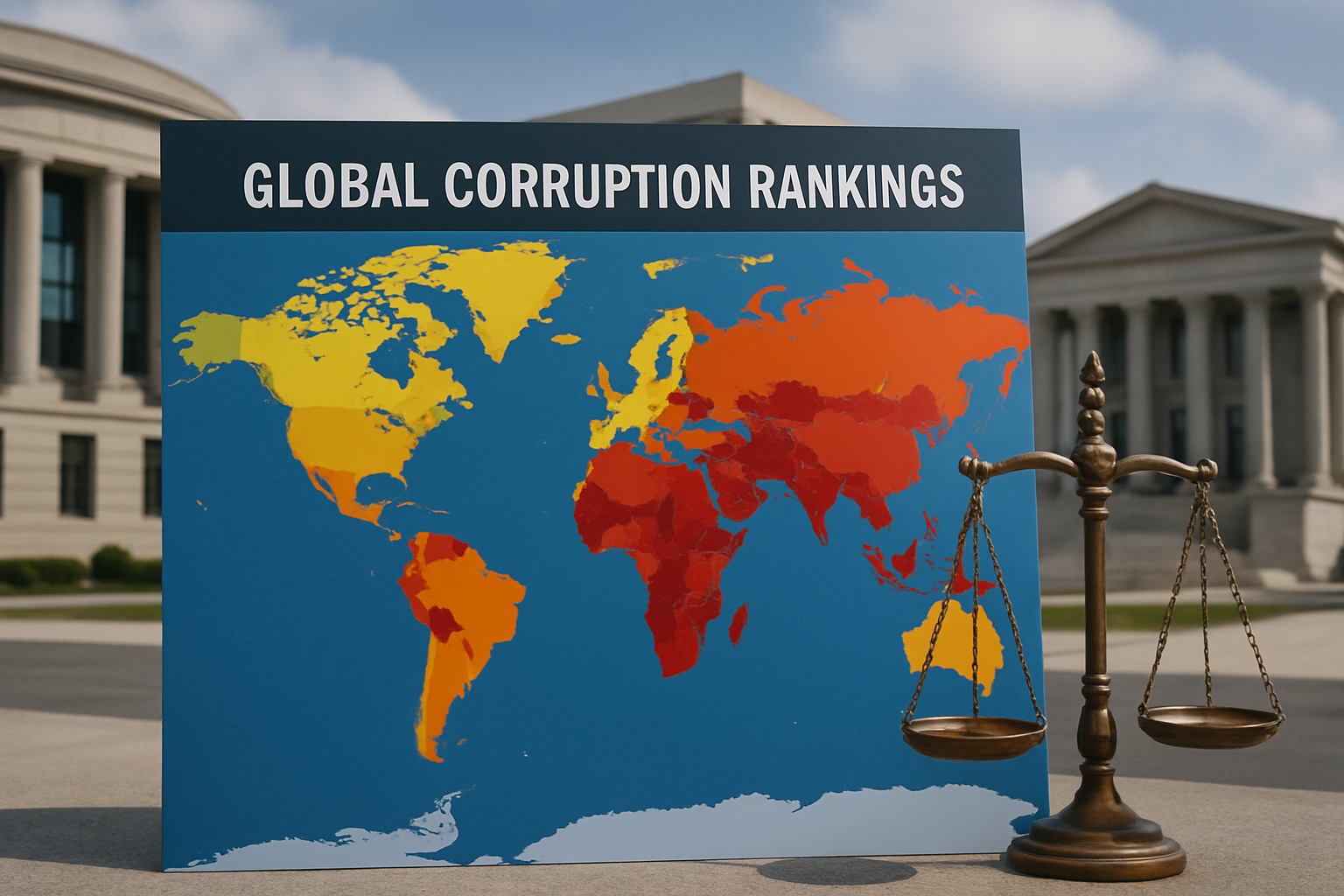
Transparency International's Corruption Perceptions Index 2025, released Tuesday, revealed a troubling global landscape where established democracies are experiencing unprecedented declines in transparency while some developing nations demonstrate remarkable progress in anti-corruption efforts.
The comprehensive analysis of 182 countries and territories shows the average global corruption score has reached its worst level in a decade, with democratic backsliding emerging as the most concerning trend affecting governance worldwide.
Democratic Nations Post Historic Lows
The United States recorded its lowest-ever score in the index's history, with Danish media reporting that America has "plummeted" in corruption rankings during a period marked by significant political upheaval. The decline represents a dramatic shift for a nation traditionally seen as a beacon of democratic governance.
France similarly hit a historic low following high-profile scandals involving former president Nicolas Sarkozy, far-right leader Marine Le Pen, and government cover-ups in the Perrier mineral water company case. The French decline exemplifies how corruption perceptions can be severely damaged by elite misconduct even in established democratic systems.
Israel dropped to 35th place globally amid what observers call a "worrying trend" affecting democratic institutions. The slip reflects broader regional instability and governance challenges that have undermined public trust in government institutions.
"The Pacific cannot afford to let corruption undermine its future. Pacific leaders should move beyond statements and prioritise meaningful action to combat corruption, uphold integrity and strengthen democracy."
— Kellera Serelini-Vanua, Transparency International Pacific Regional Engagement and Advocacy Lead
Sub-Saharan Africa Faces Persistent Challenges
Sub-Saharan Africa remains the lowest-scoring region with an average of just 32 points out of 100. Chad, with a score of 22, exemplifies the region's struggles, maintaining its position among the world's most corrupt nations. The country's poor performance illustrates persistent challenges in governance and transparency that have plagued the region for decades.
Mozambique experienced a particularly sharp decline, losing four points from 2024 to score just 21 points, placing it 161st globally. This represents a concerning 10-point drop over the past decade, making it the worst-performing Portuguese-speaking African nation in corruption measures.
The regional analysis reveals that only four of 49 Sub-Saharan African countries score above 50 points, the threshold where corruption is considered relatively controlled. This statistic underscores the massive governance challenges facing the continent.
Bright Spots Emerge from Unexpected Quarters
Estonia continues to outperform many older democracies, ranking 8th globally with a score of 76, tied with Australia, Hong Kong, and Ireland. The Baltic nation's success demonstrates that newer democracies can achieve exceptional governance standards through sustained institutional development.
The Dominican Republic emerged as one of the few countries in the Americas to show improvement, with its progress standing out in a region where 12 of 33 countries have worsened since 2012. The improvement signals that dedicated anti-corruption efforts can yield results even in challenging regional environments.
Taiwan jumped significantly in the rankings to 24th place, demonstrating that sustained political commitment to transparency can produce measurable improvements in governance perceptions.
Regional Patterns Reveal Systemic Issues
The Americas showed no significant progress in combating corruption, averaging 42 out of 100 points. Venezuela and Nicaragua once again ranked among the most corrupt countries globally, while the region faces growing influence from transnational organized crime networks that undermine institutional integrity.
Fiji's stagnation at 55 points over five years highlights ongoing accountability challenges despite strong legislative frameworks. While the Pacific island nation remains the highest-ranked among Small Island Developing States, its lack of progress demonstrates the difficulty of translating legal reforms into tangible improvements.
The Asia-Pacific Divergence
Asia-Pacific countries show dramatic variation in corruption perceptions. While some nations like Estonia and Taiwan demonstrate strong governance, others struggle with persistent challenges. The region's diversity illustrates how political systems, economic development levels, and cultural factors interact to shape corruption outcomes.
Methodological Rigor Underpins Global Assessment
The Corruption Perceptions Index draws from 13 independent data sources, measuring expert and business perceptions of public sector corruption. The methodology ensures comprehensive coverage while maintaining consistency across diverse political and economic systems.
Strong democracies average 71 points with none falling below 50, while fragile democracies average just 47 points. This correlation demonstrates the fundamental link between democratic institutions and corruption control.

Economic Implications of Corruption Rankings
The correlation between corruption scores and foreign investment flows has become increasingly pronounced. Countries with transparent governance frameworks attract significantly larger international commitments, while nations with poor governance face capital flight and reduced economic opportunities.
The Index reveals how corruption undermines economic development through multiple channels: reduced business confidence, inefficient resource allocation, and weakened rule of law. These factors create self-reinforcing cycles where poor governance leads to economic stagnation, which further weakens institutional capacity.
Technology and Transparency
Modern anti-corruption efforts increasingly rely on technological solutions including enhanced monitoring systems, digital transparency platforms, and artificial intelligence for detecting irregular patterns. However, the Index shows that technology alone cannot address deeper systemic governance problems.
Countries achieving improvement combine technological tools with sustained political commitment, civil society engagement, and international cooperation. This multi-faceted approach proves essential for meaningful progress against entrenched corruption networks.
International Cooperation Emerges as Critical Factor
The 2025 rankings emphasize the transnational nature of modern corruption, requiring unprecedented international coordination. Enhanced cooperation mechanisms have emerged for addressing cross-border financial crimes, money laundering, and elite criminal networks.
Successful anti-corruption efforts increasingly depend on information sharing, coordinated sanctions, and joint investigations across multiple jurisdictions. The Index reflects how countries with strong international partnerships often achieve better corruption control outcomes.
Civil Society Under Pressure
A concerning trend revealed by the 2025 Index is the systematic targeting of civil society organizations, journalists, and anti-corruption activists across multiple countries. This pressure on transparency advocates undermines the social accountability mechanisms essential for corruption control.
Countries experiencing the steepest declines often show concurrent restrictions on press freedom, civil society operations, and whistleblower protections. These patterns suggest that corruption control requires robust protection for transparency advocates.
Looking Forward: Reform Imperatives
The 2025 Index demonstrates that corruption outcomes are not predetermined. Countries at all development levels can achieve significant improvements through sustained reform efforts, while even well-established democracies can experience rapid deterioration without vigilant institutional maintenance.
Key factors for improvement include: transparent governance frameworks, sustained political commitment across electoral cycles, enhanced international cooperation, robust civil society protection, and innovative approaches to institutional accountability.
The mixed results of 2025 represent both a warning and an opportunity. Democratic backsliding in established nations provides sobering lessons about governance fragility, while progress in unexpected quarters demonstrates that meaningful change remains possible through coordinated action and sustained commitment to transparency principles.
As global challenges from climate change to technological disruption require unprecedented international cooperation, the Corruption Perceptions Index 2025 serves as a crucial reminder that effective governance and institutional integrity remain fundamental prerequisites for addressing humanity's most pressing challenges.