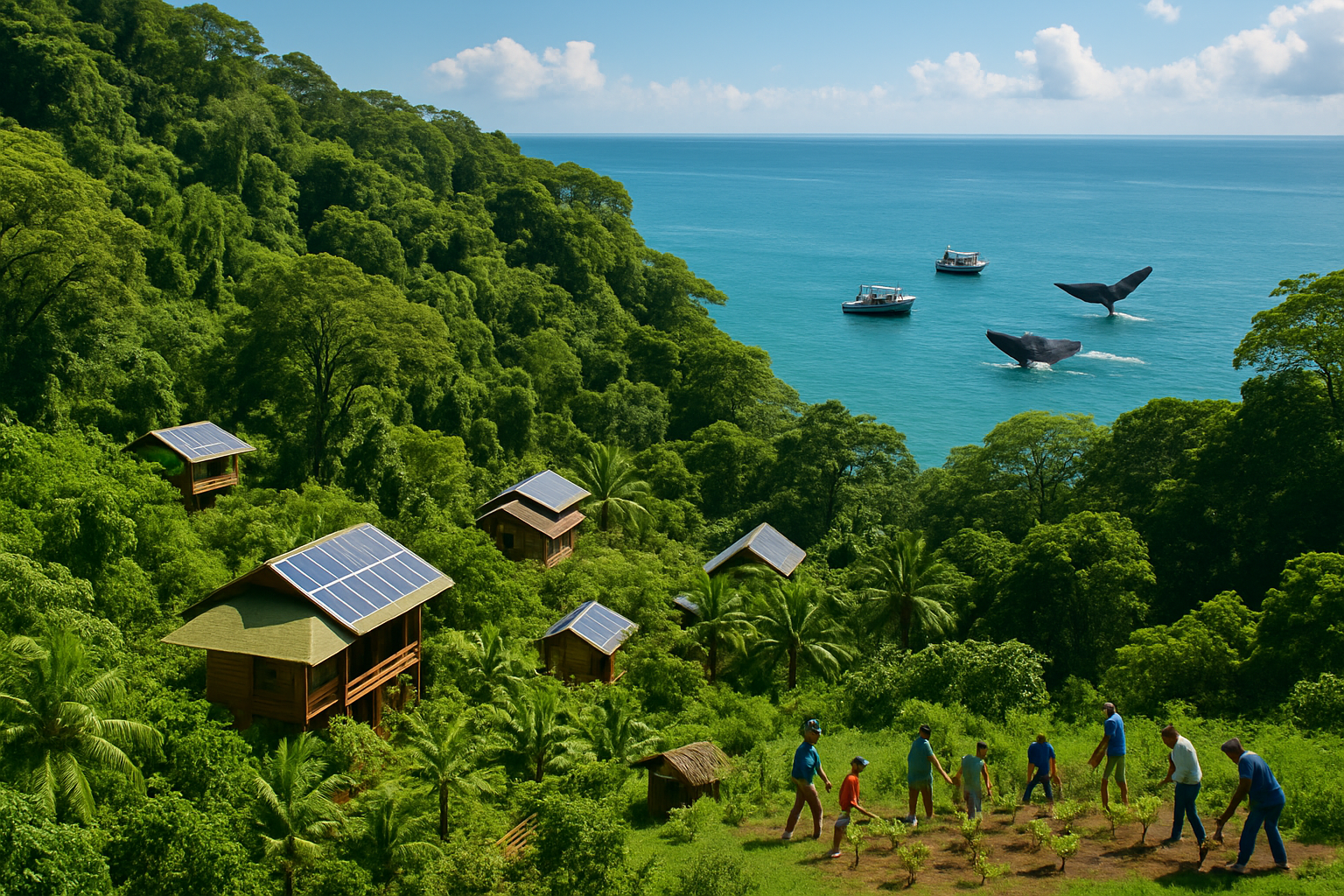
Costa Rica has emerged as a global leader in sustainable development for Earth Day 2026, implementing comprehensive environmental strategies that integrate marine conservation breakthroughs, healthcare innovation, and sustainable economic expansion while maintaining its position as a model for environmental stewardship during the ongoing climate crisis.
As the world observes Earth Day during the 24th consecutive month of global temperatures exceeding 1.5°C above pre-industrial levels—the longest sustained warming streak in recorded human history—Costa Rica's multifaceted approach to sustainability offers crucial insights for nations worldwide seeking to balance environmental protection with economic development.
Marine Conservation Breakthrough
Misión Tiburón organization achieved a historic milestone in March 2026 by successfully attaching the first satellite tracking device to a whale shark in Costa Rican waters. The whale shark, named "Chorotega" in honor of Guanacaste province where this achievement occurred, represents a major advancement in marine science for Central America.
This breakthrough comes at a critical time when marine ecosystems face unprecedented pressure from climate change. Costa Rica's Pacific waters serve as crucial breeding and migration corridors for numerous marine species, including humpback, sperm, and endangered North Atlantic right whales. Recent research has documented unprecedented marine mammal activity, with "super pods" of dolphins exceeding 120 individuals, indicating healthy ecosystems despite mounting environmental pressures.
"This satellite tracking initiative provides essential data for understanding whale shark migration patterns and protecting critical marine habitats throughout Central America."
— Misión Tiburón Research Team
Healthcare Innovation Leadership
Costa Rica's commitment to comprehensive development extends beyond environmental protection to healthcare innovation. The country opened Central America's first Outsourced Sterilization Services Center, introducing a specialized medical instrument management system that encompasses washing, disinfection, sterilization, and detailed tracking for clinical procedures.
This healthcare infrastructure development aligns with the broader "Therapeutic Revolution of 2026," which emphasizes prevention-first healthcare strategies over reactive treatment approaches. The centralized solution demonstrates Costa Rica's commitment to enhancing community resilience while creating economic multiplier effects throughout the healthcare sector.
Sustainable Economic Expansion
La Lima Free Trade Zone's achievement in earning the Essential COSTA RICA Country Brand license exemplifies the nation's approach to sustainable economic development. Over a decade of operation, the zone has created more than 10,000 direct jobs, attracted 19 multinational companies from six countries, and generated over $817 million in annual exports—all while maintaining focus on sustainability, innovation, and environmental responsibility.
This economic success comes as Costa Rica achieved a historic 4th place ranking in the 2026 World Happiness Report, the highest position ever attained by a Latin American country. The tourism sector has shown remarkable resilience, with 602,960 international arrivals in the first two months of 2026, representing a 14.1% increase compared to 2025 and marking the fifth consecutive month of growth.
Environmental Stewardship at Reserva Conchal
Private sector leadership in sustainability is exemplified by Reserva Conchal, which has reaffirmed its comprehensive sustainability strategy as Earth Day 2026 approaches. The destination's management model integrates conservation of natural resources, biodiversity protection, and promotion of sustainable development as core operational principles rather than peripheral considerations.
This approach represents an evolution from reactive environmental management to proactive ecosystem service development, where every decision is guided by criteria for natural resource conservation and community engagement. The model demonstrates how private enterprise can serve as a catalyst for environmental protection while maintaining economic viability.
Regional Conservation Leadership
Costa Rica's environmental leadership extends throughout Central America, with Nestlé Central America's Global Reforestation Program contributing to the planting of approximately 2 million trees in the company's coffee and milk supply chains in Nicaragua and Honduras. These efforts strengthen agroforestry systems and restore productive landscapes throughout the region.
The nation's approach to environmental conservation has positioned it within the broader "conservation renaissance of 2026," a global movement characterized by scientific innovation, community engagement, economic viability, and international cooperation integration. This evolution from reactive crisis management to proactive ecosystem service management emphasizes community participation and technological innovation as essential components of sustainable conservation.
Technology-Tradition Integration
Costa Rica's success demonstrates the critical importance of sophisticated synthesis between cutting-edge technology and traditional ecological knowledge. The whale shark tracking project combines advanced satellite monitoring with decades of local marine expertise. Environmental DNA sampling, satellite monitoring, and AI-powered analysis work alongside traditional conservation practices developed by coastal communities over generations.
This integration addresses a critical challenge in scaling conservation efforts globally while respecting local cultural autonomy and traditional management systems that have sustained ecosystems for generations. The approach represents a fundamental evolution in conservation methodology beyond purely technological or traditional approaches toward comprehensive frameworks that combine scientific rigor with cultural sensitivity.
Economic Development Strategy
Environmental protection in Costa Rica functions as an economic development strategy rather than a regulatory burden. The country's comprehensive protection policies demonstrate economic resilience and attract sustainable investment across multiple sectors including eco-tourism, environmental technology, and green services.
Economic analyses consistently show that ecosystem services from intact natural systems often provide greater long-term economic benefits than resource extraction activities. Costa Rica's forests regulate water and climate patterns, wetlands prevent billions in flood damage, and biodiversity hotspots support pharmaceutical research and premium eco-tourism worth hundreds of billions annually.
International Cooperation Framework
Costa Rica's approach highlights the critical importance of international cooperation in addressing transnational environmental challenges. Ocean currents, atmospheric systems, and species migrations cross political boundaries, making unilateral conservation efforts insufficient for addressing the scale and complexity of current environmental challenges.
The diversity of approaches demonstrated by Costa Rica provides resilience against single-solution dependencies, offering multiple adaptation pathways for complex environmental challenges. Knowledge sharing creates global networks that strengthen local capacity while contributing to planetary sustainability.
Climate Context and Global Significance
Costa Rica's achievements take on heightened significance against the backdrop of unprecedented climate conditions. January 2026 confirmed the hottest month in recorded history, extending a warming streak that has completely overridden natural climate variability, including La Niña cooling effects that typically moderate global temperatures.
This sustained warming demonstrates that human-induced climate change has fundamentally altered Earth's atmospheric systems beyond natural recovery mechanisms. The compound environmental effects create challenges that traditional conservation approaches struggle to address, requiring innovative strategies that account for rapidly changing baseline conditions while maintaining long-term sustainability goals.
Critical Action Window
Environmental scientists emphasize that the window for effective environmental action is rapidly narrowing as ecological systems approach critical thresholds that could trigger irreversible changes affecting global food security, climate stability, and human settlements. Costa Rica's comprehensive approach represents the choice between reactive crisis management and proactive ecosystem service management that may determine whether conservation efforts can keep pace with accelerating environmental change during this decisive climate action decade.
The tools, knowledge, and cooperation frameworks for comprehensive environmental protection exist, as demonstrated by Costa Rica's diverse initiatives. However, success depends on sustained international cooperation, enhanced multi-sector coordination, and increased financial commitments that recognize environmental protection as essential infrastructure for human prosperity and planetary sustainability.
Future Implications
Costa Rica's environmental developments in 2026 may prove decisive for conservation approaches in the decades ahead, influencing global biodiversity protection, climate adaptation, and sustainable development strategies for generations. The integration of cutting-edge technology with traditional ecological wisdom creates adaptable frameworks that respect cultural diversity while leveraging global capabilities for maximum conservation impact.
Success in maintaining planetary habitability during this unprecedented environmental challenge period depends on humanity's ability to organize and implement solutions rapidly enough to match the pace of environmental change while protecting the natural systems upon which human prosperity depends. Costa Rica's "conservation renaissance" offers both hope and practical guidance for the massive coordinated effort required to maintain planetary habitability during the most environmentally challenging period in recorded history.
As Earth Day 2026 demonstrates, the convergence of innovation, cooperation, and political commitment provides a foundation for decisive climate action in the crucial decade ahead. Costa Rica's comprehensive approach serves as a template for nations worldwide seeking to balance immediate human needs with long-term environmental sustainability, proving that environmental leadership and economic prosperity can advance together through thoughtful integration and sustained commitment to planetary stewardship.