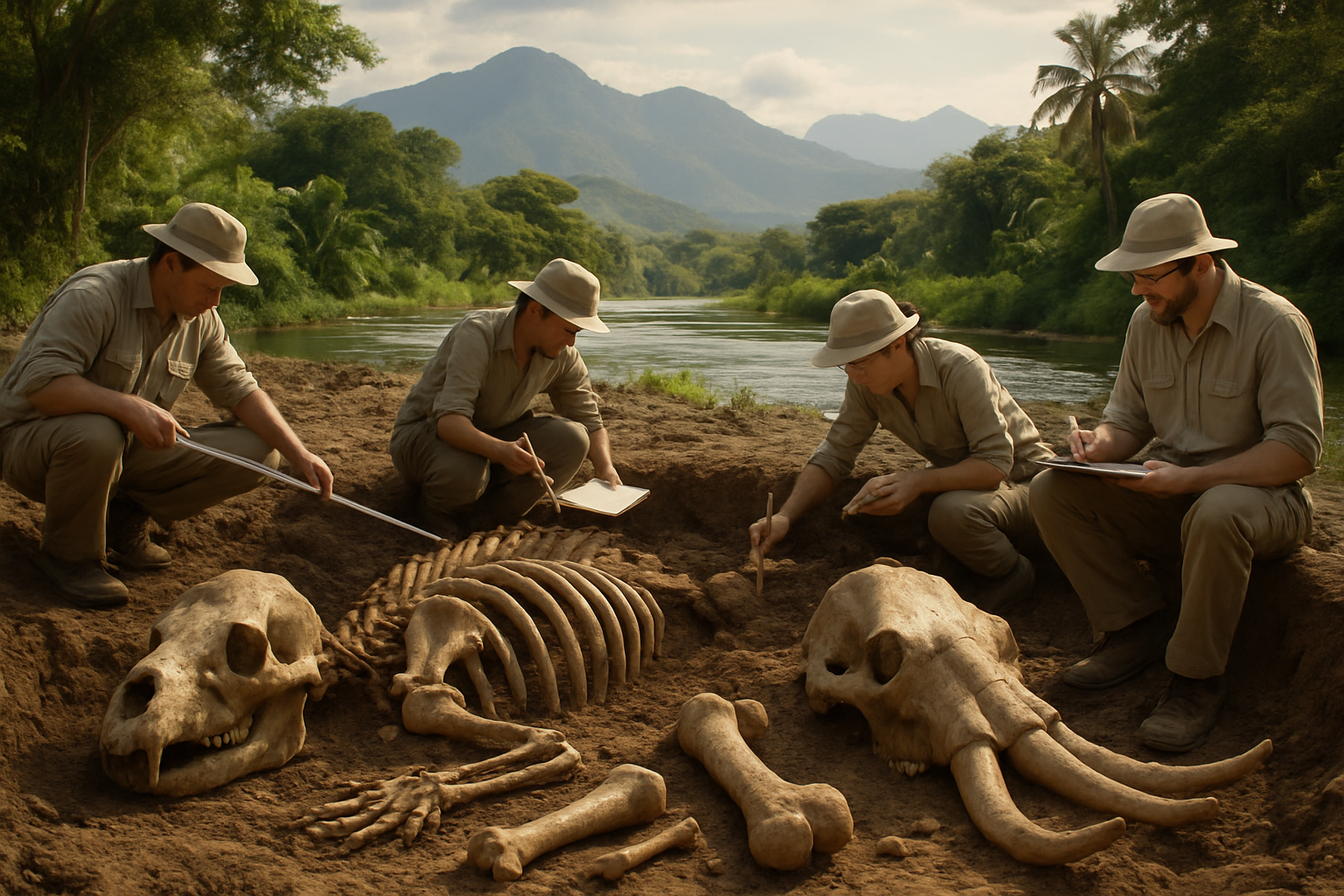
In a discovery that promises to rewrite our understanding of prehistoric Central America, Costa Rican researchers have unearthed extraordinary fossils of a giant sloth and mastodon (Cuvieronius) estimated to be between 10,000 and 40,000 years old near a river in the province of Cartago.
The remarkable find, announced in February 2026, includes 49 meticulously preserved specimens featuring a spectacular 1.60-meter tusk and multiple vertebrae. This discovery ranks among Costa Rica's most significant paleontological breakthroughs in recent decades, offering unprecedented insights into the diverse megafauna that once roamed the Central American landscape during the late Pleistocene epoch.
The Prehistoric Giants of Central America
The discovery site has yielded remains of two distinct species that dominated the ancient ecosystem of what is now Costa Rica. The giant ground sloth, a massive herbivore that could reach sizes comparable to modern elephants, represents one of the most iconic megafauna species of the Americas. These formidable creatures, equipped with powerful claws and robust skeletal structures, were perfectly adapted to the tropical environments of prehistoric Central America.
Equally impressive is the mastodon specimen, identified as belonging to the Cuvieronius genus. The preserved 1.60-meter tusk stands as a testament to the massive scale of these ancient proboscideans, which were among the largest land mammals of their era. Mastodons differed significantly from their mammoth cousins, with distinctive dental patterns that reveal their preference for browsing on leaves and twigs rather than grazing on grasses.
Revolutionary Dating and Analysis Techniques
The age estimation of 10,000 to 40,000 years places these fossils within a critical period of Earth's history, spanning the end of the last Ice Age and the transition into the Holocene epoch. This timeline coincides with significant climate changes that ultimately led to the extinction of megafauna across the Americas.
Modern analytical techniques have been employed to confirm the authenticity and significance of the specimens. Advanced geological dating methods, chemical analysis of bone composition, and environmental reconstruction have provided researchers with unprecedented detail about the conditions these animals faced during their final millennia on Earth.
Costa Rica's Paleontological Renaissance
This discovery contributes to what scientists are calling the "2026 Archaeological Renaissance," a period marked by groundbreaking findings across the globe. The Costa Rican fossils join a remarkable collection of discoveries that have fundamentally challenged our understanding of prehistoric life and ancient civilizations.
The systematic excavation near the Cartago river demonstrates Costa Rica's growing prominence in paleontological research. The country's unique geographical position as a land bridge between North and South America made it a crucial corridor for ancient wildlife migrations, creating ideal conditions for the preservation of diverse fossil specimens.
Environmental Context and Climate Implications
The discovery occurs during a period of unprecedented climate awareness, with January 2026 marking the 18th consecutive month of global temperatures exceeding 1.5°C above pre-industrial levels. This context adds urgency to paleontological research, as understanding how ancient species responded to climate changes provides valuable insights for contemporary conservation efforts.
The fossil evidence suggests that Costa Rica's ancient climate supported vast populations of megafauna, indicating significantly different environmental conditions than those present today. The presence of both giant sloths and mastodons in the same geological layer suggests a rich ecosystem capable of supporting multiple large herbivore species simultaneously.
International Collaboration and Research Methods
The success of this discovery exemplifies the power of modern international cooperation in paleontological research. Advanced analytical techniques, including ground-penetrating radar, sophisticated chemical analysis, and digital documentation methods, have enabled researchers to extract maximum information from each specimen while ensuring their preservation for future study.
Digital documentation has created permanent records that enable global scholarly access while protecting the original fossils from handling damage. This approach represents a new standard in archaeological research, balancing scientific investigation with long-term preservation requirements.
Significance for Evolutionary Biology
The Costa Rican discoveries provide crucial evidence for understanding the evolutionary pathways that led to the development of Central America's unique biodiversity. The coexistence of giant sloths and mastodons offers insights into ancient ecological relationships and competition patterns among megafauna.
These findings also contribute to ongoing debates about the causes of Pleistocene megafauna extinction. The timing of the specimens, potentially extending to 40,000 years ago, predates human arrival in the Americas by thousands of years, supporting theories that climate change rather than human hunting was the primary driver of megafauna extinction.
Economic and Cultural Impact
Beyond their scientific value, the fossils are expected to generate significant cultural and economic benefits for Costa Rica. The discovery has already attracted international media attention, positioning the country as a premier destination for paleontological tourism. Educational institutions worldwide are expressing interest in collaborative research programs, potentially establishing Costa Rica as a regional center for paleontological studies.
The specimens will likely become centerpieces of museum exhibitions, contributing to Costa Rica's cultural diplomacy efforts while generating sustainable revenue through scientific tourism. This economic model demonstrates how paleontological discoveries can serve broader national interests while advancing scientific knowledge.
Future Research Directions
The initial discovery represents only the beginning of what promises to be an extensive research program. Scientists plan detailed analysis of the specimens using advanced techniques including isotope studies to determine diet and migration patterns, microscopic examination of bone structure to understand growth patterns and health status, and environmental DNA sampling to reconstruct the ancient ecosystem.
Future excavations in the Cartago region may yield additional specimens, potentially revealing complete skeletons that could provide unprecedented insights into the anatomy and behavior of these ancient giants. The research team has identified several promising locations for continued investigation.
Preservation Challenges and Opportunities
The discovery highlights both the opportunities and challenges facing paleontological research in the 21st century. Climate change poses increasing threats to fossil sites through extreme weather events, but it also creates opportunities for discovery as changing conditions expose previously hidden specimens.
Costa Rica's commitment to environmental protection provides an ideal framework for long-term paleontological research. The country's extensive national park system and strong conservation traditions ensure that significant fossil sites receive appropriate protection while remaining accessible for scientific study.
Global Archaeological Context
The Costa Rican discovery contributes to a remarkable year of archaeological and paleontological breakthroughs worldwide. From 350,000-year-old fire control evidence in England to sophisticated ancient astronomical systems discovered globally, 2026 has revealed the complexity and sophistication of both human and natural history.
These findings collectively challenge linear progression models of both human development and natural evolution, revealing complex, interconnected processes that shaped the development of life on Earth. The Costa Rican megafauna represents one piece of this larger puzzle of planetary biological heritage.
Looking Forward
As research continues, the Costa Rican giant sloth and mastodon fossils promise to yield insights that extend far beyond their immediate scientific value. They represent a window into a vanished world, offering lessons about adaptation, extinction, and resilience that remain relevant for understanding contemporary environmental challenges.
The discovery underscores Costa Rica's unique position as a natural laboratory for understanding the complex interactions between climate, geography, and biological diversity. As research teams continue their investigations, these ancient giants may provide crucial guidance for preserving the biodiversity that makes Costa Rica one of the world's most biologically rich nations.
The 40,000-year-old fossils serve as powerful reminders of the deep history that underlies our contemporary world, connecting modern Costa Rica to its prehistoric past while informing efforts to protect its biological future. In an era of rapid environmental change, these ancient witnesses offer both warnings about extinction and inspiration about the remarkable resilience of life on Earth.