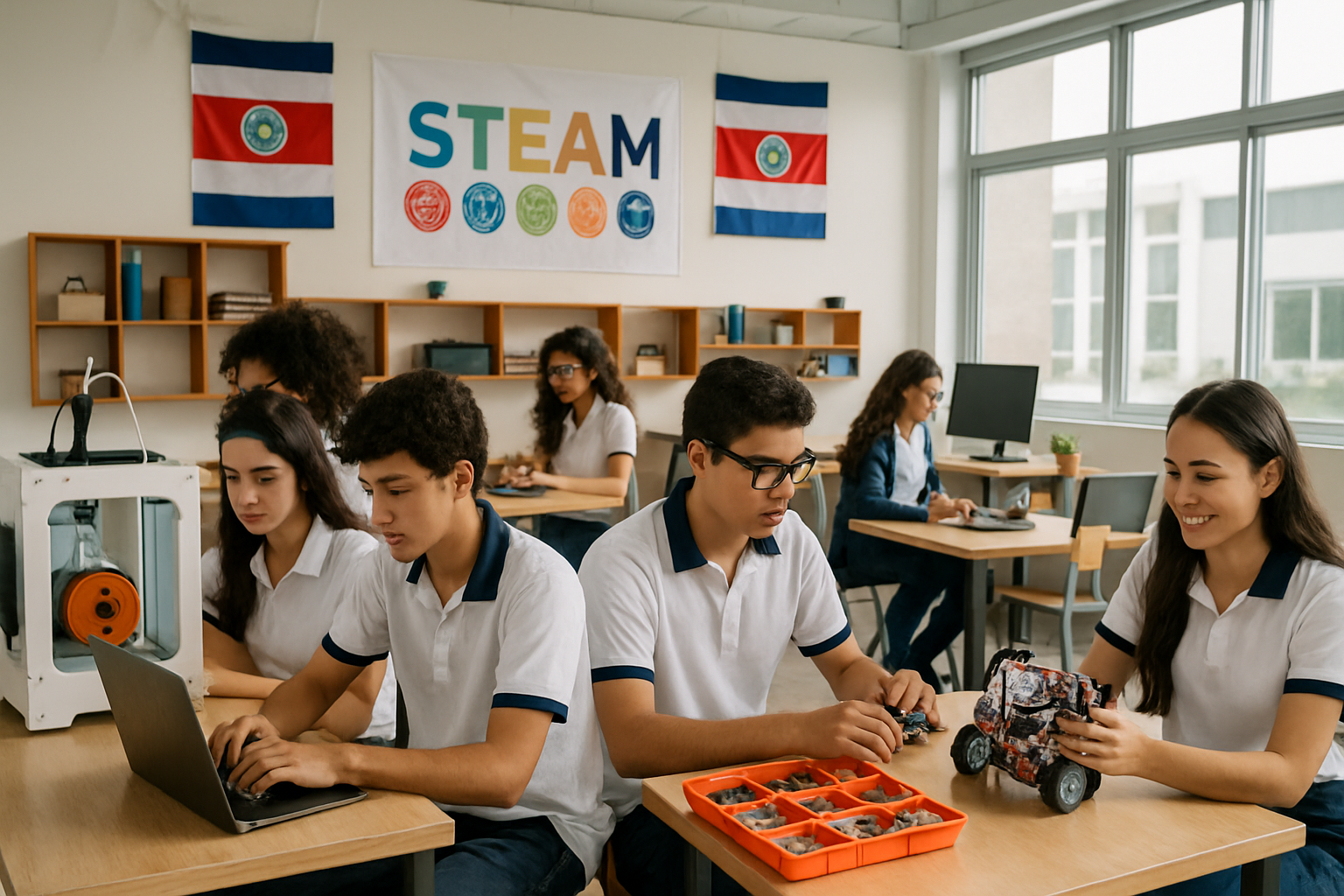
Costa Rica has achieved a historic milestone in educational innovation with the inauguration of the country's first maker space within the public education system at the Fernando Volio Jiménez Technical and Vocational School (CTP) in Cartago, marking a significant advancement in the nation's commitment to STEAM education and technological literacy.
This groundbreaking initiative, sponsored by Garnier & Garnier Real Estate Developments through Zona Franca La Lima in partnership with Tecnikids and the Ministry of Public Education (MEP), represents more than an isolated educational innovation. It signals Costa Rica's strategic positioning within what educational experts are terming the "2026 Educational Technology Renaissance" - a global movement toward thoughtful integration of hands-on learning with traditional academic instruction.
Addressing 21st Century Educational Challenges
The maker space was created in direct response to current educational challenges, particularly in a context where advances in artificial intelligence demand the development of uniquely human skills including creativity, critical thinking, problem-solving, and collaborative innovation. The facility will benefit more than 900 students and 50 teachers, providing access to cutting-edge technology and hands-on learning experiences previously unavailable in Costa Rica's public education system.
According to project documentation, the initiative has already reached more than 2,000 students in its first phase, with the explicit goal of fostering careers in STEAM fields (Science, Technology, Engineering, Arts, and Mathematics). This approach aligns with global educational trends that emphasize practical skill development alongside traditional academic learning.
International Context and Educational Transformation
Costa Rica's maker space initiative occurs within a broader international educational transformation. The country joins other nations leading the 2026 Educational Technology Renaissance, including Malaysia's achievement of 97.82% teacher placement rates with the world's first AI-integrated Islamic school, Singapore's WonderBot 2.0 heritage education system, and Canada's responsible AI teaching assistants that maintain critical thinking standards while providing personalized learning support.
"The goal is fostering careers in STEAM fields while developing creativity, critical thinking, and collaborative innovation skills that artificial intelligence cannot replace."
— Ministry of Public Education, Costa Rica
This coordinated global phenomenon represents the most significant educational transformation since post-World War II expansion, characterized by thoughtful digital tool integration with traditional educational values rather than wholesale technological replacement of human learning relationships.
Strategic Partnership Model
The success of Costa Rica's maker space demonstrates the effectiveness of public-private partnerships in educational innovation. The collaboration between Garnier & Garnier Real Estate Developments, Tecnikids, and the Ministry of Public Education creates a sustainable funding model that could serve as a template for other developing nations seeking to modernize their educational infrastructure without overwhelming government budgets.
Zona Franca La Lima's involvement reflects broader trends where free trade zones and international businesses recognize their strategic interest in developing local technical talent. This approach creates self-reinforcing cycles where educational excellence supports economic development, which in turn enables further educational investment.
Practical Learning Focus
The maker space emphasizes hands-on experiential learning through state-of-the-art equipment including 3D printers, robotics kits, microcontroller programming stations, and collaborative project areas. Students engage in real-world problem-solving activities that bridge theoretical knowledge with practical application, preparing them for careers in emerging technology sectors while developing critical thinking skills that remain essential regardless of technological advancement.
Educational experts note that this approach addresses the "AI paradox" in education - as artificial intelligence becomes more capable of routine tasks, human skills like creativity, emotional intelligence, cultural understanding, and ethical reasoning become more valuable rather than less important.
Regional Leadership and Global Implications
Costa Rica's initiative positions the nation as a regional leader in educational innovation within Central America. The country's commitment to educational technology infrastructure development occurs despite global challenges including semiconductor shortages that have driven memory chip prices to sixfold increases, affecting educational technology programs until new manufacturing facilities come online in 2027.
This constraint has paradoxically driven innovation toward more efficient and sustainable technology integration approaches, emphasizing educational enhancement over wholesale replacement of traditional methods. Costa Rica's maker space model demonstrates how nations can achieve significant educational advancement through strategic partnerships and focused investments rather than requiring massive infrastructure overhauls.
Economic and Social Impact
The maker space represents more than educational innovation; it constitutes strategic economic infrastructure for the 21st century. Countries implementing prevention-first educational approaches demonstrate superior economic outcomes through reduced crisis intervention costs, decreased unemployment, and improved workforce productivity.
Costa Rica's initiative creates economic multiplier effects beyond direct educational benefits. Enhanced community resilience, reduced social service demands, and improved educational outcomes create self-reinforcing cycles where educational excellence supports economic development, enabling further educational investment and attracting international partnerships.
Cultural Integration and Authenticity
Successful educational technology integration requires balancing global competencies with local cultural identity. Costa Rica's approach demonstrates how nations can embrace technological advancement while preserving cultural authenticity and values. The maker space incorporates Costa Rican cultural elements and emphasizes collaborative learning approaches that reflect the nation's cooperative traditions.
This cultural sensitivity distinguishes successful educational transformation from failed approaches that impose standardized solutions without considering local contexts. Educational experts emphasize that effective AI-age reform requires thoughtful adaptation of technological tools to serve specific cultural, economic, and social needs rather than generic implementation.
Future Scalability and Sustainability
The Fernando Volio Jiménez Technical School maker space serves as a pilot program with potential for nationwide expansion. Success factors identified include sustained political commitment beyond electoral cycles, comprehensive stakeholder engagement, adequate resource allocation for long-term sustainability, and international cooperation through knowledge sharing and technical assistance.
Plans for scaling include developing teacher training programs, establishing regional maker space networks, and creating partnerships with universities and international institutions. The initiative's success could influence educational policy throughout Latin America and other developing regions seeking to modernize their educational systems.
Critical Juncture for Global Education
Costa Rica's maker space inauguration occurs at what educational policy experts identify as a critical juncture for global education. The success or failure of current reform initiatives will significantly affect global capacity for addressing climate change, technological disruption, and social cohesion through quality educational systems.
The challenge lies in preparing students for an AI-integrated global economy while preserving human creativity, critical thinking, and cultural knowledge that define authentic educational excellence. Costa Rica's approach suggests that this balance is achievable through thoughtful integration of advanced technologies with fundamental human relationships that make learning meaningful and culturally authentic.
As the 2026 Educational Technology Renaissance continues to unfold globally, Costa Rica's pioneering maker space initiative demonstrates that smaller nations can achieve significant educational transformation through strategic partnerships, cultural sensitivity, and commitment to human-centered learning approaches. The project represents not just a technological upgrade, but a fundamental reimagining of education's role in preparing students for a rapidly evolving world while preserving the human elements that make learning transformative.