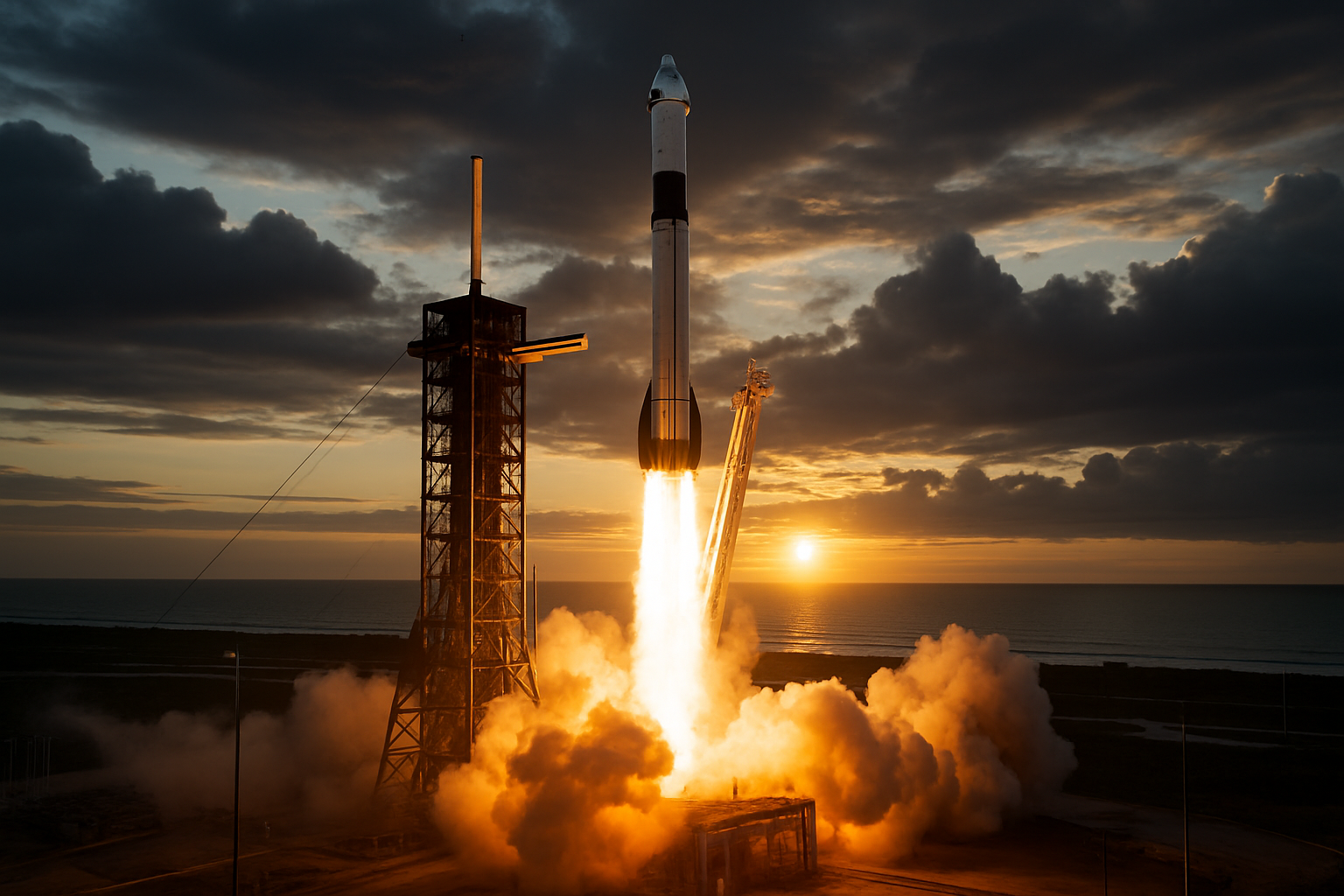
French astronaut Sophie Adenot made history on February 13, 2026, becoming only the second French woman to fly to space as NASA's SpaceX Crew-12 mission successfully launched from Kennedy Space Center, sending four astronauts to the International Space Station for a critical eight-month mission.
The Falcon 9 rocket carrying the Dragon capsule lifted off without incident at the scheduled time, marking a significant milestone for European space exploration and international cooperation. The mission represents a crucial crew rotation to restore full staffing aboard the ISS, where only three astronauts remained following an unprecedented medical evacuation earlier this year.
Historic Achievement for France and Women in Space
At 43 years old, Sophie Adenot joins an elite group as only the second French woman to reach space, following Claudie Haigneré's missions 25 years earlier. A former helicopter pilot and engineer, Adenot's journey to space represents a "born astronaut" fulfilling a lifelong dream while carrying the hopes of a nation.
"This is the perfect moment to reflect on the role of women in space, a field still very much dominated by men," noted France 24 in their coverage of the launch. "Yet years before Adenot set her sights on a career in space, other women were actively involved in the sector, though many of their names have been forgotten by history."
The launch comes at a time when the space industry is experiencing what experts describe as a transition from the "AI revolution to space economy golden age," with SpaceX preparing a potential June 2026 IPO that could value the company at over $1 trillion.
The Crew-12 Mission Details
The international crew of four includes Adenot as Mission Specialist representing the European Space Agency, alongside NASA astronauts Jack Hathaway (pilot) and Jessica Meir (commander), and Russian cosmonaut Andrey Fedyaev (Mission Specialist). The diverse crew reflects continued international cooperation in space despite terrestrial tensions.
"The four are set to dock with the space station on Saturday, returning the orbital lab to its full complement of seven," NASA confirmed in their mission statement.
— NASA Mission Control
The crew had been in quarantine for a week at Kennedy Space Center prior to launch, following standard protocols. Their Dragon capsule is traveling at speeds exceeding 27,000 kilometers per hour on its journey to the orbiting laboratory, where they will conduct vital scientific research for the next eight months.
Addressing Critical Staffing Needs
The Crew-12 mission takes on special significance as it restores the ISS to full operational capacity following the early departure of Crew-11 due to a medical emergency—marking the first medical evacuation in ISS history. The station had been operating with a skeleton crew of just three astronauts, limiting its scientific research capabilities.
This staffing challenge highlights the critical nature of regular crew rotations in maintaining the ISS as humanity's premier orbital laboratory. The eight-month mission duration represents a record for European astronaut missions, enabling comprehensive long-term research but also presenting medical challenges including Space-Associated Neuro-Ocular Syndrome (SANS), which affects astronaut vision during extended missions.
Scientific Research and Future Implications
The crew will conduct extensive scientific experiments, with particular focus on lung tissue cultivation research crucial for understanding microgravity effects on human biology. This research directly supports future lunar settlements and Mars exploration by providing essential data on how human tissues behave in space environments.
Adenot's extended mission occurs during a pivotal period for space exploration, with NASA's Artemis II mission scheduled for March 2026 and SpaceX shifting its strategic focus from Mars to lunar colonization. The research conducted during Crew-12's eight-month stay will provide valuable insights for these future deep space missions.
International Cooperation in a Competitive Era
The successful launch demonstrates the enduring strength of international cooperation through ISS operations, even as global space competition intensifies. France's Le Monde noted that "the ISS remains one of the last terrains of cooperation between the Russians and other Western space powers."
This cooperation occurs against a backdrop of rapid space industry evolution, with China advancing its Shenlong reusable spacecraft program, European nations expanding rocket manufacturing capabilities, and emerging countries like Pakistan selecting astronaut candidates for China's Tiangong station missions later in 2026.
Looking Ahead: Space Economy and Future Missions
The Crew-12 launch represents more than a personnel rotation—it symbolizes humanity's commitment to sustained space presence during a transformative period. As the space economy evolves toward commercial dominance, missions like Crew-12 maintain the scientific foundation that will support future lunar settlements and interplanetary exploration.
With SpaceX preparing its potential trillion-dollar IPO and the global memory crisis driving interest in space-based data centers, Adenot's mission occurs at the intersection of traditional space exploration and emerging commercial space applications.
The crew's safe arrival at the ISS on Saturday will mark not just the completion of another successful launch, but a step forward in humanity's ongoing quest to establish a permanent presence beyond Earth. For Sophie Adenot, it represents the fulfillment of a dream that places her among the elite few who have left our planet—and inspires countless others to reach for the stars.