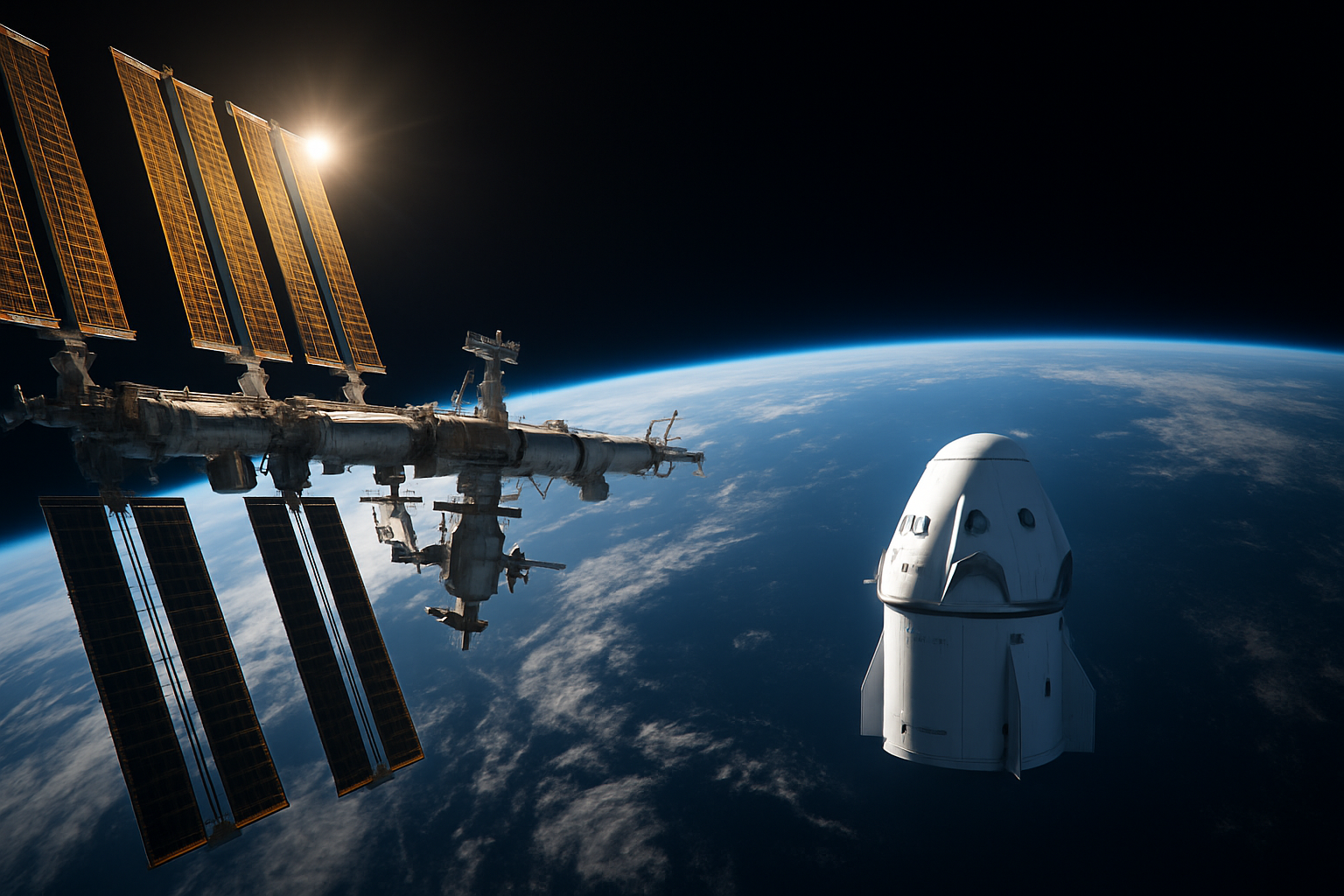
NASA and SpaceX's Crew-12 mission successfully completed its journey to the International Space Station on Saturday, February 15, 2026, restoring the orbital laboratory to full operational capacity with a diverse international crew poised to conduct critical scientific research over the next eight months.
The SpaceX Dragon capsule, carrying four astronauts from three nations, docked with the ISS at 21:15 Paris time (15:15 EST) while orbiting over South Africa, approximately 34 hours after launch from Cape Canaveral, Florida. The successful docking marks a crucial milestone in maintaining continuous human presence aboard the space station and represents a significant step forward in international space cooperation.
International Crew Composition and Leadership
The Crew-12 mission is commanded by Swedish-American astronaut Jessica Meir, a veteran of previous space missions who brings extensive experience in marine biology and space operations. The international crew also includes NASA pilot Jack Hathaway, French ESA Mission Specialist Sophie Adenot, and Russian cosmonaut Andrei Fedyaev.
Sophie Adenot's participation marks a historic moment for European space exploration, as she becomes the first French woman to reach the International Space Station in 25 years, following in the footsteps of Claudie Haigneré. This eight-month mission duration represents a record for a European astronaut, underscoring the growing capabilities and ambitions of international space partnerships.
"This mission represents more than just a crew rotation – it symbolizes the strength of international cooperation in advancing human space exploration,"
— Jessica Meir, Crew-12 Commander
Restoring Critical ISS Operations
The arrival of Crew-12 restores the International Space Station to its full seven-person complement, a critical development following an unprecedented medical evacuation that had left the station operating with a reduced skeleton crew of three astronauts. This restoration enables the resumption of full scientific operations and research capabilities that are essential for advancing our understanding of microgravity science and preparing for future deep space missions.
The crew replacement was necessitated by the first medical evacuation in ISS history, highlighting both the challenges and the robust emergency protocols that ensure astronaut safety during long-duration spaceflight missions. The successful crew rotation demonstrates the maturity of current space transportation systems and the effectiveness of international coordination in managing complex space operations.
Scientific Mission Objectives
During their eight-month stay, the Crew-12 astronauts will conduct extensive scientific research with direct applications to future lunar settlements and Mars exploration. Key research areas include lung tissue cultivation studies, which are crucial for understanding how human tissues behave in microgravity environments over extended periods.
The crew will also focus on Space-Associated Neuro-Ocular Syndrome (SANS) research, addressing vision problems that affect astronauts during extended missions. This research is particularly vital as space agencies prepare for longer missions to the Moon and eventually Mars, where crew members will face extended periods away from Earth's protective environment.

Medical Research Priorities
The extended mission duration allows for comprehensive long-term studies that cannot be replicated on Earth. Portuguese scientists have been leading breakthrough research into SANS, which manifests through neurological and ocular alterations that impact visual acuity during long-duration spaceflight. Understanding and mitigating these effects is essential for the success of future missions beyond Earth orbit.
Lung tissue cultivation research will provide insights into how microgravity affects human biology at the cellular level, with implications for developing medical countermeasures for astronauts on multi-year missions to Mars. These studies also contribute to terrestrial medical research, as the unique microgravity environment reveals biological processes that are masked by Earth's gravity.
Strategic Context and Timing
The Crew-12 mission occurs during a pivotal period in space exploration, as the industry transitions from what analysts describe as the "AI revolution to space economy golden age." This transformation is characterized by increasing commercial involvement in space activities, with SpaceX preparing for a potential June 2026 IPO that could value the company at over $1 trillion.
The mission's timing also aligns with significant developments in lunar exploration, including NASA's Artemis II mission scheduled for March 2026, which will send astronauts on a lunar flyby for the first time since the Apollo era. The research conducted by Crew-12 will directly inform the medical and operational protocols needed for these longer missions beyond Earth orbit.
International Cooperation and Competition
The successful launch and docking of Crew-12 demonstrates the continued strength of international cooperation through ISS operations, even as global competition in space capabilities intensifies. The mission includes participants from NASA, ESA, and Roscosmos, highlighting the collaborative model that has made the ISS one of humanity's greatest achievements in space.
This cooperation occurs against a backdrop of increasing space competition, with China advancing its Shenlong reusable spacecraft program, European nations expanding their independent rocket manufacturing capabilities, and emerging nations like Pakistan preparing to send astronauts to China's Tiangong space station later in 2026.
"International cooperation in space continues to serve as a beacon of what humanity can achieve when we work together toward common goals,"
— Sophie Adenot, ESA Mission Specialist
Technical Achievement and Safety Protocols
The successful docking represents a technical achievement that demonstrates the maturity of current space transportation systems. The Dragon capsule traveled at speeds exceeding 27,000 kilometers per hour during its journey to the ISS, requiring precise navigation and timing to achieve the delicate orbital rendezvous and docking procedure.
Safety remained the paramount concern throughout the mission, with the crew having undergone extensive quarantine procedures at Kennedy Space Center before launch. This safety-first approach reflects lessons learned from decades of human spaceflight and ensures that missions proceed only when all systems meet the highest standards of reliability and crew protection.
Future Implications for Space Exploration
The success of Crew-12 establishes important precedents for sustained human space presence as space agencies and commercial companies prepare for an era of routine space operations. The eight-month mission duration tests the limits of current life support systems and provides valuable data for designing longer missions to the Moon and Mars.
The mission also serves as a testing ground for international crew coordination models that will be essential for future deep space missions requiring diverse expertise and sustained international partnership. These operational experiences directly inform the planning for lunar bases and Mars missions, where international cooperation will be crucial for success.
Economic and Commercial Context
The Crew-12 mission occurs during a period of unprecedented growth in the commercial space sector, with space-based data centers, satellite constellations, and space manufacturing emerging as significant economic opportunities. The research conducted aboard the ISS contributes to this growing space economy by advancing the technologies and understanding needed for sustained human presence in space.
As the space economy transitions toward maturity, missions like Crew-12 demonstrate the practical applications of space research and the growing integration between government space agencies and commercial partners. This public-private cooperation model is becoming the standard for major space initiatives, combining government expertise with commercial efficiency and innovation.
The successful completion of the Crew-12 docking marks not just another milestone in ISS operations, but a significant step toward humanity's future as a truly spacefaring civilization, with the scientific discoveries and international cooperation forged in Earth orbit serving as the foundation for our expansion throughout the solar system.