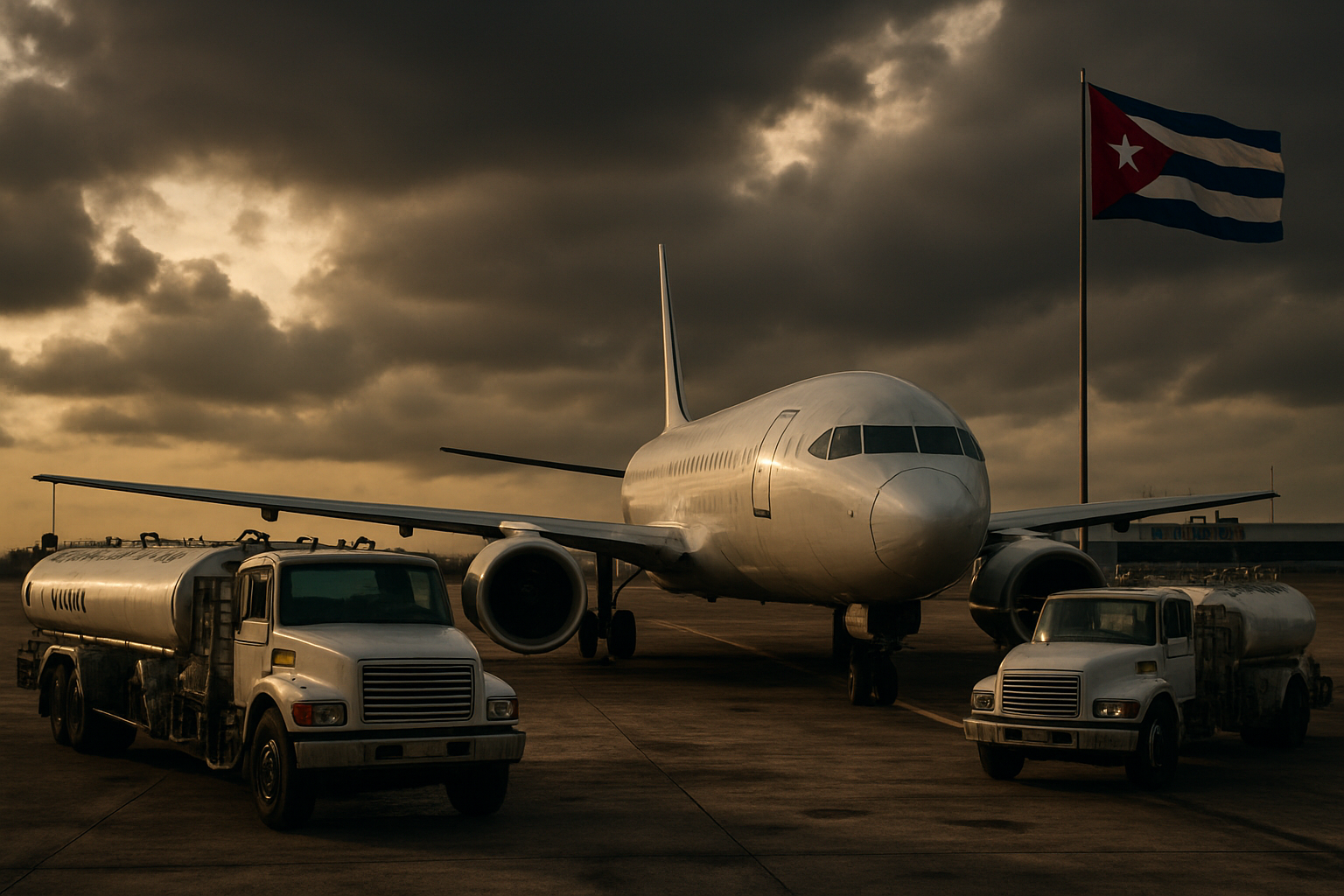
Cuba has officially notified international airlines that the country will exhaust its aviation fuel reserves within 24 hours, effectively suspending all international flights and threatening to completely isolate the Caribbean island from global air travel networks.
The Cuban government issued the unprecedented warning to international carriers operating from Havana and other Cuban airports on Sunday, February 8, 2026, according to multiple sources confirmed by news agency EFE. The aviation fuel shortage represents the latest and most dramatic escalation of Cuba's deepening energy crisis, which has already devastated the island's economy and daily life.
Airlines Scrambling for Solutions
International carriers affected by the fuel shortage include primarily U.S., Spanish, Panamanian, and Mexican airlines that operate regular routes to Cuba. While the airlines have not yet publicly announced their response strategies, industry sources indicate they are exploring contingency measures similar to those employed during previous Cuban fuel crises.
During the economic crisis of the 1990s, known as Cuba's "Special Period," airlines adapted by rerouting flights with additional fuel stops in Mexico or the Dominican Republic. However, the current situation may prove more challenging given the scale of the energy crisis and international pressure on fuel suppliers.
The aviation fuel depletion threatens to cut off Cuba's remaining lifeline to the outside world, with most international flights connecting the island to Miami, Tampa, Fort Lauderdale, Madrid, Mexico City, and other regional capitals. The routes are crucial not only for the thousands of Cuban-Americans who visit family but also for the island's struggling tourism industry and essential supply chains.
Escalating Energy Crisis
The aviation fuel shortage is the latest manifestation of Cuba's broader energy emergency, which has intensified dramatically since the Trump administration's January 30, 2026 executive order threatening tariffs on countries that supply oil to Cuba. The policy effectively forced traditional suppliers, including Mexico and Venezuela, to suspend petroleum deliveries to avoid U.S. economic retaliation.
Cuba's oil reserves have dwindled to just 15-20 days supply, according to government sources, while Venezuelan crude shipments—historically Cuba's primary energy source—have been completely halted. The island's domestic oil production capacity remains severely limited, producing only approximately 700,000 barrels daily compared to its peak capacity of 3 million barrels.
The energy crisis has already triggered comprehensive emergency measures across Cuban society. The government has implemented four-day work weeks for public employees, reduced public transportation services, converted university classes to semi-virtual formats, and instituted strict fuel rationing for civilian vehicles.
Humanitarian and Economic Impact
More than 3.4 million Cubans are currently affected by scheduled blackouts during peak evening hours, with some regions experiencing power outages for more than 12 hours daily. The eastern provinces have been particularly hard hit following the failure of the Holguín electrical substation, leaving major cities including Santiago de Cuba in darkness for extended periods.
The tourism industry, one of Cuba's few remaining sources of hard currency, has suffered devastating losses. Major Spanish hotel chains Meliá and Iberostar, along with Canadian operator Blue Diamond, have closed resort facilities in Varadero and along the northern coast due to transportation difficulties and infrastructure failures. Canada has issued a "high degree of caution" travel advisory, leading to widespread trip cancellations.
"Cuba currently experiences severe fuel shortages, which has led the country to enter subsistence mode."
— Cubanet, February 9, 2026
Healthcare services face critical challenges, with some hospitals suspending non-emergency surgeries due to power outages threatening medicine storage and critical equipment operation. Medical staff report significant transportation difficulties reaching facilities, compounding the crisis.
International Response and Geopolitical Context
Mexico has emerged as Cuba's primary humanitarian lifeline, with President Claudia Sheinbaum authorizing emergency aid shipments despite U.S. pressure. Mexican naval vessels Papaloapan and Isla Holbox departed from Veracruz carrying 814 tons of essential supplies, marking Mexico's largest humanitarian operation to Cuba in recent decades.
The Mexican president has emphasized that her country "will not allow its territory to be used to pressure other nations," demonstrating the limits of U.S. economic coercion in Latin America. However, Mexico has suspended oil shipments to Cuba to avoid potential U.S. tariffs, illustrating the complex balance regional powers must maintain.
European media outlets have characterized the situation as a "deliberately engineered humanitarian emergency," raising questions about the effectiveness and morality of using economic pressure to achieve political objectives. The crisis affects Cuba's entire population of 11 million inhabitants, with international observers calling for humanitarian monitoring.
Comparisons to Historical Precedent
The current crisis draws comparisons to Cuba's "Special Period" of the 1990s following the Soviet Union's collapse, when the island lost its primary economic patron and faced severe shortages of fuel, food, and basic goods. However, analysts note key differences: while the 1990s crisis resulted from the external collapse of a supporting power, the current emergency stems from deliberate policy actions by the United States.
During the Special Period, Cuba maintained some level of international connectivity, allowing for gradual economic adaptation and limited foreign investment. The complete aviation fuel depletion threatens unprecedented isolation, potentially cutting off even humanitarian aid delivery and medical evacuations.
Cuban President Miguel Díaz-Canel has called for dialogue with the United States, describing the situation as an attempt at "total asphyxiation" of Cuba's economy. In a two-hour televised address on February 5, he urged international support while acknowledging the gravity of the crisis facing Cuban society.
Regional Aviation Implications
The suspension of flights to Cuba creates broader implications for Caribbean aviation networks and regional connectivity. Airlines that rely on Cuba as a transit point for connecting flights to other Caribbean destinations must reconfigure routes, potentially increasing costs and travel times for passengers across the region.
The crisis also highlights the vulnerability of island nations to supply chain disruptions and the critical importance of aviation fuel security for maintaining international connectivity. Other Caribbean countries are likely reassessing their own fuel supply arrangements to avoid similar isolation scenarios.
Looking Ahead
The aviation fuel crisis represents a critical test of Cuba's resilience and the international community's response to humanitarian emergencies created by geopolitical tensions. While Mexico's humanitarian aid provides some relief, the suspension of international flights threatens to deepen Cuba's isolation and exacerbate the humanitarian crisis.
The situation also demonstrates the complex intersection of energy policy, international sanctions, and humanitarian consequences in an interconnected global economy. As Cuba faces potential complete aviation isolation, the international community watches to see whether diplomatic solutions can emerge to address both the immediate humanitarian needs and the underlying geopolitical tensions driving the crisis.
The next few days will be crucial in determining whether emergency measures can restore some level of aviation fuel supply or if Cuba will face extended isolation from international air travel networks, with profound implications for the island's 11 million inhabitants and their connections to the broader world.