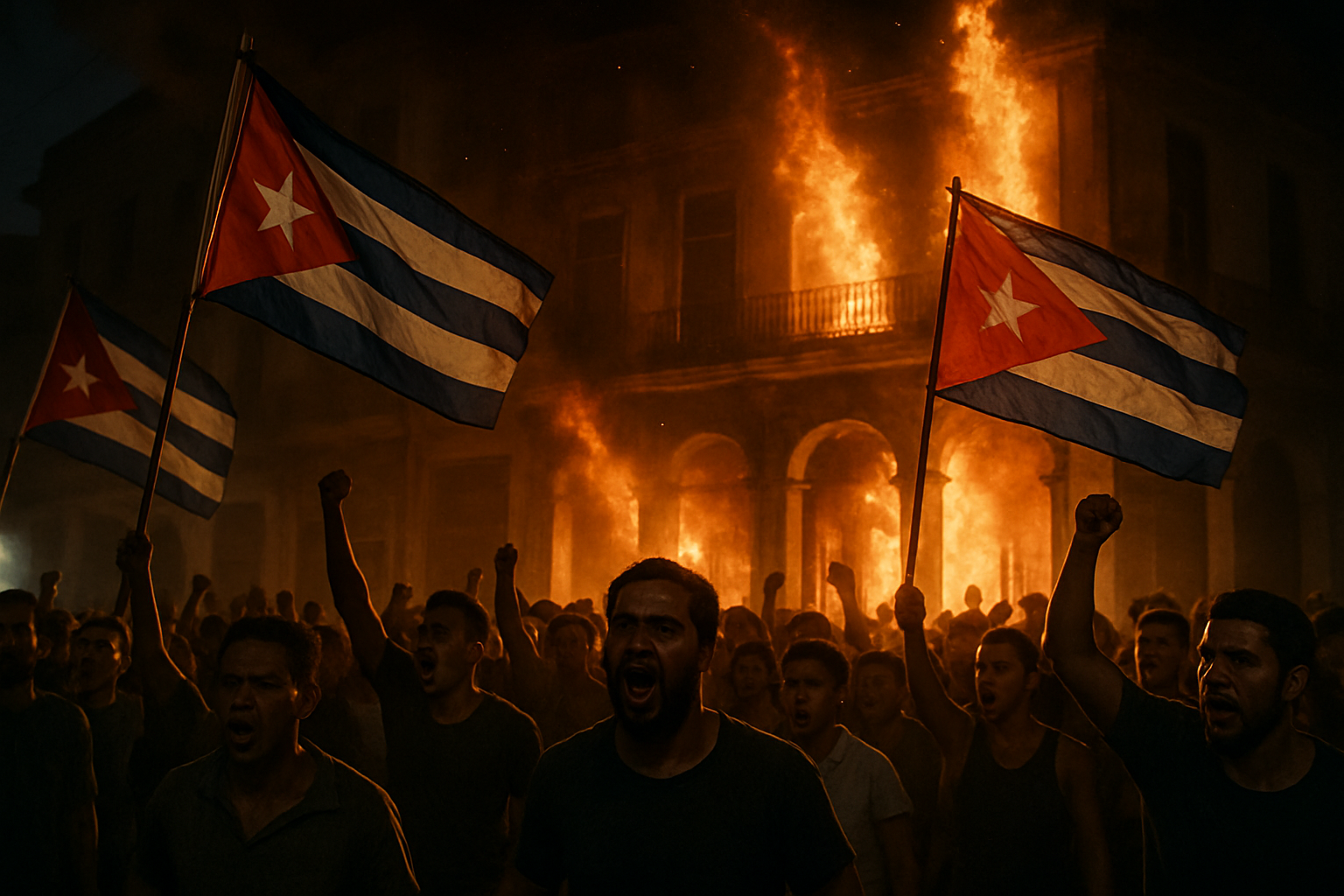
Anti-government protesters attacked and ransacked the Communist Party headquarters in Morón, Cuba, early Saturday morning, setting fire to office furniture, computers, and propaganda materials in the streets during a rare outburst of civil unrest triggered by the island's worst energy crisis since the 1990s Special Period.
The unprecedented attack occurred in the northern city of Morón, Ciego de Ávila province, on the night of March 13-14, 2026, as demonstrations against prolonged blackouts and food shortages escalated from peaceful rallies into violent confrontations with authorities. Videos circulating on social media showed large fires illuminating protesters' faces as they chanted "¡Libertad!" (Freedom) while dragging office equipment from the party building.
According to state-run newspaper Invasor and multiple independent sources, protesters forcibly entered the Communist Party municipal headquarters, removing furniture, computers, files, and propaganda posters before creating bonfires in nearby streets. The dramatic scenes, captured on cellphone videos despite internet restrictions, represent the most significant direct challenge to Communist Party authority in a generation.
Escalating Energy Crisis Fuels Public Anger
The attack comes amid Cuba's most severe energy emergency since the 1990s "Special Period," with the island facing complete aviation isolation, critical fuel shortages, and systematic infrastructure collapse. Currently, 51% of Cuba's population—approximately 5.5 million people—experience scheduled blackouts during peak hours, while oil reserves have dwindled to a critical 15-20 day supply.
The crisis intensified dramatically following President Trump's January 30, 2026 executive order threatening 25% tariffs on countries supplying oil to Cuba, which successfully forced Venezuela and Mexico to halt petroleum shipments despite humanitarian concerns. This "maximum pressure" campaign has achieved what officials describe as "total energy supply severance," exceeding even the hardships of the Special Period through deliberate policy rather than external collapse.
Cuban President Miguel Díaz-Canel has characterized the situation as an attempt at "total asphyxiation" of the island's economy, as domestic oil production has collapsed from 3 million to just 700,000 barrels daily, while the Cuban peso has hit a historic low of 500 units per dollar.
Civil Unrest Spreads Across the Island
The Morón incident represents the culmination of growing civil unrest across Cuba, with reports of "cacerolazos" (pot-banging protests) occurring in multiple cities. Witnesses described dozens of residents taking to the streets with flashlights from their mobile phones, chanting freedom slogans while confronting police forces attempting to disperse the crowds.
At least five people were reportedly detained during the confrontations in Morón, according to 14ymedio, an independent Cuban media outlet. The protesters, many illuminated only by their cellphone lights due to power outages, demonstrated remarkable coordination despite internet restrictions and government surveillance.
Cuban authorities have shifted their priorities to "defense of internal order" as the crisis deepens, implementing emergency measures including four-day government work weeks, closure of 90% of gas stations, and suspension of non-essential hospital surgeries. Universities have moved to semi-virtual operations while public transportation systems face near-complete paralysis.
Unprecedented Isolation and International Response
Cuba's crisis has been compounded by complete aviation isolation, with all nine major airports confirming zero jet fuel availability through March 11, 2026. This represents the most comprehensive aviation blockade since the 1962 Cuban Missile Crisis, affecting 400 weekly flights and 70,000 scheduled seats.
Major airlines including Air Canada, WestJet, Rossiya Airlines, and Nordwind have suspended all operations, leading to the emergency evacuation of over 25,000 tourists, including 21,000 Canadians and 4,000 Russians. Spanish hotel chains Meliá, Iberostar, and Blue Diamond have closed their Varadero and northern coast facilities, effectively ending Cuba's crucial winter tourism season.
International responses have been divided. Russia has condemned what it terms "economic strangulation" and pledged oil aid as humanitarian assistance. Former British Labour leader Jeremy Corbyn has announced plans for an international flotilla to challenge the blockade, while China has demanded the United States immediately cease its pressure campaign.
Mexico, despite suspending oil shipments to avoid US tariff retaliation, has maintained humanitarian aid through naval vessels carrying 814 tons of supplies. President Claudia Sheinbaum emphasized that Mexico "won't allow its territory to be used to pressure other nations" while navigating the delicate balance between regional solidarity and economic necessity.
Healthcare and Humanitarian Emergency
The energy crisis has created a humanitarian emergency affecting Cuba's 11 million inhabitants. Healthcare systems are severely compromised, with hospitals unable to maintain power for critical equipment, medicine storage threatened, and medical staff facing transportation difficulties. Eastern provinces, home to 3.4 million people, have been particularly affected following failures at the Holguín electrical substation.
The February 13 fire at the Ñico López oil refinery in Havana eliminated the island's remaining domestic petroleum processing capacity, while the March 4-5 collapse of the Antonio Guiteras thermoelectric power plant—Cuba's main power station—plunged two-thirds of the island into complete darkness for up to 72 hours.
European media outlets have characterized the situation as a "deliberately engineered humanitarian emergency," raising questions about the ethics and effectiveness of comprehensive economic pressure campaigns targeting entire civilian populations.
Historical Significance and Regional Implications
The attack on the Communist Party headquarters in Morón carries profound historical significance, representing the first time since the 1959 revolution that protesters have successfully stormed and damaged a major party facility. The symbolism of burning party propaganda and office equipment in the streets echoes revolutionary moments throughout Latin American history.
The crisis has broader implications for the Caribbean region, serving as a laboratory for testing 21st-century economic warfare capabilities. Trump's "Corolario Trump" strategy represents an updated Monroe Doctrine combining military pressure, economic coercion, and selective engagement to reshape hemispheric relationships.
Regional powers face increasingly difficult choices between maintaining traditional solidarity with Cuba and preserving crucial economic relationships with the United States. The success of the maximum pressure campaign in forcing even close allies like Venezuela and Mexico to comply with US demands demonstrates the gravitational pull of American economic influence.
Looking Ahead: Crisis Resolution or Deeper Confrontation
As Cuba enters its second month of unprecedented isolation, the path forward remains uncertain. Cuban authorities have provided no timeline for when the crisis might end, stating only that priorities have shifted to maintaining "internal order" amid growing social tensions.
The attack in Morón may represent either the beginning of broader civil unrest or an isolated incident that authorities can contain. However, with the underlying energy and economic crises showing no signs of resolution, the conditions that sparked this unprecedented challenge to Communist Party authority appear likely to persist.
The international community faces a critical test of how to respond to what many characterize as collective punishment of civilian populations through systematic economic isolation. The coming weeks will be decisive in determining whether diplomatic breakthroughs emerge or whether Cuba descends into deeper confrontation between an increasingly desperate government and a population pushed to its limits by infrastructure collapse and economic desperation.
The Morón incident thus stands as a watershed moment in modern Cuban history, potentially marking the beginning of a new chapter in the island's complex relationship with both its own government and the broader international community. As protesters' chants of "¡Libertad!" echoed through the darkened streets of Morón, they signaled that even six decades after the revolution, the Cuban people's desire for freedom and dignity remains unextinguished despite the most severe repression and economic hardship in generations.