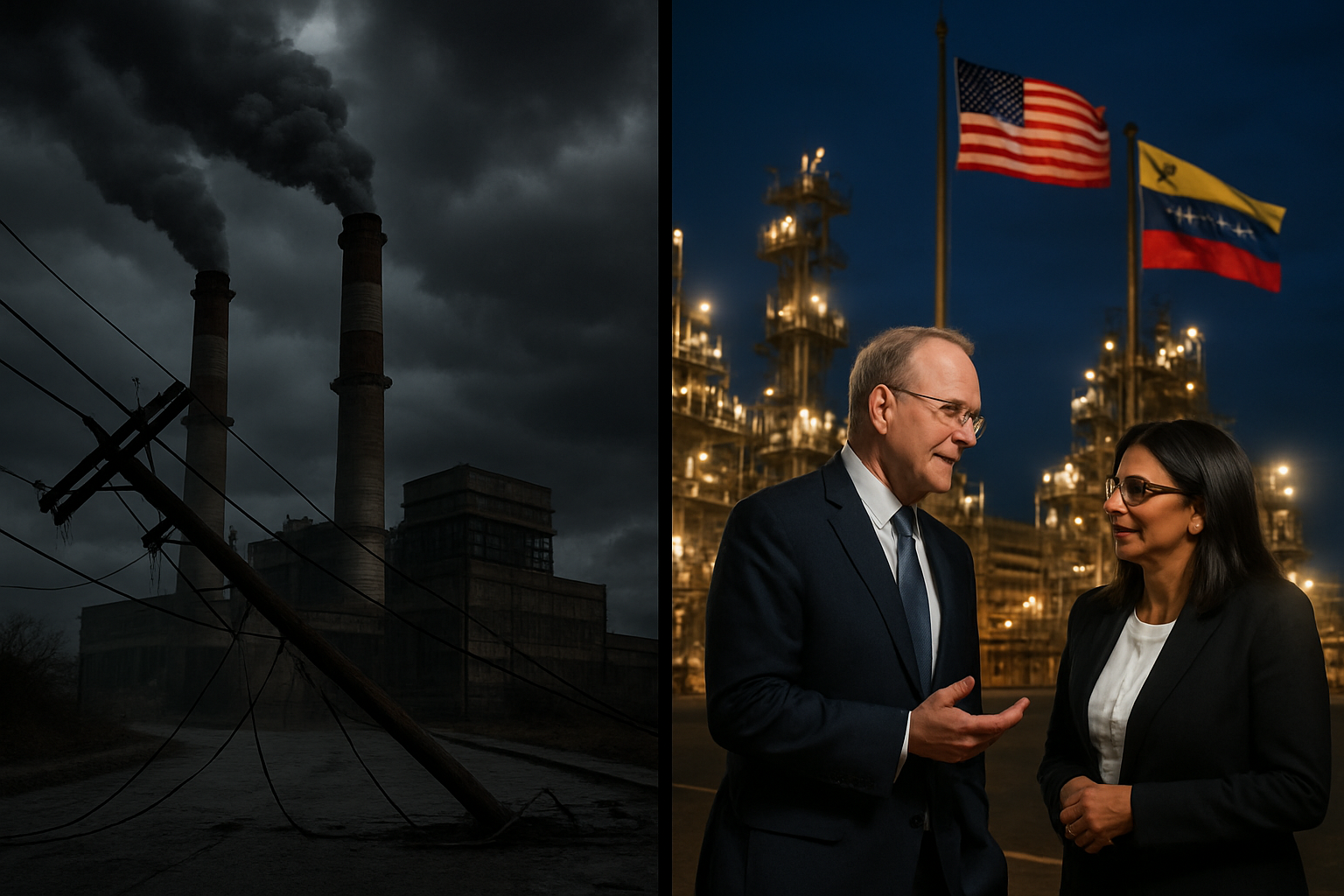
Cuba confronts its most severe energy crisis in decades with complete aviation isolation and widespread blackouts affecting millions, while just 1,000 miles away, US Energy Secretary Chris Wright signs a historic oil cooperation agreement with Venezuela's interim government, illustrating the stark geopolitical realignment reshaping the Caribbean region.
The contrasting fates of these two Caribbean nations encapsulate the Trump administration's "maximum pressure" approach toward Cuba while simultaneously forging unprecedented energy partnerships with Venezuela following the removal of Nicolás Maduro in January 2026.
Cuba's Energy Catastrophe Deepens
Cuba's energy emergency reached critical proportions this week as aviation authorities confirmed all nine international airports, including José Martí International in Havana, will have zero Jet A-1 fuel availability from February 10 through March 11, 2026. The aviation fuel shortage represents the most comprehensive flight isolation since the 1962 Cuban Missile Crisis.
Air Canada, WestJet, and Air Transat have officially suspended all flights to Cuba, leaving an estimated 21,000 Canadian tourists stranded on the island. These Canadian visitors represent nearly half of Cuba's current foreign tourist base, underscoring the tourism industry's complete collapse. Major Spanish hotel chains including Meliá and Iberostar have shuttered their Varadero and northern coast facilities, while Canada's government issued a "high degree of caution" travel advisory effectively ending the winter tourism season.
The aviation crisis stems from Cuba's broader energy emergency, with oil reserves down to just 15-20 days supply. Venezuelan crude shipments, previously a lifeline, have been completely halted following the political transition in Caracas. Mexico, under President Claudia Sheinbaum, suspended oil deliveries to avoid US retaliation under Trump's January 30 executive order threatening 25% tariffs on countries supplying oil to Cuba.
Widespread Blackouts and Emergency Measures
Cuba's state electricity company Unión Eléctrica reports that 51% of the population—approximately 5.5 million people—are experiencing scheduled blackouts during peak evening hours. The government has implemented drastic emergency measures unprecedented since the 1990s "Special Period" following the Soviet Union's collapse.
"We are facing a total asphyxiation attempt by the US government," Cuban President Miguel Díaz-Canel declared in a recent televised address, calling for dialogue with Washington while acknowledging the crisis's severity.
— Miguel Díaz-Canel, President of Cuba
Emergency restrictions include four-day government work weeks, semi-virtual university classes, suspension of non-essential public transportation, and closure of 90% of gas stations nationwide. Hospitals have suspended non-emergency surgeries due to power outages threatening medical equipment and medication storage. In eastern provinces, 3.4 million people lost power after the Holguín substation failure, while sugar harvests have been halted and international conferences canceled.
The healthcare system faces particular strain, with medical staff unable to reach hospitals due to transportation difficulties and critical equipment compromised by power instability. The crisis affects all aspects of daily life for Cuba's 11 million inhabitants, from basic food storage to communication networks.
Trump's Maximum Pressure Strategy
The current crisis represents the culmination of Trump's intensified economic pressure campaign against Cuba. His January 30 executive order threatening 25% tariffs on any country supplying oil to Cuba successfully forced Venezuela and Mexico to halt shipments, despite their stated humanitarian concerns.
European media outlets have characterized the situation as a "deliberately engineered humanitarian emergency," noting that unlike the 1990s Special Period caused by external economic collapse, the current crisis results from targeted US policy. The comprehensive nature of the isolation—including the complete severance of aviation connectivity maintained even during the worst years of the 1990s—marks a new dimension in economic warfare.
The effectiveness of Trump's approach is evident in its reach: Mexico's Sheinbaum, despite deploying naval vessels with 814 tons of humanitarian aid, bowed to US pressure by suspending oil shipments. Similarly, Venezuela's interim government under Acting President Delcy Rodríguez has prioritized US relations over traditional solidarity with Cuba.
Venezuela's Dramatic Energy Partnership with US
In stark contrast to Cuba's isolation stands Venezuela's remarkable transformation. Energy Secretary Chris Wright's February 12 tour of Chevron-PDVSA facilities in the Orinoco Belt alongside Acting President Delcy Rodríguez represents the highest-level US energy visit to Venezuela in nearly three decades.
Wright announced that US-controlled Venezuelan oil sales have already topped $1 billion since Maduro's removal, with an additional $5 billion expected in coming months. Venezuelan oil exports have surged 60% from 498,000 to 800,000 barrels daily since January, with the United States displacing China as Venezuela's top customer.
"This marks an absolutely dramatic turn in the trajectory of this nation. We're here to liberate the Venezuelan people and economy through unprecedented energy cooperation."
— Chris Wright, US Energy Secretary
The comprehensive energy cooperation agreement signed at Miraflores Palace encompasses oil, natural gas, and electricity production through American technical assistance and investment. Chevron has doubled its Venezuelan shipments while the US released 40 million barrels from strategic reserves to support the partnership.
Geopolitical Realignment in the Caribbean
The simultaneous Cuban crisis and Venezuelan breakthrough illustrates the Trump administration's "Corolario Trump"—a 21st-century update to the Monroe Doctrine combining military pressure with selective economic engagement. This Caribbean strategy serves as a testing ground for reimagined American hemispheric dominance.
Venezuela's rapid diplomatic evolution from maximum pressure target to strategic partner demonstrates the gravitational pull of systematically applied American economic power. The interim government's decision to halt oil shipments to Cuba in favor of US relations exemplifies how regional powers are being forced to choose between traditional solidarity and economic necessity.
Secretary of State Marco Rubio's three-phase reconstruction plan for Venezuela—stabilization, economic recovery, and democratic transition—provides a template for US engagement. The first phase has achieved immediate results with the release of over 400 political prisoners and the National Assembly's unanimous approval of comprehensive amnesty legislation.
International Humanitarian Concerns
The humanitarian implications of Cuba's crisis extend far beyond the island's borders. Medical evacuation capacity has been eliminated, severing Cuban-American family connections and affecting diaspora communities worldwide. The complete aviation isolation prevents not only tourism but essential supply chains for medical equipment, food, and other necessities.
International responses reflect growing concern about the use of economic coercion affecting civilian populations. An international flotilla led by figures including UK Labour leader Jeremy Corbyn has been announced to challenge the US oil blockade, representing the most significant international solidarity effort since Cuba's crisis began.
Russia has condemned the "economic strangulation" and officially confirmed plans to send crude oil and petroleum products to Cuba as humanitarian aid, directly challenging Trump's maximum pressure campaign. China has demanded Washington "immediately" cease its pressure campaign, escalating great power competition over hemispheric influence.
Regional Implications and Global Precedent
The Caribbean crisis tests the limits of economic coercion as a diplomatic tool while setting dangerous precedents for 21st-century international relations. The success of comprehensive economic isolation affecting entire populations raises questions about collective punishment policies and territorial sovereignty principles.
Mexico's position demonstrates both the reach and limits of US economic pressure. While Sheinbaum suspended oil shipments to avoid tariffs, she maintained humanitarian aid and declared Mexico "won't allow its territory to be used to pressure other nations." This balance reflects the complex calculations regional powers must make under US economic hegemony.
The Venezuelan partnership creates a template for bilateral energy diplomacy that could be applied globally as the Trump administration counters Chinese influence through strategic economic partnerships. The rapid transformation from adversary to ally demonstrates how economic incentives can reshape geopolitical alignments more effectively than military pressure alone.
Energy Security and Global Markets
The Caribbean energy realignment occurs against a backdrop of global energy volatility, with natural gas prices up 24% in Europe and 78% in the US. Oil markets have reflected the regional tensions, with prices rising over $1 per barrel on Cuban crisis developments and Middle Eastern tensions involving Iran.
Venezuela's production capacity, historically at 3 million barrels daily but collapsed to 700,000 under Maduro, represents enormous potential under US technical assistance. The partnership addresses both American energy security and Venezuelan economic recovery while demonstrating the strategic value of energy cooperation in geopolitical competition.
Cuba's domestic oil production, similarly collapsed from 3 million to 700,000 barrels daily, illustrates the vulnerability of small island states to external economic pressure when domestic resources prove insufficient for basic needs.
Looking Forward: Crisis Resolution or Extended Isolation
The coming weeks will determine whether Cuba's crisis leads to diplomatic breakthrough or extended isolation unprecedented in modern history. The international flotilla and Russian aid commitment represent potential challenges to US policy effectiveness, while Cuba's government faces the dual pressure of humanitarian emergency and political survival.
Venezuela's success as a US energy partner will influence the template's application elsewhere, potentially reshaping bilateral relationships throughout Latin America and beyond. The rapid diplomatic reversal from maximum pressure to strategic cooperation demonstrates both the power and limitations of economic coercion in achieving geopolitical objectives.
The stark contrast between Cuban isolation and Venezuelan partnership encapsulates the fundamental choice facing regional powers in the Trump era: alignment with US economic interests or confrontation with increasingly sophisticated tools of economic warfare. The outcome will influence international relations far beyond the Caribbean, establishing precedents for economic coercion, territorial sovereignty, and humanitarian protection in the 21st century.
As Cuba enters its second month of crisis with no clear resolution pathway, and Venezuela celebrates unprecedented US investment commitments, the Caribbean region serves as a laboratory for testing whether American economic dominance can be successfully reconfigured for an era of great power competition and institutional transformation.