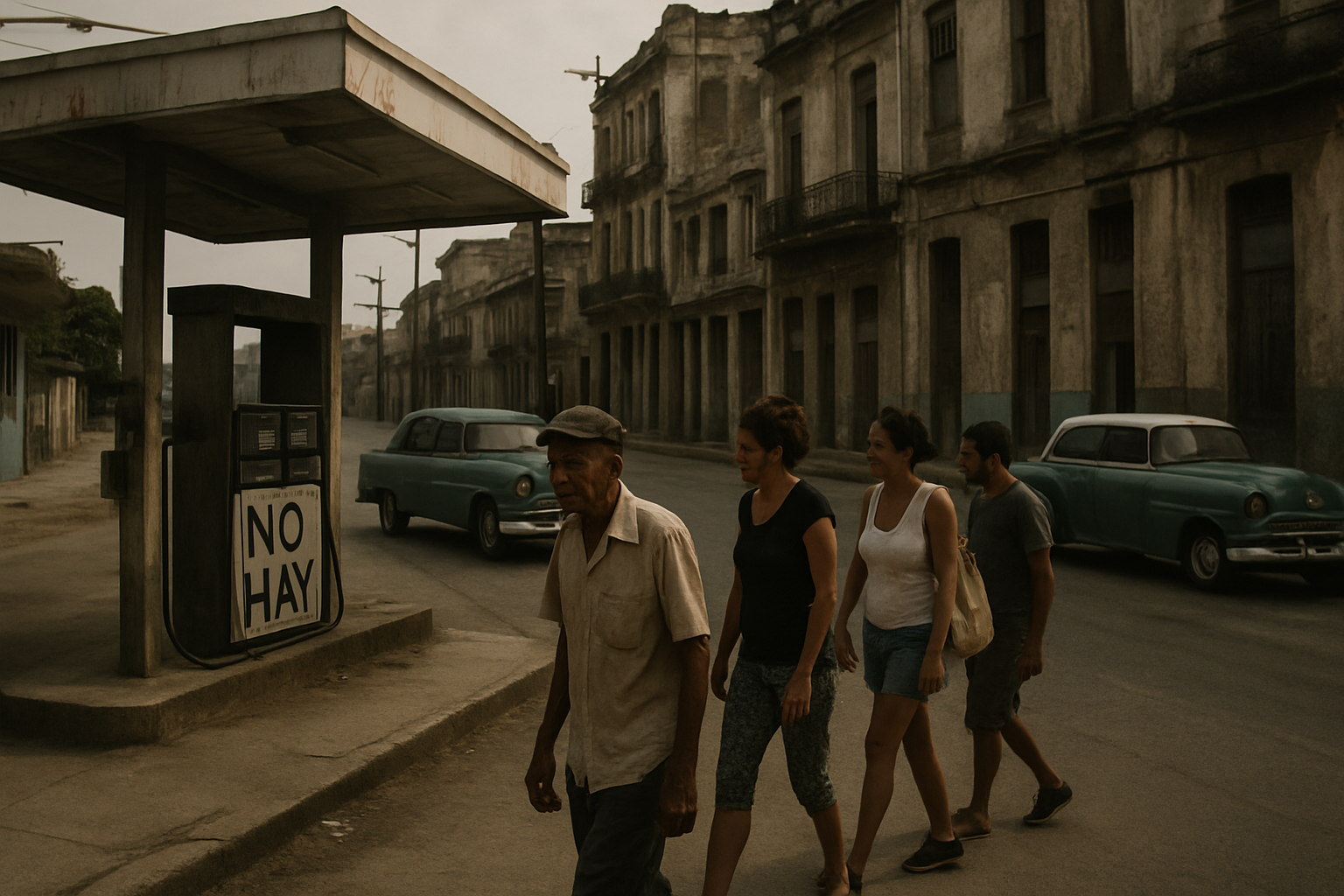
Cuba is experiencing its most severe humanitarian crisis since the 1990s "Special Period," with complete aviation isolation, critical fuel shortages affecting over half the population, and a deepening economic emergency that has prompted calls for international assistance while exposing the limits of regional solidarity.
The crisis, which has escalated dramatically since February 2026, represents what experts are calling a "deliberately engineered humanitarian emergency" that exceeds the severity of Cuba's previous worst economic collapse through systematic policy targeting rather than external collapse.
Complete Aviation Isolation Unprecedented
All nine of Cuba's international airports, including José Martí International in Havana, have been without aviation fuel since February 10, creating the most comprehensive aviation blockade since the 1962 Cuban Missile Crisis. The fuel shortage is expected to continue through March 11, 2026, affecting approximately 400 weekly flights and 70,000 scheduled seats.
Major international carriers have suspended all operations indefinitely. Air Canada, WestJet, and Air Transat organized emergency evacuations for over 21,000 stranded Canadian tourists, while Russian carriers Rossiya Airlines and Nordwind evacuated approximately 4,000 Russian visitors. The aviation crisis has effectively severed Cuba's connectivity to the outside world for the first time in modern history.
"Aviation fuel will not be commercially available at the island's airports effective immediately," Air Canada announced, highlighting the unprecedented nature of the crisis.
— Air Canada Official Statement
Energy Crisis Paralyzes Daily Life
The energy emergency has reached catastrophic proportions, with 5.5 million Cubans—51% of the population—experiencing scheduled blackouts during peak evening hours according to the state electricity company Unión Eléctrica. Oil reserves have dropped to a critical 15-20 day supply, while domestic production has collapsed from 3 million to just 700,000 barrels daily.
The government has implemented unprecedented emergency measures including four-day work weeks for government employees, semi-virtual university classes, and the closure of 90% of gas stations nationwide. Eastern provinces have been particularly affected, with 3.4 million people experiencing power outages after the failure of the Holguín electrical substation.
The situation worsened on February 13 when a major fire erupted at the Ñico López oil refinery in Havana, eliminating the island's remaining domestic petroleum processing capacity and sending thick black smoke columns visible across the capital.
Healthcare System Under Strain
Cuba's renowned healthcare system faces unprecedented challenges as hospitals suspend non-emergency surgeries due to power outages and fuel shortages affecting medical staff transportation. The medical evacuation capacity has been eliminated, effectively cutting off Cuban-American family connections and stranding patients requiring specialized treatment abroad.
Power outages threaten medicine storage and critical medical equipment, while healthcare workers struggle with transportation difficulties that prevent them from reaching their posts. The crisis has exposed the vulnerability of even Cuba's most celebrated institutions.
Tourism Industry in Freefall
The tourism sector, a crucial source of foreign currency, has collapsed entirely. Major Spanish hotel chains including Meliá and Iberostar have closed their Varadero and northern coast facilities, while Canadian operator Blue Diamond has shuttered operations. Canada issued a "high degree of caution" travel advisory, effectively ending the winter tourism season.
Cultural events have been canceled, including the prestigious Festival del Habano and a planned Vatican meeting with Pope Leo XIV, as organizers cite concerns about return travel arrangements. The crisis has isolated Cuba not just economically but culturally from the global community.
Trump Administration's Maximum Pressure Campaign
The humanitarian emergency stems directly from the Trump administration's renewed "maximum pressure" campaign, culminating in a January 30, 2026 executive order threatening 25% tariffs on any country supplying oil to Cuba. This policy has successfully forced both Mexico and Venezuela—Cuba's primary energy suppliers—to halt oil shipments despite humanitarian concerns.
President Trump has characterized the lack of fuel as creating a "humanitarian threat" while simultaneously pursuing complex diplomatic discussions with Cuba. The administration appears to be using the crisis as leverage to force negotiations, with Trump calling Cuba a "failed nation" that should "seek negotiations" to "return to being free."
"There doesn't have to be a humanitarian crisis," Trump responded when warned about the consequences of oil cutoffs.
— President Donald Trump
International Response Reveals Solidarity Limits
The crisis has exposed the practical limits of international solidarity with Cuba. Mexico, led by President Claudia Sheinbaum, has maintained humanitarian aid—delivering 814 tons of supplies via naval vessels Papaloapan and Isla Holbox—while suspending oil shipments to avoid U.S. economic retaliation.
Venezuela's new interim government, following the January 2026 removal of Nicolás Maduro, has completely halted crude oil shipments as it prioritizes rebuilding relations with the United States. This represents a dramatic shift from Venezuela's traditional role as Cuba's primary energy benefactor.
Russia has condemned what it calls "economic strangulation" and pledged to provide oil aid as humanitarian assistance, directly challenging U.S. policy. However, practical delivery remains complicated by logistics and potential U.S. countermeasures.
Regional Powers Face Difficult Choices
The crisis has forced Latin American countries to choose between maintaining solidarity with Cuba and preserving economic relationships with the United States. Several countries that historically provided support to Cuba have quietly wound down cooperation programs under U.S. pressure.
European media outlets have characterized the situation as a "deliberately engineered humanitarian emergency," raising questions about the morality and effectiveness of using economic pressure that primarily affects civilian populations. The European Union faces its own divisions over how to respond to the crisis.
Historical Context and Precedent
While Cuba experienced severe economic hardship during the 1990s "Special Period" following the Soviet Union's collapse, the current crisis is fundamentally different. Unlike the previous emergency, which resulted from external economic collapse, today's humanitarian emergency is the product of deliberate U.S. policy designed to create maximum pressure on the Cuban government.
The complete aviation connectivity severance is unprecedented in modern Cuban history, going beyond even the restrictions of the 1962 Cuban Missile Crisis when some international connections were maintained. The systematic nature of the current isolation has created what experts describe as a template for 21st-century economic siege warfare.
Implications for International Law
The Cuban crisis raises significant questions about international law and the limits of economic coercion. Legal scholars debate whether the comprehensive targeting of civilian infrastructure and services crosses lines established by international humanitarian law, even when applied through economic rather than military means.
The success or failure of the U.S. approach toward Cuba is being closely watched globally as a potential template for economic warfare capabilities in the 21st century, with implications for how great powers might handle territorial disputes and political conflicts in the future.
Uncertain Path Forward
Cuban President Miguel Díaz-Canel has called the situation "total asphyxiation" while appealing for dialogue with the United States. The government has shifted its priorities to "defense and internal order," with no timeline provided for when the current restrictions might be lifted.
Resolution of the crisis appears to require either a diplomatic breakthrough between Cuba and the United States, alternative supply arrangements that can circumvent U.S. pressure, or fundamental changes to Cuba's energy infrastructure that would reduce dependence on imports.
As the crisis enters its second month with no clear resolution pathway, the international community faces a critical test of how to respond to economic coercion that creates collective punishment for civilian populations. The outcome will likely influence approaches to humanitarian protection, territorial sovereignty, and international cooperation for years to come.
For Cuba's 11 million inhabitants, the immediate focus remains on surviving what has become the most severe isolation in the island's modern history, while the world watches to see whether innovative diplomatic solutions can emerge or whether the crisis will set dangerous precedents for comprehensive economic warfare in the 21st century.