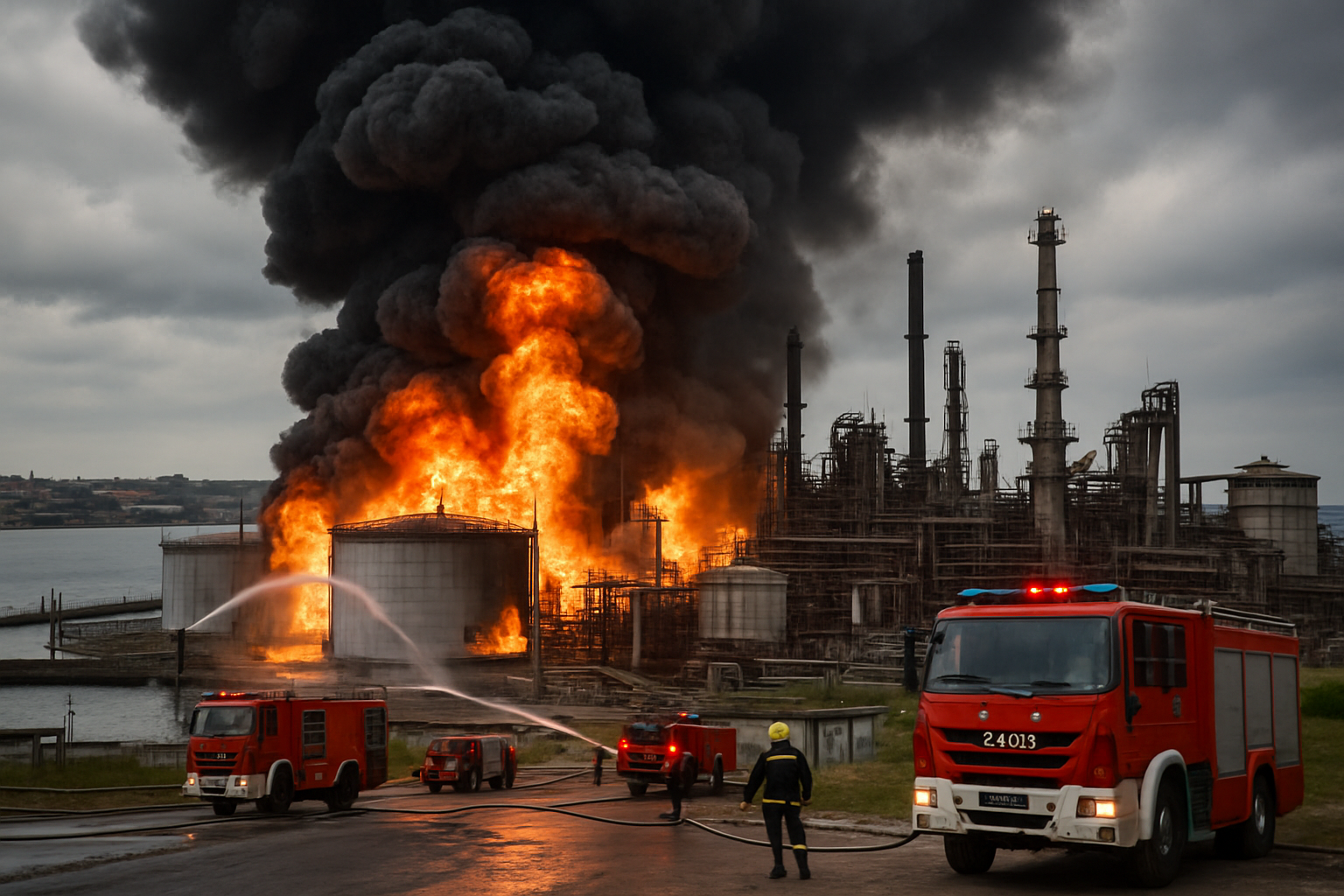
A major fire erupted at Cuba's Ñico López oil refinery in Havana on February 13, 2026, sending massive columns of thick black smoke across the capital city as the island nation grapples with its most severe energy crisis in decades.
The blaze at one of Cuba's few functioning refineries began during the afternoon hours, creating a dense smoke plume visible from kilometers away according to multiple international media reports. Cuban authorities have not yet officially reported casualties or disclosed the cause of the incident at the facility located in Havana Bay.
The fire represents a catastrophic escalation of Cuba's ongoing energy emergency, which has already left the island virtually isolated from international aviation and struggling with critical fuel shortages. The Ñico López refinery, a crucial component of Cuba's energy infrastructure, previously experienced a fire incident in May 2022 but had continued operations despite deteriorating conditions.
Critical Infrastructure Under Strain
The refinery fire occurs as Cuba faces what officials describe as complete "asphyxiation" of its energy supply. According to Mexican media reports, the island's refineries have suffered significant deterioration due to the inability to import spare parts and modernization materials under ongoing U.S. sanctions.
Cuba's domestic oil production has collapsed from a peak of 3 million barrels daily to just 700,000 barrels, forcing the island to rely heavily on imports that have now been completely severed. Venezuelan crude shipments, which previously sustained Cuba's energy needs, were halted following the removal of Nicolás Maduro's government in January 2026.
The energy crisis has reached unprecedented proportions, with Cuban authorities confirming that aviation fuel remains unavailable at all nine major airports through March 11, 2026. This has led to complete aviation isolation, with major international carriers including Air Canada, WestJet, and Russian airlines suspending all flights and evacuating stranded tourists.
Escalating Humanitarian Emergency
The refinery fire compounds an already dire humanitarian situation affecting Cuba's 11 million inhabitants. According to state electricity company Unión Eléctrica, 51% of the population currently experiences scheduled blackouts during peak evening hours as the government implements comprehensive emergency measures.
These measures include four-day work weeks for government employees, semi-virtual university classes, suspension of non-emergency hospital surgeries, and closure of 90% of gas stations. The eastern provinces, home to 3.4 million people, have been particularly affected by power outages following failures at the Holguín electrical substation.
Healthcare systems across the island face critical challenges, with medical staff unable to travel to work, power outages threatening medicine storage and critical equipment, and the elimination of medical evacuation capacity due to aviation fuel shortages.
Tourism Industry Devastation
The energy crisis has devastated Cuba's vital tourism sector, with major Spanish hotel chains including Meliá and Iberostar closing facilities in Varadero and along the northern coast. Canadian operator Blue Diamond has similarly shuttered operations due to staff transportation difficulties.
Canada, which typically provides nearly half of Cuba's foreign visitors, issued a "high degree of caution" travel advisory that effectively ended the winter tourism season. Approximately 21,000 Canadian tourists required emergency evacuation flights, while 4,000 Russian tourists faced similar repatriation efforts.
The Cuban bishops' conference cancelled a planned meeting with Pope Leo XIV at the Vatican, citing concerns about return travel capabilities. This level of international isolation exceeds even the hardships of Cuba's 1990s "Special Period" following the Soviet collapse.
International Response and Geopolitical Context
The energy crisis stems from the Trump administration's "maximum pressure" campaign, implemented through a January 30, 2026 executive order threatening 25% tariffs on countries supplying oil to Cuba. This policy successfully forced Mexico and Venezuela to suspend petroleum shipments despite humanitarian concerns.
Mexico has maintained limited humanitarian assistance, deploying naval vessels Papaloapan and Isla Holbox carrying 814 tons of supplies, while President Claudia Sheinbaum emphasized that Mexico "won't allow its territory to be used to pressure other nations." However, oil shipments remain suspended to avoid U.S. economic retaliation.
European media have characterized the situation as a "deliberately engineered humanitarian emergency," while Russia condemned what it termed "economic strangulation." Chinese officials have demanded that Washington "immediately" cease pressure on Cuba, highlighting the crisis's role in broader great power competition.
Historical Precedent and Regional Implications
The current crisis represents the most comprehensive economic isolation Cuba has faced since the 1962 missile crisis. Unlike the 1990s Special Period, which resulted from external economic collapse, the current emergency stems from deliberate U.S. policy targeting the entire Cuban population.
International observers note that this approach creates dangerous precedents for 21st-century economic warfare, demonstrating how modern powers can achieve near-complete isolation of small island states through systematic targeting of energy infrastructure and transportation networks.
The success of the U.S. campaign in forcing regional allies like Mexico to comply with pressure despite ideological sympathy for Cuba illustrates the gravitational pull of American economic influence across the Western Hemisphere.
Uncertain Resolution Timeline
Cuban officials have provided no timeline for resolving the current emergency, with government priorities shifted to "defense and internal order." The refinery fire eliminates one of the few remaining domestic processing capabilities, potentially extending the crisis indefinitely without diplomatic intervention.
International flotillas led by figures including UK Labour leader Jeremy Corbyn have announced plans to challenge the blockade through humanitarian aid missions, though their practical impact remains uncertain given the scale of Cuba's energy infrastructure collapse.
The crisis tests international law principles regarding collective punishment of civilian populations and could influence future approaches to economic coercion as a diplomatic tool. With Cuba's peso hitting historic lows of 500 units per dollar, the island faces economic pressures that exceed any previous emergency in its modern history.
The international community now faces critical decisions about how to respond to what many characterize as a humanitarian emergency affecting millions of civilians, while the United States maintains that Cuba can end its suffering simply by pursuing democratic reforms and dialogue.