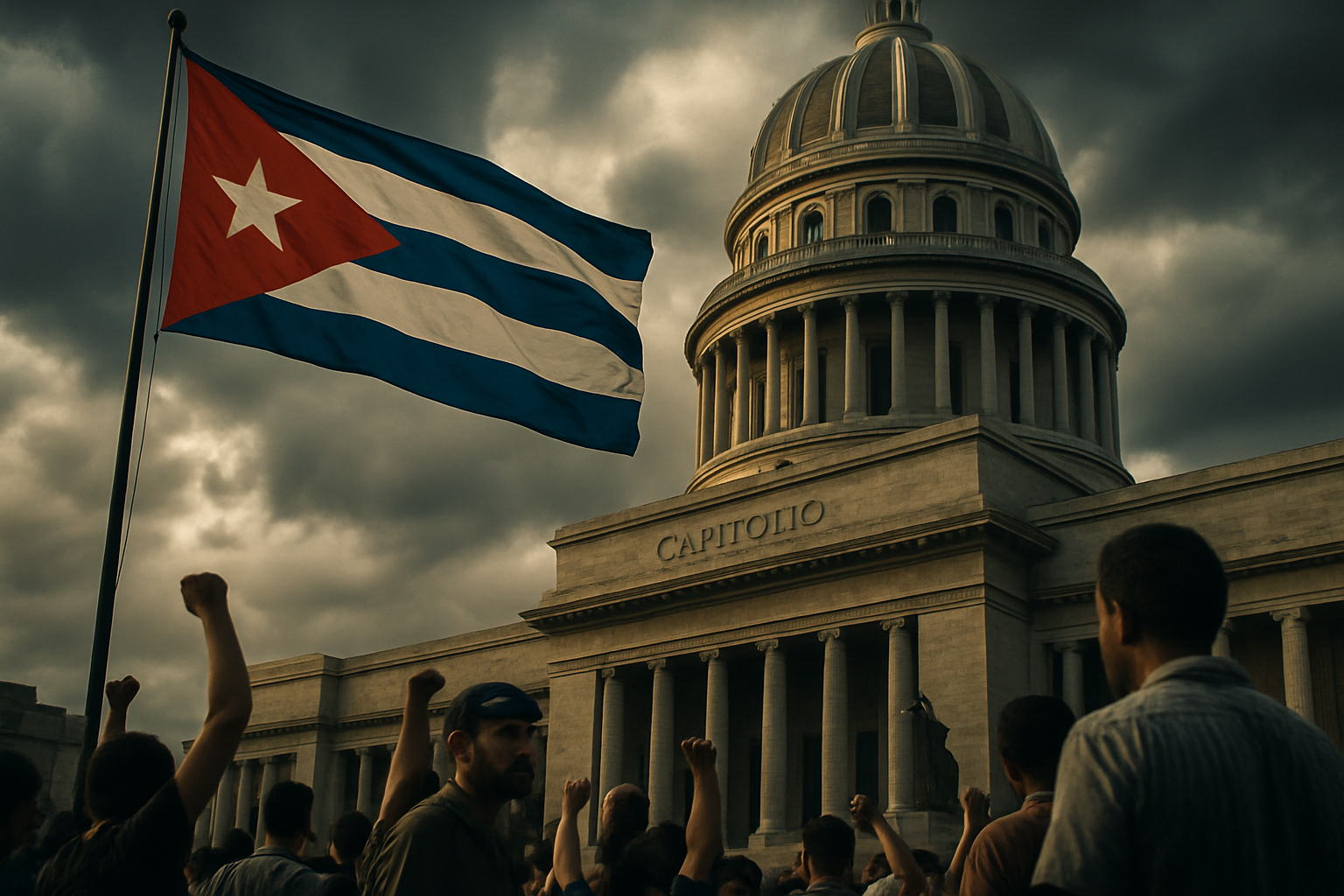
Cuba is experiencing its most severe political and humanitarian crisis since the 1990s Special Period, with widespread protests erupting across the island and cultural icon Silvio Rodríguez receiving an AKM rifle from government officials in a symbolic gesture highlighting the regime's siege mentality.
The Caribbean nation faces multiple converging crises that have plunged it into unprecedented turmoil. Nationwide blackouts affecting millions, systematic infrastructure collapse, and rising civil unrest have created what energy experts describe as a "zero hour" moment for the Cuban government.
Protests Reach Government Strongholds
In a historic breakthrough for Cuban dissent, protesters successfully stormed Communist Party headquarters in Morón, Ciego de Ávila on March 13-14, chanting "¡Libertad!" and burning party materials - marking the first successful attack on a major party facility since the 1959 revolution. The incident represents a watershed moment in Cuban political resistance.
The protests have spread to areas traditionally supportive of the government, with "cacerolazos" (pot-banging demonstrations) reaching neighborhoods where military officials, government functionaries, and state journalists reside. These areas, once considered regime strongholds populated by loyal "comuñangas" and "sarampionosos," have joined the cacophony of indignation in recent days.
"Even with an initial proportion of 'comuñangas' and 'sarampionosos' neighbors, this zone has banged the pots of indignation several times in the last few days."
— Local report from 14ymedio
Silvio Rodríguez and the Regime's Symbolic Response
In a bizarre and deeply symbolic gesture, the Cuban government delivered an AKM assault rifle to legendary singer-songwriter Silvio Rodríguez during a ceremony attended by President Miguel Díaz-Canel and Defense Minister Álvaro López Miera. The 79-year-old troubadour had previously stated he was prepared to take up arms if the United States attacked Cuba.
The weapon presentation, conducted with the regime's top leadership present, carries grotesque undertones given Rodríguez's advanced age and artistic background. The ceremony reflects the government's narrative that "every citizen is essentially a soldier in potential" ready to defend the revolution against foreign aggression.
Rodríguez belongs to a generation of artists who experienced the structural distrust of power firsthand, making his current alignment with the regime particularly significant for understanding the cultural dimensions of Cuba's political crisis.
Student Protests Challenge Official Control
The crisis has extended to Cuba's universities, where students have defied official control with unprecedented protests. The University of Havana's iconic steps have become a focal point for peaceful sit-ins, challenging the government's authority in spaces traditionally under strict state supervision.
Despite the mounting pressure, the Ministry of Higher Education has refused to suspend classes, attempting to maintain normalcy even as protests continue. The government's response reveals both its determination to project control and its recognition that educational institutions represent critical battlegrounds for public opinion.
Mass Detentions and Repression
The Cuban authorities have responded to the protests with systematic repression. According to independent reports, 51 people have been detained for participating in demonstrations over the past 11 days. Among those detained is Ariel Alemán, who participated in a pot-banging protest in Regla municipality, Havana, and later appeared in Vivac prison.
The detention campaign represents the government's attempt to suppress dissent through intimidation and incarceration, following patterns established during previous waves of protest in 2021 and earlier periods of unrest.
International Humanitarian Response
The crisis has prompted international humanitarian interventions despite political tensions. Italy has prepared to deliver 50 tons of medical supplies and solar panels worth €500,000 to Cuba via the cargo ship Granma 2.0, including 100 solar panels to help address the energy crisis.
From Miami, an international humanitarian convoy called "Nuestra América" departed for Havana with approximately 140 people, aiming to deliver nearly 20 tons of supplies including medical equipment, food, and solar equipment. The initiative, supported by international organizations, unionists, and activists, represents rare cooperation across political divides for humanitarian purposes.
"This initiative, carried by an international coalition of organizations, unionists and militants, plans to deliver nearly 20 tons of supplies by air and sea."
— Convoy organizers
Regional and International Perspectives
The international community has responded with mixed approaches to Cuba's crisis. Saint Lucia's government issued a statement emphasizing Cuba's role as a "loyal and supportive friend in the region," noting that "for over thirty years, the Cuban people have given generously, expecting nothing in return."
This Caribbean solidarity contrasts with perspectives from other regions. Swedish media analysis suggests that "no other country in Latin America and the Caribbean evokes such strong feelings as Cuba," with political positions ranging from support for regime change to defense of the authoritarian government's historical achievements.
The crisis has also highlighted the complex networks supporting authoritarian regimes globally. Analysis from Havana Times suggests that what supporters call "internationalism" or "solidarity" often serves as a legitimizing argument for defending authoritarian governments, complicating international responses to the Cuban situation.
Energy Crisis Compounds Political Turmoil
Cuba's political crisis occurs against the backdrop of its worst energy emergency since the 1990s Special Period. The nation faces critical oil reserves of only 15-20 days, with domestic production having collapsed from 3 million to 700,000 barrels daily. The February Ñico López refinery fire eliminated domestic processing capacity, exacerbating the energy shortage.
The crisis has forced the evacuation of over 25,000 tourists, including 21,000 Canadians and 4,000 Russians, due to complete aviation isolation through March 11. Major hotel chains including Meliá, Iberostar, and Blue Diamond have closed facilities, devastating the tourism industry that serves as a crucial source of foreign currency.
Implications for Cuban Society
The convergence of political protests, energy collapse, and international pressure represents the most serious challenge to the Cuban government since the revolution. The successful storming of party headquarters, the spread of protests to government-supporting neighborhoods, and the regime's symbolic arming of cultural figures like Silvio Rodríguez all point to a system under unprecedented stress.
The crisis tests whether Cuba's political system can adapt to mounting pressures or whether the current situation represents the beginning of more fundamental political transformation. The government's prioritization of "defense of internal order" suggests recognition that its primary challenge now comes from domestic rather than foreign sources.
Looking Forward
As Cuba continues to face this multifaceted crisis, several factors will determine the outcome: the government's ability to restore basic services, the sustainability of protest movements, the effectiveness of international pressure or support, and the regime's capacity for political adaptation.
The situation remains fluid, with daily developments reshaping the political landscape. Whether Cuba emerges from this crisis with renewed stability under the current system or experiences more fundamental political change will depend on how these various pressures interact in the coming weeks and months.
The symbolic handing of a rifle to Silvio Rodríguez, while protesters storm party headquarters for the first time in over six decades, encapsulates the contradictions and tensions that define Cuba's current historical moment - a nation caught between defending an aging revolution and confronting the aspirations of a new generation demanding change.