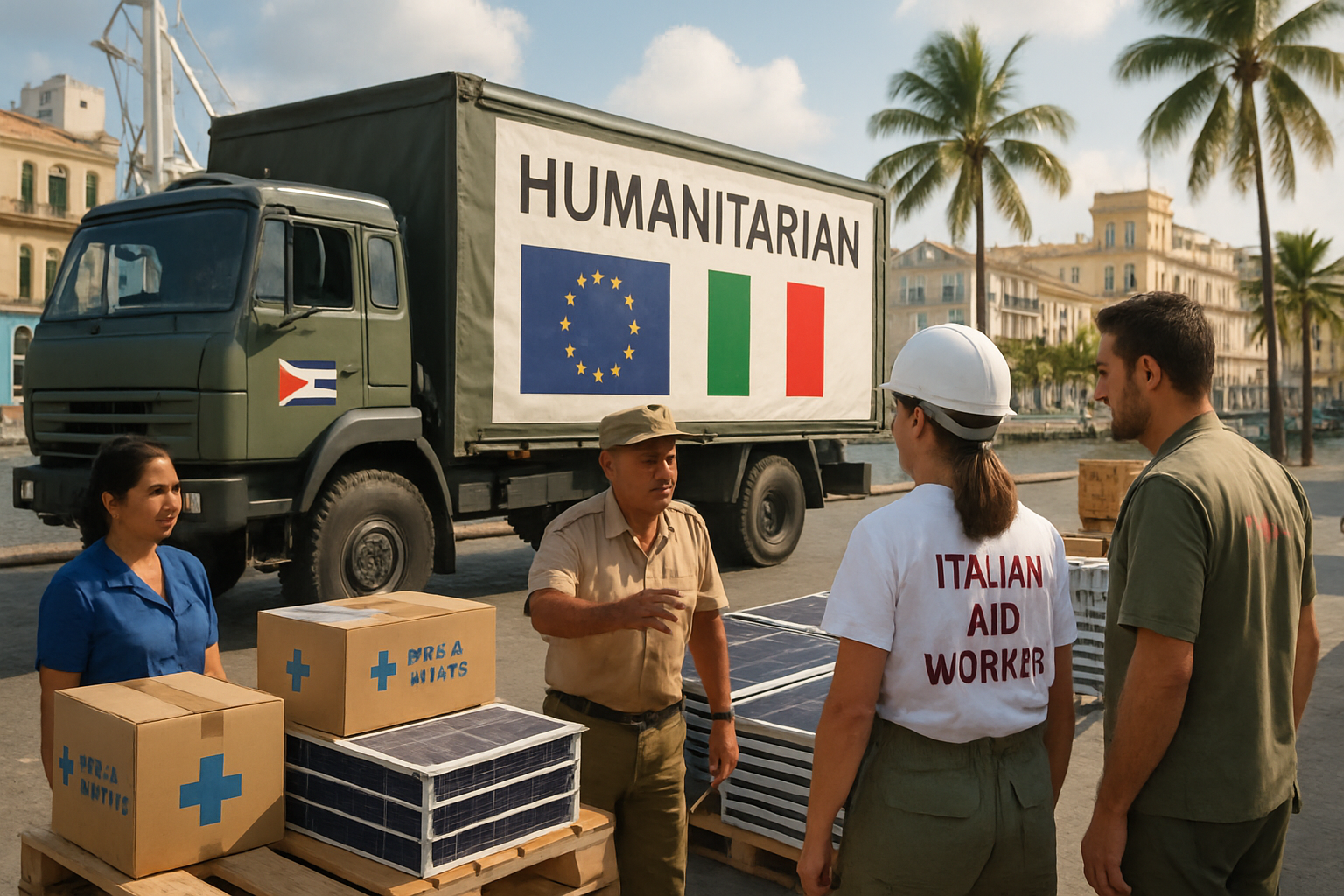
Cuba received a vital humanitarian lifeline from Italy as President Trump escalated his rhetoric about taking control of the embattled island nation, declaring he could "do anything I want" with Cuba while the country experiences its most severe crisis since the 1990s Special Period.
The Italian convoy carrying five tons of medical supplies and solar panels worth €500,000 arrived in Havana on March 19, representing a crucial intervention as Cuba faces unprecedented isolation under Trump's maximum pressure campaign. The aid delivery coincided with Trump's most explicit statements about Cuban control since the 1960s, creating a stark contrast between European humanitarian concerns and American geopolitical ambitions.
Trump's Most Direct Control Statements in Decades
President Trump's March 17 Oval Office remarks marked the most explicit U.S. discussion of Cuban control since the 1960s. "I will have the honor of taking Cuba in some form," Trump declared, describing the island as "very weakened" and a "failed nation with nice landscape." These statements represent a dramatic escalation from his February "friendly takeover" comments, positioning Cuba as potentially the next target after resolving the Iran crisis.
The President claimed Secretary of State Marco Rubio is conducting negotiations "at very high level," though Cuban officials have not publicly confirmed such talks. Trump's rhetoric comes as Cuba enters its second month of unprecedented economic isolation, with his January 30 executive order successfully forcing Venezuela and Mexico to halt oil shipments despite historical solidarity commitments.
Humanitarian Crisis Reaches Breaking Point
The Italian aid arrives amid Cuba's worst humanitarian emergency since the 1990s Special Period. The island has experienced complete aviation isolation with zero jet fuel at all nine airports through March 11, forcing the evacuation of over 25,000 foreign tourists, including 21,000 Canadians and 4,000 Russians. Major airlines including Air Canada, WestJet, and Russian carriers suspended operations indefinitely.
Cuba's infrastructure has suffered systematic collapse, with 51% of the population (5.5 million people) experiencing scheduled blackouts. Oil reserves remain at critical 15-20 day supply levels, while domestic production has collapsed from 3 million to 700,000 barrels daily. The February 13 Ñico López refinery fire eliminated remaining domestic processing capacity, compounding the crisis indefinitely.
The healthcare system faces unprecedented strain with surgery suspensions, medical evacuation elimination, and power outages threatening critical equipment and medicine storage. Eastern provinces, home to 3.4 million residents, have been particularly affected by Holguín substation failures.
Historic Civil Unrest Challenges Communist Authority
In an unprecedented development, protesters on March 13-14 stormed the Communist Party headquarters in Morón, Ciego de Ávila, chanting "¡Libertad!" while burning party materials. This marked the first successful attack on a major party facility since the 1959 revolution, representing a direct challenge to Communist authority amid infrastructure collapse.
Widespread "cacerolazos" (pot-banging protests) have spread across multiple cities, forcing the government to shift priorities to "defense of internal order." The civil unrest highlights the unprecedented nature of the current crisis, which Cuban energy expert Jorge Piñón of the University of Texas describes as reaching "zero hour" - a critical point where energy reserves are insufficient for basic services without immediate intervention.
International Response: Solidarity vs. Pressure
The Italian humanitarian aid convoy represents broader European concern about what media outlets have characterized as a "deliberately engineered humanitarian emergency." Spain has announced plans to provide humanitarian aid through UN channels following a Madrid meeting between Foreign Minister José Manuel Albares and Cuban Foreign Minister Bruno Rodríguez.
Russia has condemned the "economic strangulation" and pledged oil aid as humanitarian assistance, though no timeline has been provided. China has demanded the U.S. immediately cease pressure on Cuba, while former UK Labour leader Jeremy Corbyn has announced an international flotilla to challenge the blockade.
Mexico maintains a delicate balance, providing 814 tons of humanitarian supplies via naval vessels Papaloapan and Isla Holbox while suspending oil shipments to avoid U.S. economic retaliation. President Claudia Sheinbaum's position demonstrates the limits of regional solidarity when confronted with American economic pressure.
Tourism Industry Devastation
The tourism sector has experienced complete collapse, with major Spanish hotel chains Meliá and Iberostar closing their Varadero and northern coast facilities. Canadian Blue Diamond resorts have also shuttered operations. Canada issued its highest-level travel advisory, effectively ending the winter tourism season that typically provides crucial foreign currency for the island.
The Festival del Habano was cancelled, and Cuban bishops cancelled a scheduled Vatican meeting with Pope Leo XIV, citing concerns about return travel. The industry is in "freefall" according to analysts, with international conferences suspended and the sugar harvest halted due to transportation paralysis.
"Corolario Trump" Strategy Tested
The Cuba crisis represents a key test of what analysts have termed the "Corolario Trump" - a 21st-century update to the Monroe Doctrine combining military pressure, economic coercion, and selective engagement for hemispheric dominance. The strategy has achieved notable success with Venezuela, where maximum pressure transformed into strategic partnership after Nicolás Maduro's January 2026 capture.
Venezuelan oil exports surged 60% to 800,000 barrels daily following sanctions relief, with the U.S. displacing China as the top customer. This template is now being applied to Cuba, though the island faces different challenges due to its political structure and economic base.
The maritime dimension adds lethal complexity to the crisis. A February 25 incident saw Cuban coast guards kill four and wound six aboard a Florida speedboat in territorial waters - the most serious bilateral incident in years, occurring within the broader Operation Southern Spear that has resulted in 145+ deaths since September 2025.
Regional Powers Face Difficult Choices
The crisis forces Caribbean nations to choose between traditional solidarity with Cuba and maintaining relationships with the United States. Trinidad and Tobago Prime Minister Kamla Persad-Bissessar has controversially dismissed CARICOM's "zone of peace" policy, creating fundamental breaches in Caribbean diplomatic norms.
The success of Trump's pressure campaign demonstrates the gravitational pull of systematically applied American economic power, forcing regional compliance despite ideological commitments. Several countries have quietly wound down Cuban medical programs under pressure, though Jamaica maintains 300 medical personnel with uncertain renewal prospects.
Historical Significance and Global Implications
The current crisis exceeds the 1990s Special Period in severity through systematic U.S. policy targeting rather than external collapse. Complete aviation connectivity severance has not occurred since the 1962 Cuban Missile Crisis, making this the most comprehensive economic isolation in modern Cuban history.
The crisis sets dangerous precedents for 21st-century economic warfare capabilities affecting entire civilian populations through energy and transportation targeting. Success would provide a template for systematic isolation of small states, while failure could establish concerning precedents for comprehensive economic siege warfare.
International law experts worry about the normalization of collective punishment affecting civilian populations beyond political objectives. The template demonstrates how small island states remain vulnerable to external coercion despite international sovereignty principles.
Path Forward Uncertain
Resolution requires either diplomatic breakthrough, alternative supply arrangements circumventing U.S. pressure, or fundamental changes to Cuban energy infrastructure. Cuban authorities have provided no timeline for restriction removal, with government priorities shifted to maintaining internal order.
The international community faces an unprecedented test of how to respond to economic coercion affecting collective punishment of civilian populations. The Italian humanitarian aid represents one model of response, but the scale of Cuba's crisis requires much broader intervention.
As Cuba enters its third month of unprecedented isolation, the stakes extend far beyond bilateral relations to questions of territorial sovereignty, humanitarian protection principles, and economic coercion limits in the 21st century. The outcome will influence how great powers approach similar challenges globally, potentially reshaping international relations for decades to come.
The convergence of humanitarian crisis and geopolitical competition in the Caribbean serves as a laboratory for testing American hemispheric dominance reconfiguration. Whether diplomatic solutions emerge or the crisis establishes new precedents for economic warfare will determine both Cuba's immediate future and broader international order adaptation for the multipolar era.