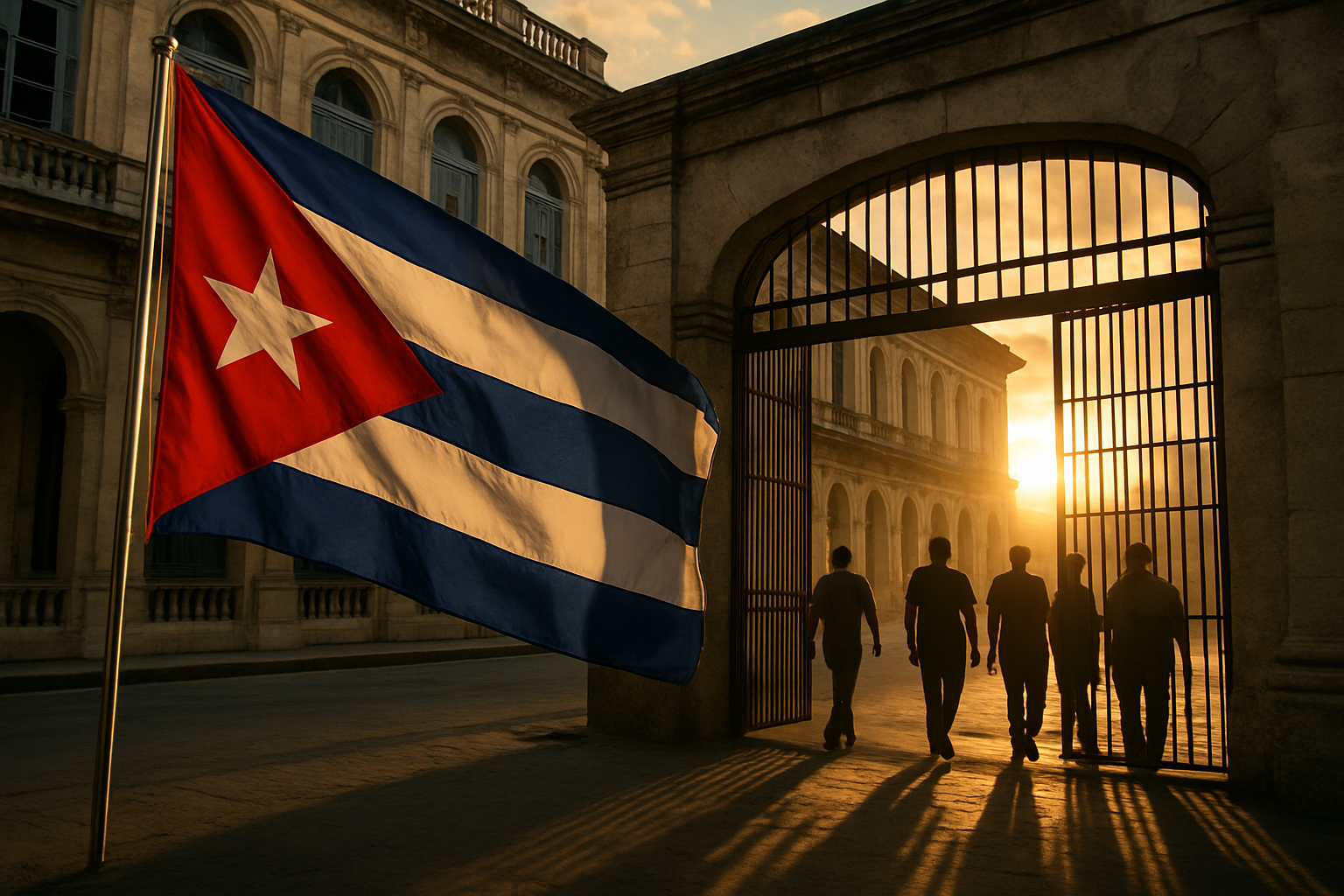
Cuba announced plans to release 2,010 prisoners during Holy Week, marking one of the largest prisoner pardons in the island's recent history, as the nation grapples with its most severe crisis since the 1990s Special Period amid unprecedented US economic pressure.
The Cuban government characterized the mass pardon as a "humanitarian gesture" coinciding with the Christian Holy Week observances, according to multiple sources reporting the announcement Thursday. The release excludes individuals convicted of serious crimes including murder and drug trafficking offenses.
Crisis Context: Deliberate Isolation vs Historical Collapse
The prisoner release comes as Cuba endures what experts describe as a crisis exceeding even the catastrophic 1990s Special Period, but this time resulting from deliberate US policy rather than external economic collapse. The island has faced complete aviation isolation since February 2026, with zero jet fuel available at all nine airports, effectively severing Cuba's connection to the outside world.
Switzerland's NZZ reported that Havana wants the pardons understood as an Easter gesture, but noted the releases could be connected to potential loosening of the American oil embargo. The timing suggests Cuba may be seeking diplomatic openings amid mounting humanitarian pressures.
More than 25,000 tourists have been evacuated from the island, including 21,000 Canadians and 4,000 Russians, after major airlines including Air Canada, WestJet, and Air Transat suspended all flights. The aviation blockade represents the most comprehensive connectivity severance since the 1962 missile crisis.
Energy Strangulation and Humanitarian Impact
Cuba's energy crisis has reached critical proportions, with 51% of the population—approximately 5.5 million people—experiencing scheduled blackouts during peak hours. Oil reserves have dwindled to a critical 15-20 day supply after Venezuelan crude shipments completely halted and Mexican deliveries were suspended following President Trump's January 30 executive order threatening 25% tariffs on countries supplying oil to Cuba.
The healthcare system faces unprecedented challenges, with hospital surgery suspensions, power outages threatening medicine storage and critical equipment operations, and medical evacuation capacity completely eliminated. Eastern provinces housing 3.4 million residents remain particularly affected by the Holguín substation failure.
Tourism infrastructure has collapsed, with major hotel chains including Meliá, Iberostar, and Blue Diamond closing facilities along the Varadero and northern coast. Canada issued a "high degree of caution" travel advisory, effectively ending winter tourism that traditionally provides crucial foreign currency reserves.
Trump's Maximum Pressure Evolution
The prisoner release represents a potential shift in Cuba's approach as the Trump administration's "maximum pressure" campaign has achieved unprecedented effectiveness. Trump's January 30 executive order forced Mexico's President Claudia Sheinbaum to halt oil shipments to Cuba despite humanitarian concerns, while Venezuela's interim government under Delcy Rodríguez also suspended deliveries.
This policy represents what analysts call the "Corolario Trump"—a 21st-century update to the Monroe Doctrine combining military pressure with selective economic engagement. The approach has already transformed Venezuela from a maximum pressure target to a strategic energy partner following Nicolás Maduro's capture in January 2026.
International Responses and Russian Intervention
The crisis has prompted unprecedented international responses. Russia confirmed plans to deliver crude oil and petroleum products as humanitarian aid to Cuba, directly challenging US economic pressure. A Russian tanker, the Anatoly Kolodkin, delivered 730,000 barrels to Port Matanzas on March 30 after the White House granted a humanitarian exception.
An international flotilla led by former UK Labour leader Jeremy Corbyn has announced plans to challenge the US oil blockade, while China has demanded the US "immediately" cease pressure on Cuba. European media have characterized the situation as a "deliberately engineered humanitarian emergency."
Mexico has maintained limited humanitarian aid through naval vessels Papaloapan and Isla Holbox, delivering 814 tons of supplies while carefully avoiding economic retaliation from Washington.
Historical Civil Unrest
The crisis has generated the most significant civil unrest in Cuba since the 1959 revolution. On March 13-14, protesters successfully stormed Communist Party headquarters in Morón, Ciego de Ávila—the first successful attack on a major party facility since the revolution—chanting "¡Libertad!" and burning materials inside.
The peso has collapsed to historic lows of 500 pesos per dollar, while domestic oil production has fallen from 3 million to 700,000 barrels daily. Emergency measures include four-day government work weeks, closure of 90% of gas stations, and suspension of university classes except for virtual sessions.
Regional Template for Economic Coercion
Cuba's crisis serves as a laboratory for testing modern economic siege warfare capabilities. Unlike the 1990s Special Period, which resulted from the Soviet Union's collapse, the current situation demonstrates deliberate policy implementation affecting civilian populations through comprehensive aviation and energy isolation.
The Venezuelan model offers a potential pathway—where maximum pressure gave way to strategic partnership after political change, with oil exports surging 60% to 800,000 barrels daily and the US displacing China as the top customer. However, Cuba's situation remains more complex given its continued one-party system and lack of internal political transition.
Humanitarian Stakes and Future Implications
The prisoner release of 2,010 individuals, while significant in scale, represents a modest gesture compared to the broader humanitarian challenges facing Cuba's 11 million inhabitants. Essential supply chains remain disrupted, medical evacuation capabilities eliminated, and Cuban-American family connections severed.
International observers are closely monitoring whether this release signals a broader policy shift or represents an isolated humanitarian gesture. The coming months will prove decisive as Cuba enters what could be its most challenging period since independence, testing the limits of economic coercion in contemporary international relations.
The success or failure of the Trump administration's Cuba policy will influence global approaches to territorial sovereignty enforcement, humanitarian protection principles, and economic coercion effectiveness in the 21st century. As the Caribbean continues to serve as a laboratory for great power competition, Cuba's response to unprecedented pressure will determine not only the island's future but also set precedents for international economic warfare worldwide.