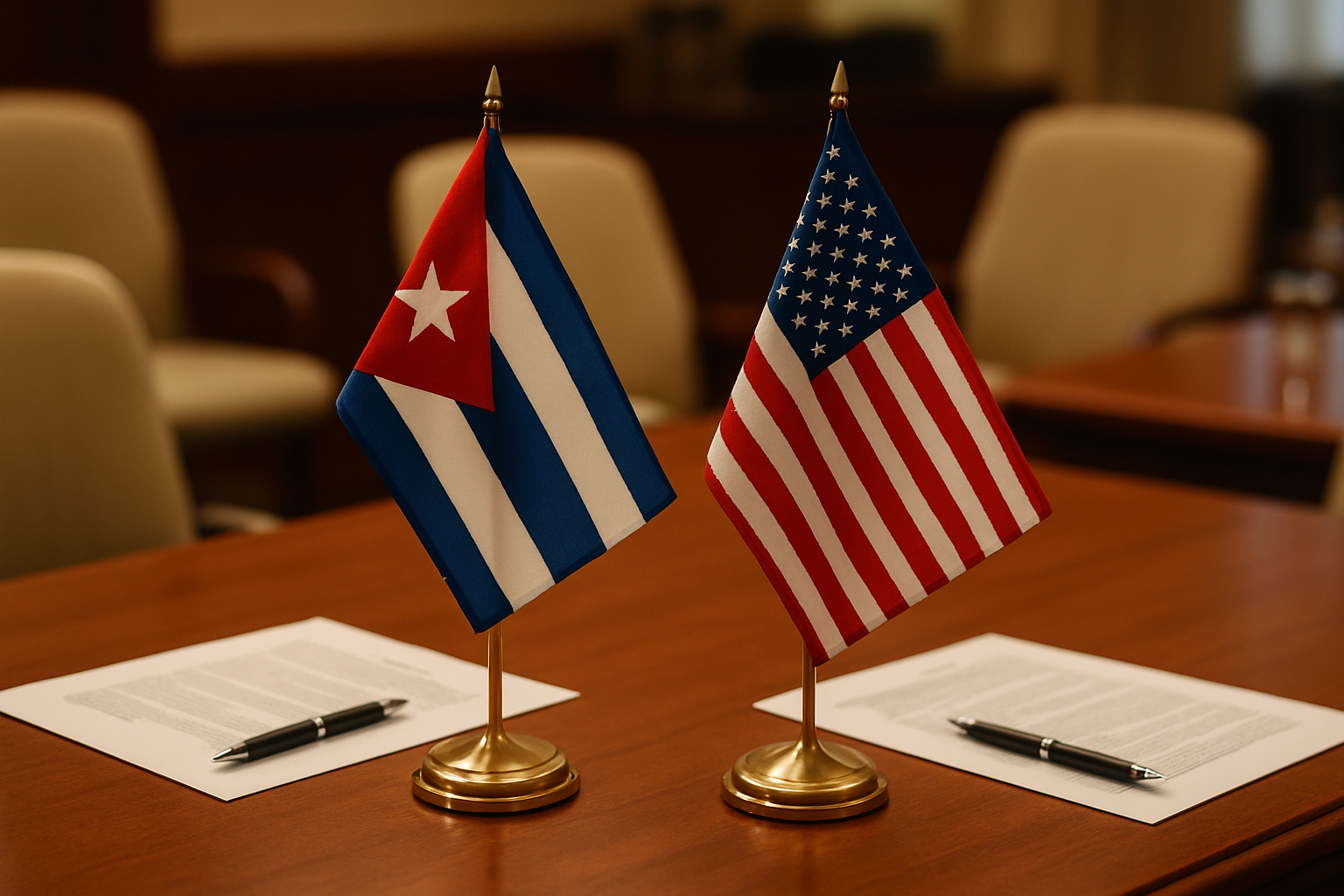
Cuban President Miguel Díaz-Canel confirmed Friday that his government is engaged in high-level diplomatic conversations with the United States, marking a significant development in Cuba-US relations as the Caribbean island faces its worst energy crisis since the 1990s Special Period and mounting pressure from the Trump administration.
The confirmation comes as Cuba grapples with an unprecedented humanitarian emergency that has left 51% of the population—approximately 5.5 million people—experiencing scheduled blackouts during peak hours. The crisis has been exacerbated by what Díaz-Canel calls "total asphyxiation" through US economic pressure, including the complete halt of oil shipments from traditional suppliers Venezuela and Mexico.
Diplomatic Opening Amid Crisis
Speaking on national television, Díaz-Canel indicated that Cuban officials have recently met with US government representatives to explore solutions "through dialogue." The Cuban leader emphasized that certain international factors have facilitated these exchanges, though he declined to reveal specific details about the nature or scope of the discussions.
The talks represent a notable shift in tone from the increasingly confrontational rhetoric of recent months. In February, President Trump made his most explicit threat yet against Cuba, suggesting a "friendly takeover" might be necessary if the island fails to reach an agreement with Washington. Trump declared that "the Cuban government is talking with us, and they're in a big deal of trouble. Maybe we'll have a friendly takeover of Cuba."
According to multiple sources, including reports from Al Jazeera and Portuguese media outlets, the diplomatic contacts are being conducted at a senior level, with discussions focused on finding pragmatic solutions to the bilateral crisis that has intensified dramatically since Trump's return to office.
Energy Crisis Reaches Breaking Point
The backdrop to these diplomatic overtures is Cuba's most severe energy crisis in decades. The island's oil reserves have dropped to a critical 15-20 day supply after the Trump administration's "maximum pressure" campaign successfully forced traditional suppliers to halt deliveries.
The crisis deepened in February when the Ñico López refinery in Havana suffered a major fire, eliminating the island's remaining domestic petroleum processing capacity. Cuba's oil production has collapsed from 3 million barrels daily to just 700,000, while domestic consumption needs far exceed current supply capabilities.
The humanitarian impact has been severe. Over 25,000 tourists were evacuated from the island in February and March, including 21,000 Canadians and 4,000 Russians, after all nine Cuban airports ran out of aviation fuel. Major international hotel chains, including Spain's Meliá and Iberostar, have closed facilities in Varadero and along the northern coast.
"We are experiencing the most comprehensive aviation blockade since the 1962 Missile Crisis. This goes far beyond the Special Period of the 1990s—this is systematic, deliberate targeting of our energy infrastructure."
— Cuban Government Official, speaking anonymously
Trump's Maximum Pressure Strategy
The current crisis is the direct result of Trump's January 2026 executive order threatening 25% tariffs on any country supplying oil to Cuba. The policy successfully forced both Venezuela's interim government under Acting President Delcy Rodríguez and Mexico under President Claudia Sheinbaum to suspend petroleum shipments, despite humanitarian concerns.
Venezuela's decision to halt oil exports to Cuba marked a dramatic shift, as the country had been Cuba's primary supplier for decades. However, following the January 2026 capture of Nicolás Maduro and the subsequent political transition in Caracas, the new Venezuelan leadership has prioritized rebuilding relations with Washington over maintaining traditional solidarity with Havana.
The economic warfare has extended beyond energy to aviation and tourism. Canada has issued its highest-level travel advisory for Cuba, warning of "serious and life-threatening risks," effectively ending the crucial winter tourism season that provides vital foreign currency earnings for the island.
Historical Context and Regional Implications
The current diplomatic opening occurs against the backdrop of broader regional realignments that have fundamentally altered the Caribbean geopolitical landscape. Trump's "Corolario Trump"—a 21st-century update to the Monroe Doctrine—has systematically reshaped American influence throughout the Western Hemisphere.
The dramatic transformation of US-Venezuela relations provides a template for potential Cuba engagement. Within weeks of Maduro's removal, Venezuela went from maximum pressure target to strategic partner, with oil exports to the US surging 60% and American companies gaining unprecedented access to the country's energy sector.
However, Cuba's situation presents unique challenges. Unlike Venezuela, which possessed significant oil reserves and a clear succession mechanism through Delcy Rodríguez, Cuba faces deeper structural economic challenges and lacks obvious alternative leadership structures that might appeal to Washington.
International Response and Maritime Incidents
The diplomatic talks are taking place amid rising tensions following several maritime incidents in Cuban territorial waters. Most notably, Cuban coast guard forces clashed with a Florida speedboat on February 25, resulting in four deaths and six wounded—the most serious bilateral incident in years.
International response to the crisis has been sharply divided. Russia has condemned what it calls "economic strangulation" and has pledged oil aid to Cuba, directly challenging US pressure. Former UK Labour leader Jeremy Corbyn has announced plans for an international flotilla to challenge the oil embargo, while China has demanded the US "immediately cease" pressure on Cuba.
European media has characterized the situation as a "deliberately engineered humanitarian emergency," with Ireland issuing its second-highest travel warning citing "serious and life-threatening risks" for its citizens.
FBI Investigation Dimension
Adding another layer of complexity to the diplomatic equation, Venezuelan sources report that President Díaz-Canel has announced the FBI will travel to Cuba to investigate the February maritime incident involving the Florida speedboat. This unprecedented law enforcement cooperation would represent a significant breakthrough in bilateral relations, as Cuba has historically rejected US requests for judicial cooperation.
The FBI investigation announcement signals a potential shift toward pragmatic engagement, even as broader political tensions remain high. Such cooperation could serve as a confidence-building measure in ongoing diplomatic discussions.
Domestic Pressures and Political Calculations
For the Cuban government, the diplomatic opening represents a stark choice between ideological purity and economic survival. The healthcare system is under severe strain, with hospitals suspending non-emergency surgeries and struggling to maintain critical equipment during power outages. Transportation has largely collapsed, and essential services operate on drastically reduced schedules.
The Trump administration faces its own calculations. While the maximum pressure campaign has achieved unprecedented leverage over Cuba, it has also created a humanitarian crisis that complicates America's broader regional diplomatic initiatives. The success of rapid engagement with Venezuela provides both a model and political pressure for similar results with Cuba.
Cuban-American communities in Florida, a crucial Trump constituency, remain divided between those supporting maximum pressure to force regime change and others concerned about the humanitarian impact on family members still on the island.
Strategic Implications for Regional Order
The Cuba-US talks carry implications far beyond bilateral relations. Success in reaching some accommodation could complete Trump's reshaping of the Caribbean political order, creating a hemisphere largely aligned with US preferences. Failure, however, could lead to deeper radicalization of remaining US adversaries and potential military escalation.
The talks also test the limits of economic coercion as a diplomatic tool. Cuba's resistance despite unprecedented pressure could influence how other nations assess American leverage, while successful resolution might provide a template for future engagements with challenging regimes.
Regional observers note that the Caribbean has become a laboratory for 21st-century power projection, combining traditional military deployment with sophisticated economic warfare and selective diplomatic engagement. The outcome of Cuba-US talks will likely influence American approaches to similar challenges globally.
Looking Forward: Uncertain Trajectory
As diplomatic contacts continue, both sides face significant constraints. Cuba cannot easily abandon the revolutionary ideology that provides its government's legitimacy, while the Trump administration must balance engagement with domestic political pressures and alliance relationships.
The success of US-Venezuela normalization provides hope for rapid breakthroughs, but Cuba's different political structure, economic base, and international relationships create unique challenges. Unlike Venezuela's clear succession mechanism and oil wealth, Cuba lacks obvious pathways to the kind of dramatic political change that facilitated Caracas-Washington rapprochement.
International observers will be watching closely to see whether the conversations develop into substantive negotiations or remain limited to crisis management. The humanitarian situation provides urgency, but fundamental political differences remain substantial.
The coming weeks will likely determine whether these diplomatic contacts represent a genuine opening toward normalization or merely tactical discussions to manage an increasingly dangerous bilateral crisis. For millions of Cubans facing daily hardships from the energy crisis, the stakes could not be higher.