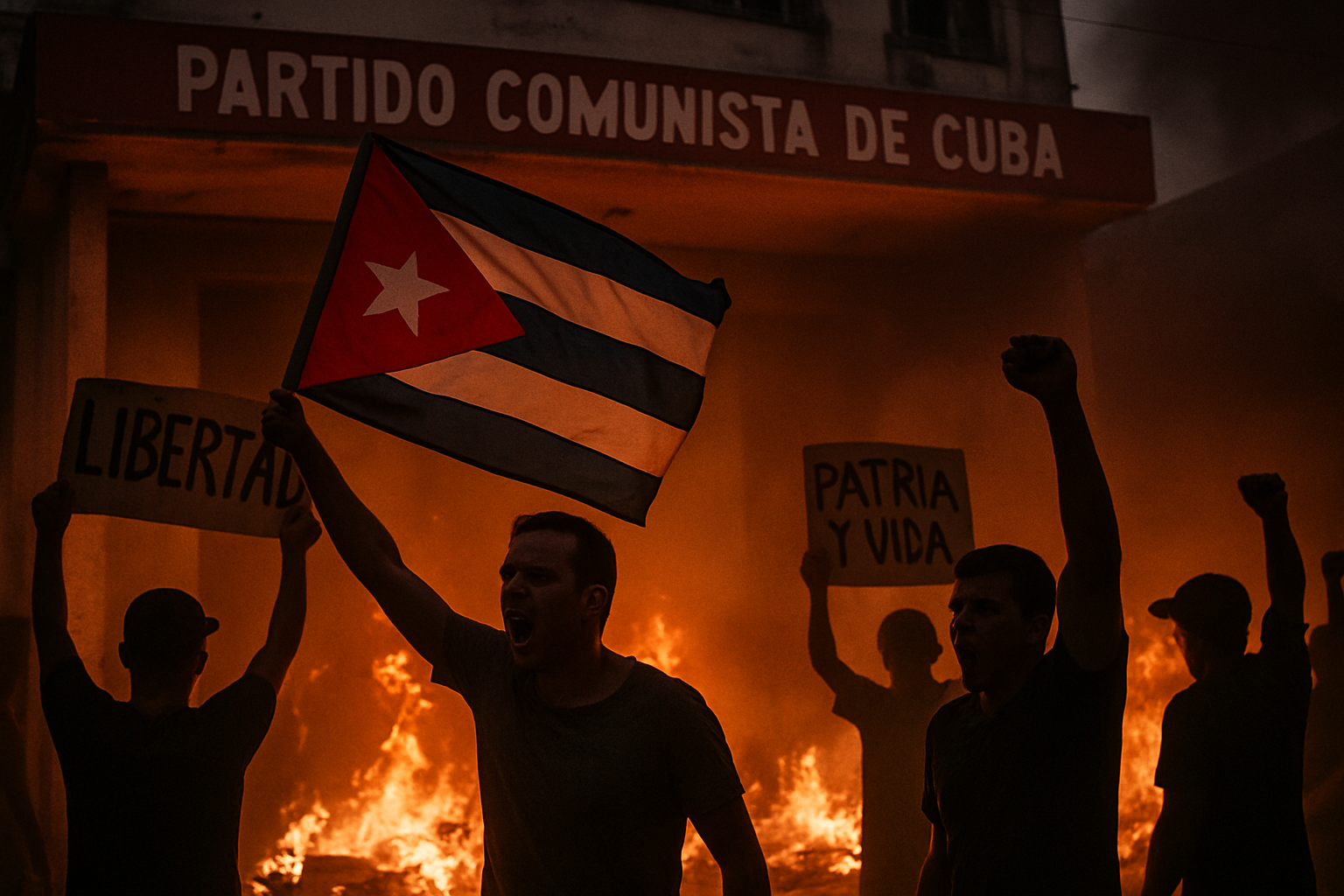
Cuban protesters stormed and ransacked the Communist Party headquarters in Morón, Ciego de Ávila province, in a rare outbreak of civil unrest triggered by the island's worst energy crisis since the 1990s Special Period. Five people were detained following the unprecedented attack on the symbolic seat of power.
The incident, which occurred in the early hours of Saturday morning, represents the most direct challenge to Communist Party authority since the 1959 revolution. State media outlet Invasor confirmed that "vandalistic acts" had taken place, with protesters dragging furniture, computers, files, and propaganda materials from the party building into the street, where they were burned in bonfires.
The attack comes as Cuba faces its most severe energy emergency in decades, with 51% of the population – approximately 5.5 million people – experiencing scheduled blackouts during peak hours. Oil reserves have dwindled to a critical 15-20 day supply after the Trump administration's maximum pressure campaign forced Venezuela and Mexico to halt shipments.
Energy Crisis Reaches Breaking Point
The island's infrastructure has been pushed beyond breaking point, with the Antonio Guiteras power plant – Cuba's largest – suffering a catastrophic failure that plunged two-thirds of the country into darkness for up to 72 hours. This marked the fifth major system-wide blackout since late 2024, highlighting the precarious state of Cuba's electrical grid.
Complete aviation isolation has compounded the crisis, with all nine major airports maintaining zero jet fuel availability through March 11, 2026. Over 25,000 tourists have been evacuated, including 21,000 Canadians and 4,000 Russians, as major airlines suspended operations indefinitely.
"Not even in the hardest years of the Special Period had we seen anything like this."
— Cuban Government Official
The transportation system has collapsed entirely, with crowds waiting indefinitely at major transit hubs like Viaducto carrying backpacks and water bottles as buses fail to arrive. Medical staff cannot reach hospitals, students cannot access schools, and workers are unable to reach their jobs.
Government Response and International Reactions
President Miguel Díaz-Canel has called the situation "total asphyxiation" and announced that government priorities have shifted to "defense of internal order." Emergency measures now include four-day work weeks for government employees, suspension of non-emergency surgeries at hospitals, closure of 90% of gas stations, and semi-virtual university classes.
The Cuban peso has plummeted to a historic low of 500 units per dollar, representing a 15% weekly decline as the economic crisis deepens. Domestic oil production has collapsed from 3 million to just 700,000 barrels daily, making the island completely dependent on imports that are no longer arriving.
International reactions have been sharply divided. Russia condemned what it called "economic strangulation" and pledged humanitarian oil aid, directly challenging U.S. pressure. Former UK Labour leader Jeremy Corbyn announced an international flotilla to challenge the blockade, while China demanded that Washington "immediately cease" its pressure campaign.
Historical Significance of the Protests
The attack on the Communist Party headquarters in Morón carries profound symbolic weight. Unlike the July 2021 protests, which were the largest since the revolution but did not target party buildings directly, Saturday's events represent the first successful storming and damaging of a major party facility since 1959.
Protesters chanting "¡Libertad!" (Freedom) systematically removed party propaganda and created street bonfires with the materials, echoing revolutionary moments throughout Latin American history. The scene marked an extraordinary breach of the political order that has governed Cuba for over six decades.
European media outlets have characterized the crisis as a "deliberately engineered humanitarian emergency," with observers noting that the current situation exceeds the severity of the 1990s Special Period because it results from systematic U.S. policy rather than external economic collapse.
Trump's Maximum Pressure Success
The crisis stems directly from President Trump's January 30 executive order threatening 25% tariffs on countries supplying oil to Cuba. This policy successfully forced both Venezuela's interim government and Mexico to halt shipments despite humanitarian concerns, achieving what officials call "complete energy supply severance."
Trump has made increasingly explicit statements about regime change, declaring that Cuba's government "will fall pretty soon" and suggesting potential negotiations through Secretary of State Marco Rubio. The administration's "Corolario Trump" strategy represents a 21st-century update to the Monroe Doctrine, combining economic coercion with selective diplomatic engagement.
Mexico has maintained limited humanitarian aid through naval vessels carrying 814 tons of supplies, but President Claudia Sheinbaum has avoided oil shipments to prevent U.S. economic retaliation. This demonstrates the effective reach of American economic influence across the hemisphere.
Humanitarian Emergency Deepens
The healthcare system faces unprecedented strain, with medical evacuation capacity eliminated and power outages threatening medicine storage and critical equipment. Eastern provinces, home to 3.4 million people, remain without power following Holguín substation failures.
Tourism, a crucial source of foreign currency, has collapsed entirely. Major Spanish hotel chains including Meliá, Iberostar, and Blue Diamond have closed their Varadero and northern coast facilities. Canada issued a "high degree of caution" travel advisory, effectively ending the winter tourism season.
The government has acknowledged that domestic agricultural production cannot meet national food requirements, representing a catastrophic failure affecting all 11 million inhabitants. Sugar harvests have been halted, and international conferences canceled as the crisis spreads across all sectors of society.
Regional and Global Implications
The Cuban crisis serves as a laboratory for testing modern economic warfare capabilities and their humanitarian consequences. The systematic isolation of an entire island nation through energy and transportation targeting sets dangerous precedents for 21st-century international relations.
Caribbean nations face difficult choices between maintaining solidarity with Cuba and preserving their own economic relationships with the United States. The crisis demonstrates how regional powers can be forced to choose between ideological commitments and economic necessity.
The international community confronts questions about the limits of economic coercion as a diplomatic tool and the protection of civilian populations from collective punishment. The template established here may influence how future territorial disputes and democratic transitions are managed globally.
Uncertain Path Forward
Cuban authorities have provided no timeline for resolving the restrictions, and the crisis appears to require either a diplomatic breakthrough, alternative supply arrangements that circumvent U.S. pressure, or fundamental changes to Cuba's energy infrastructure and political system.
The attack on the Communist Party headquarters represents a watershed moment in Cuban history, potentially signaling the beginning of a new chapter in government-population relations. Whether this incident remains isolated or sparks broader unrest will depend largely on how quickly basic services can be restored and whether international intervention can provide relief.
As Cuba enters its second month of unprecedented isolation, the world watches to see whether innovative diplomatic solutions can emerge or if the island will face sustained economic siege warfare that could reshape the Caribbean region and establish new precedents for international economic coercion in the multipolar era.