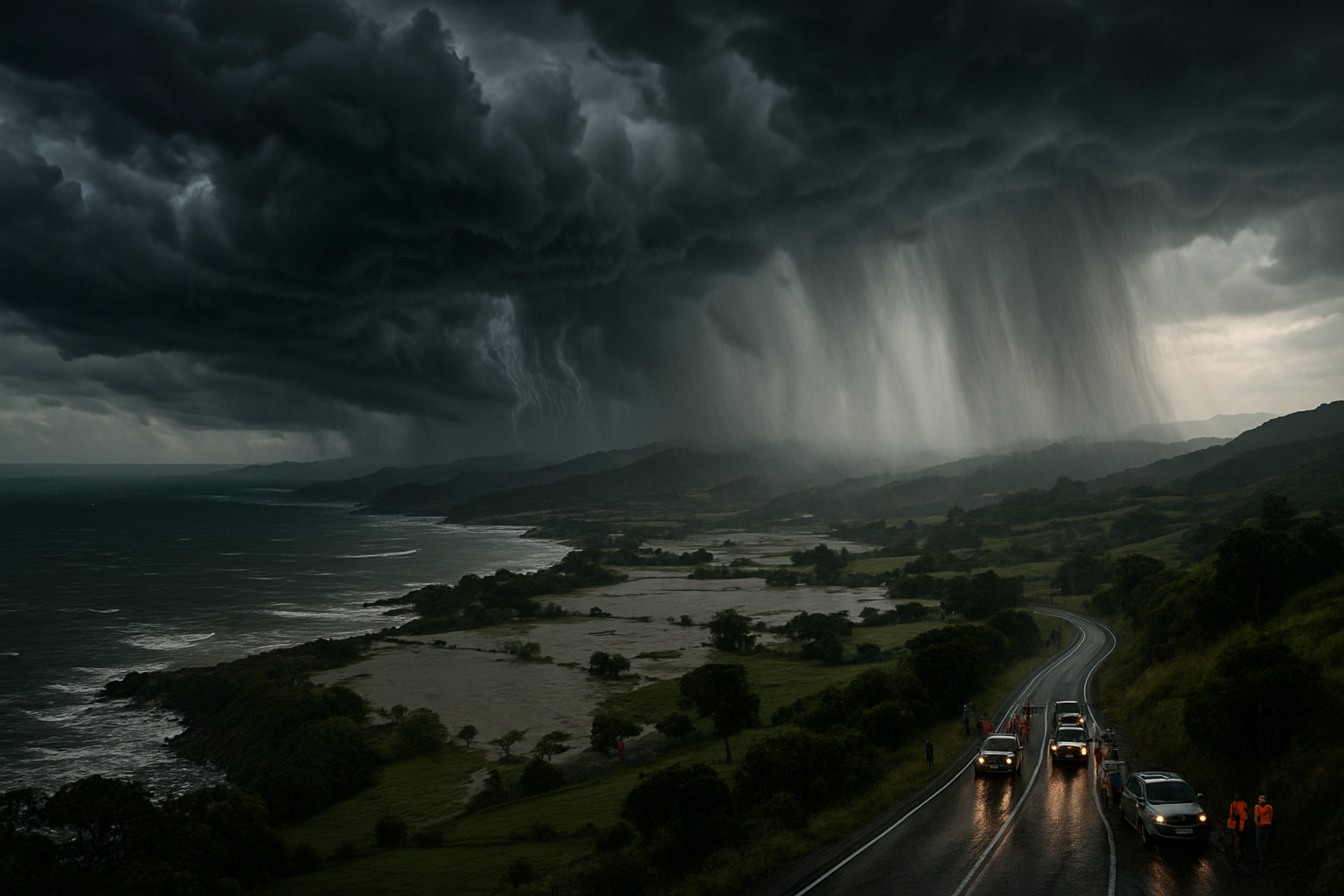
Cyclone Vaianu has delivered a devastating blow to New Zealand's North Island, dumping over 220 millimetres of rain on the Coromandel Peninsula in just 24 hours and forcing authorities to declare states of emergency across multiple regions as the storm system finally moves away from mainland New Zealand.
The tropical cyclone, which tracked from Vanuatu through Tonga before approaching New Zealand, brought widespread power outages, flooding, and road closures across the east coast of the North Island. Emergency services reported that flood-saturated Northland was particularly vulnerable, having endured repeated extreme weather events throughout 2026.
Record-Breaking Rainfall and Widespread Damage
MetService meteorologists confirmed that the Coromandel Peninsula bore the brunt of Vaianu's impact, with rainfall totals exceeding 220mm in the 24-hour period ending Monday morning. The deluge represents one of the most significant single-day precipitation events recorded in the region this year.
"The intensity and duration of this rainfall event has created life-threatening conditions across multiple districts," said Emergency Minister Mark Mitchell, acknowledging that while the storm's intensity was less severe than initially feared, it still demonstrated the stretched capabilities of New Zealand's emergency response systems.
States of emergency were declared for Northland, Whakatāne, and Hawke's Bay districts, with authorities implementing comprehensive evacuation protocols. The Auckland Harbour Bridge was forced to close on Sunday due to dangerous wind conditions, while ferry services across the region were cancelled as authorities prioritized public safety.
Emergency Response Under Pressure
The cyclone struck New Zealand during what meteorologists describe as the 23rd consecutive month of global temperatures exceeding 1.5°C above pre-industrial levels—the longest sustained period of extreme warming in recorded history. This unprecedented climate pattern has contributed to what emergency management experts now classify as "compound disasters," where multiple emergency types occur simultaneously across vast geographic areas.
Civil Defence activated comprehensive emergency protocols across the upper North Island, with major population centers including Auckland, Hamilton, and Tauranga falling within the projected impact zone. Prime Minister Christopher Luxon urged immediate preparation, recognizing that emergency response capabilities were already stretched from managing recovery efforts following the March 26 Far North and Whangārei flooding emergency.
The National Emergency Management Agency (NEMA) warned residents that "later on is too late" as the storm approached New Zealand waters with sustained winds of 130 km/h. Multiple emergency alerts were issued urging communities to finalize shelter plans and prepare for extended power outages.
Infrastructure Vulnerabilities Exposed
The cyclone highlighted critical vulnerabilities in New Zealand's infrastructure systems, which were operating beyond historical design parameters due to the unprecedented frequency and intensity of extreme weather events. Transportation networks, power grids, and communication systems faced repeated failures as conditions exceeded their operational capabilities.
Recovery timelines have fundamentally shifted from the traditional expectation of weeks to months or even years, representing a permanent change in disaster response approaches. This transformation reflects what emergency management professionals describe as the evolution from sequential regional disasters to concurrent multi-regional emergencies that challenge traditional resource allocation mechanisms.
The European Union's Civil Protection Mechanism, which recently coordinated a €246 million assistance package for Sweden and Denmark—the largest coordinated European weather response on record—demonstrates that traditional mutual aid mechanisms are proving inadequate for simultaneous multi-continental disasters.
Community Resilience and Preparedness
Despite the challenges, New Zealand communities demonstrated enhanced preparedness compared to previous years. Many households were equipped with Starlink satellite internet connections, backup generators, and strengthened community networks developed through successive weather events. Social media platforms became essential for emergency communication as traditional systems became overwhelmed.
However, mental health services reported increased demand for support related to climate anxiety, as families faced the prospect of potentially losing their homes multiple times within a single decade. The psychological toll of repeated extreme weather events has become a significant concern for healthcare providers across the country.
Economic and Agricultural Impact
The tourism industry faced widespread cancellations during a critical revenue period, while agricultural communities confronted potential crop and livestock losses during key growing seasons. The Supercars ITM Taupō Super440 was forced to implement dramatic format changes, and accommodation provider Bachcare implemented comprehensive refund and rebooking policies for Coromandel Peninsula trips.
Economic impacts extend beyond immediate response costs, affecting tourism, agriculture, and business continuity throughout the North Island. The cyclone struck during a period when businesses were already adapting to supply chain disruptions and increased operational costs from previous weather emergencies.
Global Climate Context and Future Implications
Cyclone Vaianu occurred within the broader context of global climate emergency, with January 2026 remaining the hottest month on record. The World Meteorological Organization reports a 50-60% probability of El Niño conditions developing between July and September 2026, which could potentially drive unprecedented temperatures by combining baseline warming with natural cycle amplification.
Climate experts describe April 2026 as a critical watershed moment requiring a choice between reactive crisis management and transformative infrastructure adaptation. The current conditions provide a preview of what may become routine circumstances in the 2030s without comprehensive climate adaptation investment.
Scientists emphasize that the window for effective climate action is narrowing as ecological systems approach critical thresholds that could trigger irreversible changes affecting global food security, climate stability, and human settlements. Environmental challenges transcend national boundaries through atmospheric and ocean systems, requiring unprecedented international cooperation and enhanced coordination mechanisms.
Technology and Traditional Knowledge Integration
Successful emergency responses have demonstrated the importance of sophisticated synthesis between cutting-edge technology and traditional knowledge combined with community-based management. Advanced monitoring systems utilizing satellite data, artificial intelligence, and environmental DNA sampling require community engagement and local expertise for maximum effectiveness.
The integration of modern meteorological forecasting with traditional Indigenous weather knowledge has proven particularly valuable for comprehensive weather preparedness. This hybrid approach represents a template for addressing complex climate challenges that require both technological innovation and cultural wisdom.
Strategic Implications for New Zealand
As Cyclone Vaianu moves away from New Zealand, authorities face the critical task of building resilience for future extreme weather events. The cyclone has reinforced the need for "building back better" strategies that prioritize climate-resilient infrastructure rather than simply restoring systems to their previous state.
The question facing New Zealand and the international community is no longer whether transformative action is needed, but whether humanity can organize and implement solutions rapidly enough to maintain planetary habitability during Earth's most environmentally challenging period in recorded history.
Tools, knowledge, and cooperation frameworks exist for comprehensive environmental protection, but they require unprecedented speed of coordination and sustained international cooperation with political commitment to environmental protection as essential infrastructure for human prosperity and planetary sustainability.