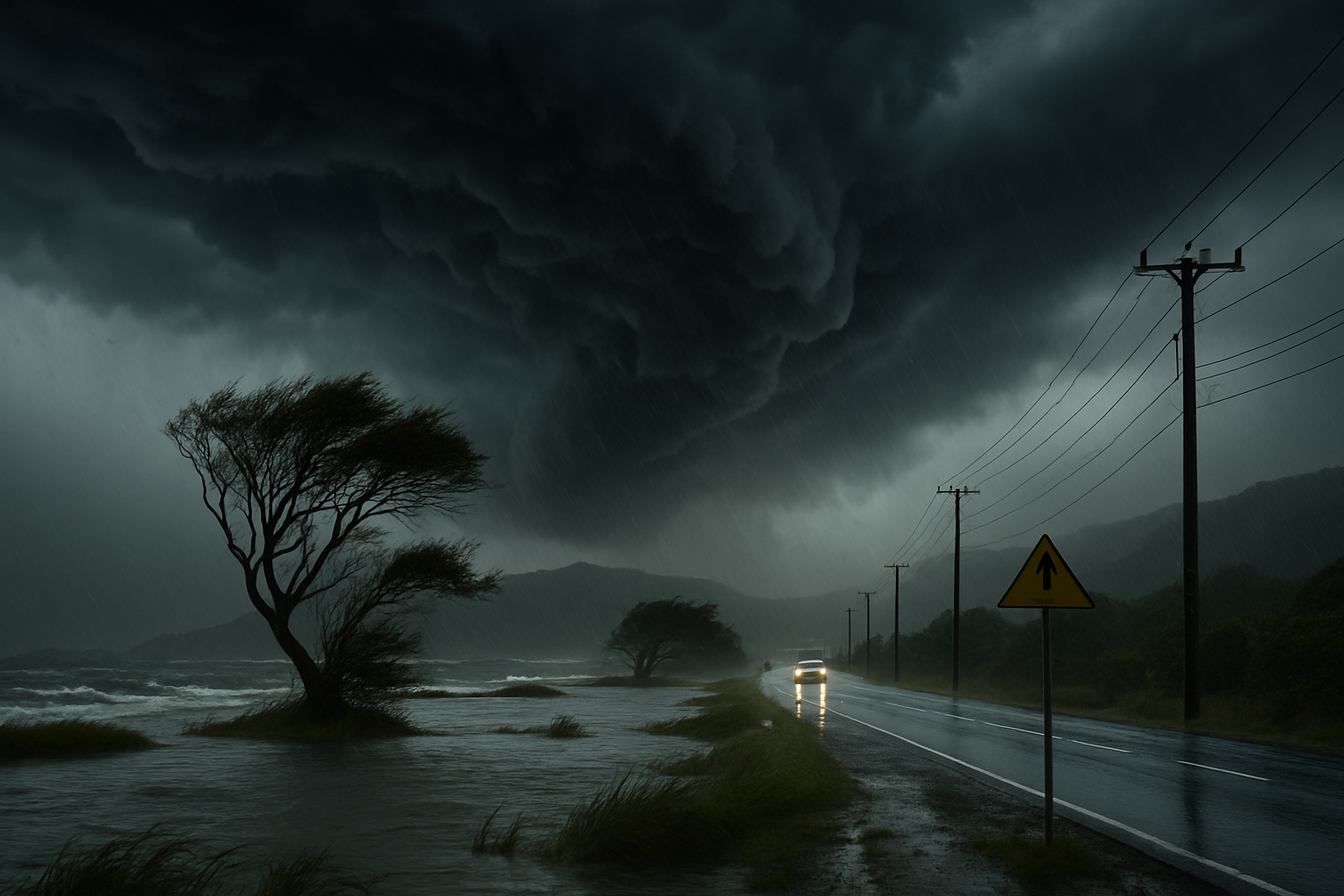
New Zealand's North Island faces imminent severe weather as Tropical Cyclone Vaianu approaches from the east of Vanuatu, prompting emergency declarations across vulnerable regions already saturated from previous flooding events.
Northland has declared a state of emergency while Whakatāne considers similar action as MetService warns of "damaging, potentially life-threatening" conditions expected to hit from Saturday night. The Category 2 tropical cyclone is gaining speed and power as it tracks toward New Zealand waters, with the most severe impacts forecast through the weekend.
Emergency Preparations Intensify
Civil Defence has activated emergency protocols across the upper North Island, with major population centers including Auckland, Hamilton, and Tauranga within the projected impact zone. Heavy rain warnings are in force for Northland, accompanied by strong wind warnings extending to Auckland from Saturday night.
The approaching storm threatens the flood-saturated Northland region, which remains particularly vulnerable following repeated extreme weather events throughout 2026. Emergency services are still managing recovery efforts from the March 26 Far North and Whangārei destructive flooding while simultaneously preparing for this new major storm system.
"This storm is gaining speed and power from its position east of Vanuatu, and threatens a region already dealing with flood-saturated soils from previous events."
— MetService Weather Advisory
Global Climate Context
This weather emergency occurs during the 23rd consecutive month that global temperatures have exceeded 1.5°C above pre-industrial levels—the longest sustained extreme warming period in recorded human history. January 2026 remains the hottest month ever recorded, while the World Meteorological Organization reports a 50-60% probability of El Niño development during July-September 2026.
The climate volatility paradox demonstrates how sustained global warming can enable both heat records and devastating regional extremes through disrupted atmospheric circulation and polar vortex patterns. This phenomenon has contributed to an unprecedented frequency of extreme weather events affecting multiple continents simultaneously.
Infrastructure Under Pressure
Transportation networks, power grids, and communication systems across New Zealand are operating beyond their historical design parameters due to the unprecedented frequency and intensity of extreme weather events. The concept of "building back better" with climate-resilient infrastructure has evolved from an optional enhancement to an essential survival strategy.
Emergency services are operating at capacity limits, with traditional mutual aid mechanisms proving inadequate when multiple regions face disasters simultaneously. This represents a fundamental shift in emergency management approaches, with recovery timelines extending from weeks to months or years.
Community Resilience and Response
Despite the challenges, communities have demonstrated enhanced preparedness compared to previous years, with residents better equipped through Starlinks, generators, and strengthened community networks developed through successive weather events. Social media platforms have become essential for emergency communication when traditional systems are overwhelmed.
However, mental health services report increased demand for climate anxiety support as families face the prospect of losing homes multiple times within a decade. The psychological toll of repeated extreme weather trauma is becoming a significant public health concern.
Economic and Agricultural Impact
The tourism industry faces cancellations during a critical revenue period, while agricultural communities confront potential crop and livestock losses during key growing seasons. Major events have already been forced to implement dramatic format changes, with accommodation providers activating comprehensive refund and rebooking policies for affected areas.
The Supercars ITM Taupō Super440 has been forced to implement significant format changes, while Bachcare is implementing comprehensive refund and rebooking policies for Coromandel Peninsula trips, demonstrating the far-reaching economic impacts of extreme weather events.
International Emergency Response Crisis
New Zealand's weather emergency is part of a broader pattern of extreme weather disasters affecting multiple continents simultaneously. Traditional mutual aid mechanisms designed for sequential disasters have proven inadequate for simultaneous multi-continental events, with emergency services worldwide operating at or beyond capacity limits.
The Australian Fire Emergency Services Authority (AFAC) has identified a paradigm shift toward "compound disasters"—multiple emergency types occurring concurrently across vast geographic areas, fundamentally challenging traditional resource allocation and response capabilities.
Scientific and Technological Integration
Successful emergency responses now require sophisticated integration of cutting-edge meteorological technology with traditional ecological knowledge and community-based management. Advanced monitoring systems including satellite imagery, environmental DNA sampling, and AI analysis are being combined with generations of traditional knowledge for more effective preparedness and response.
Looking Ahead: Adaptation Imperatives
Climate experts describe April 2026 as a watershed moment requiring a critical choice between reactive crisis management and transformative infrastructure adaptation. Current conditions provide a preview of what may become routine in the 2030s without comprehensive climate adaptation investment.
The window for effective climate action is narrowing as ecological systems approach critical thresholds that could trigger irreversible changes to global food security, climate stability, and human settlements. Environmental challenges transcend boundaries through atmospheric and ocean systems, requiring unprecedented international cooperation and coordination.
"The tools, knowledge, and cooperation frameworks exist for comprehensive environmental protection, but success depends on unprecedented speed and coordination in sustained international cooperation."
— Climate Adaptation Experts
Emergency Preparedness Recommendations
Authorities urge residents in affected areas to complete preparations immediately, emphasizing that "later on is too late" as the storm approaches New Zealand waters. Emergency supplies, communication plans, and evacuation routes should be finalized while conditions still permit safe preparation activities.
The National Emergency Management Agency (NEMA) has issued comprehensive guidance for residents to prepare for potentially extended power outages, flooding, and communication disruptions. Community coordination through social media networks has proven essential when traditional emergency communication systems become overwhelmed.
As Cyclone Vaianu approaches, New Zealand faces a critical test of its emergency preparedness and community resilience, occurring within the context of accelerating global climate change and an unprecedented period of sustained extreme weather conditions worldwide.