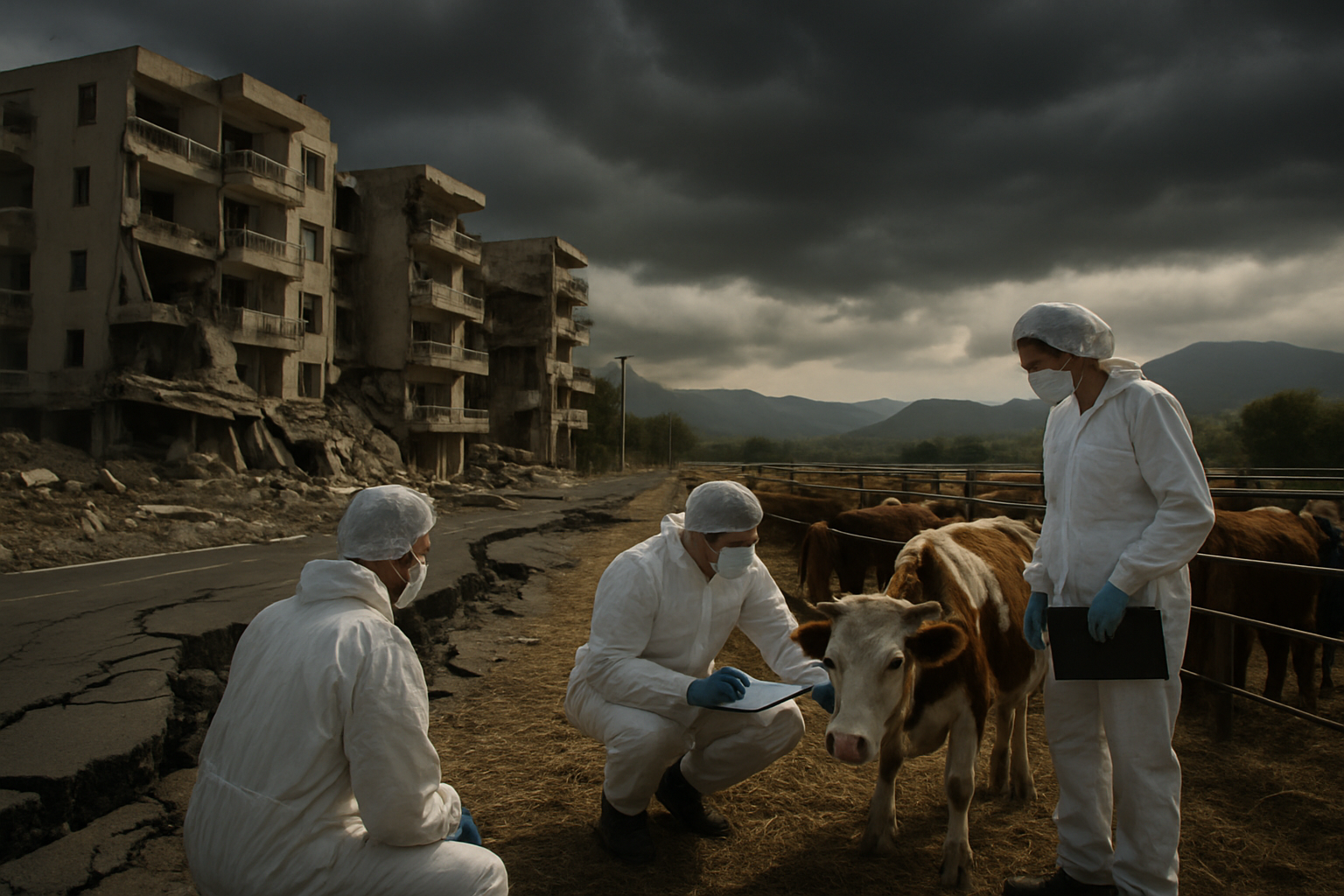
Cyprus confronted a challenging Saturday as the island nation dealt with both seismic activity and an escalating agricultural crisis, with a 2.7 magnitude earthquake recorded off the Paphos coast while veterinary authorities confirmed the spread of foot-and-mouth disease to 101 infected livestock farms.
The earthquake, detected by the European-Mediterranean Seismological Centre (EMSC), struck at 11:11 local time with its epicenter located approximately 17 kilometers west of Paphos and 74 kilometers west of Limassol in Mediterranean waters. While the tremor was relatively minor and caused no reported damage or injuries, it added another layer of concern to an island already managing one of its most severe agricultural crises in recent memory.
Agricultural Crisis Reaches Critical Scale
The more pressing challenge facing Cyprus authorities is the continued spread of foot-and-mouth disease across livestock facilities. Veterinary Services confirmed three additional infected units on Saturday, bringing the total to 101 farms affected since the outbreak began in February 2026 at Oroklini.
The newly confirmed cases include a sheep and goat unit in Dromolaxia-Meneou, a cattle unit in Geri, and a second pig unit in Palaiometocho, located near the first pig facility where the disease was initially detected in swine populations. This geographic clustering suggests continued local transmission despite intensive containment efforts.
According to Veterinary Services, the 101 infected units comprise 13 cattle operations (nine in Larnaca district and four in Nicosia), 86 sheep and goat facilities (62 in Larnaca and 24 in Nicosia), and two pig farms in the western Nicosia district, both in Palaiometocho.
Massive Culling Operations Underway
The scale of the veterinary response has been unprecedented for Cyprus. Culling and assessment procedures continue across both Nicosia and Larnaca districts, with the total number of animals destroyed now exceeding 30,000 since the outbreak's beginning. The figure includes over 28,000 sheep and goats alongside nearly 2,000 cattle.
The second phase of the vaccination campaign has achieved mixed results, with 73.5% coverage of the cattle population but significantly lower rates among sheep and goats, where complete protection requires multiple doses and extensive coordination with farmers across affected zones.
"Sampling, tracing and laboratory testing are continuing across holdings within infected livestock zones, with the goal of early detection of new cases."
— Cyprus Veterinary Services Statement
Economic Implications Mount
The agricultural crisis threatens Cyprus's crucial halloumi cheese industry, which relies on approximately 80% of the island's milk production. The disease-free status that Cyprus previously maintained was essential for agricultural exports, particularly halloumi, which generates over €250 million annually in export revenue.
President Nikos Christodoulides has coordinated a comprehensive government response involving multiple agencies, including the permanent secretaries of agriculture and interior, along with the national guard, police, fire brigade, and forestry departments. Earlier in March, the government announced a €28 million support package for affected livestock farmers, including full compensation for losses and 12-month income support schemes.
Ongoing Investigation into Origins
Authorities continue investigating the outbreak's source, with a Larnaca police specialized team examining suspected illegal animal feed smuggling from northern Cyprus. The geographic distribution of early cases suggested transmission through contaminated feed networks rather than natural disease spread patterns.
The investigation has focused on illegal hay trade from occupied areas, with particular attention to how the virus might have spread through livestock supply chains across different districts. The geographic location of some affected farms, particularly those far from border areas, supports the theory of feed-based transmission.
Enhanced Biosecurity Measures
Cyprus has implemented comprehensive biosecurity protocols across affected areas, including the establishment of disinfection points, mandatory vehicle decontamination, and designated entry and exit points for farm access. Movement restrictions remain in place, with hunting banned in affected areas and the Game Service integrated into the emergency response.
The enhanced measures represent an evolution of Cyprus's emergency management capabilities, building on lessons learned from recent wildfire responses and incorporating EU emergency protocols activated specifically for the foot-and-mouth outbreak.
Regional and Climate Context
The agricultural crisis occurs during the 21st consecutive month of global temperatures exceeding 1.5°C above pre-industrial levels, creating optimal conditions for pathogen survival and transmission. Climate experts note that sustained warming has disrupted traditional seasonal disease patterns, requiring adaptive management strategies previously unnecessary in Mediterranean agriculture.
The outbreak has had regional implications, with Greece confirming its first cases in 20 years on the island of Lesbos, while British Sovereign Base Areas in Cyprus have implemented comprehensive biosecurity measures in coordination with Cypriot authorities through daily coordination meetings.
International Cooperation Framework
The European Commission has provided emergency support through activated EU protocols, including technical expertise and vaccine supplies. Earlier efforts included the provision of 500,000 vaccine doses to areas of northern Cyprus outside effective government control, demonstrating the cross-border nature of disease management.
The crisis has also highlighted the effectiveness of international cooperation frameworks, with Slovakia providing temporary veterinary licensing assistance and other EU member states offering technical support as needed.
Community Impact and Support
Recognizing the psychological toll on farming communities, Larnaca municipality established dedicated support hotlines operating 24 hours a day. The phones (24 818706 for weekdays 7:30 AM-3 PM, and 94 069682 for 24/7 service) provide counseling and information to farming families facing devastating livestock losses.
Local farming communities have voluntarily implemented additional safety measures beyond mandatory requirements, demonstrating collective commitment to outbreak containment despite significant personal economic costs.
Looking Forward
As Cyprus manages both immediate seismic monitoring and the ongoing agricultural emergency, authorities emphasize that success in containing the foot-and-mouth outbreak depends on sustained political commitment, adequate resources, and continued international cooperation during this critical containment period.
The dual challenges facing Cyprus on Saturday underscore the complex emergency management requirements for small island nations dealing with both natural hazards and disease outbreaks. With tourism season approaching and agricultural exports at stake, the effective resolution of the current crisis will be crucial for Cyprus's economic stability and international reputation as a reliable partner in Mediterranean agriculture.
Veterinary Services continue daily inspections and sampling across quarantined premises, with automatic culling protocols remaining in effect for any additional positive cases detected within protection zones. The next several weeks will be decisive in determining whether the containment measures can prevent further geographic spread of the disease across Cyprus's remaining livestock populations.