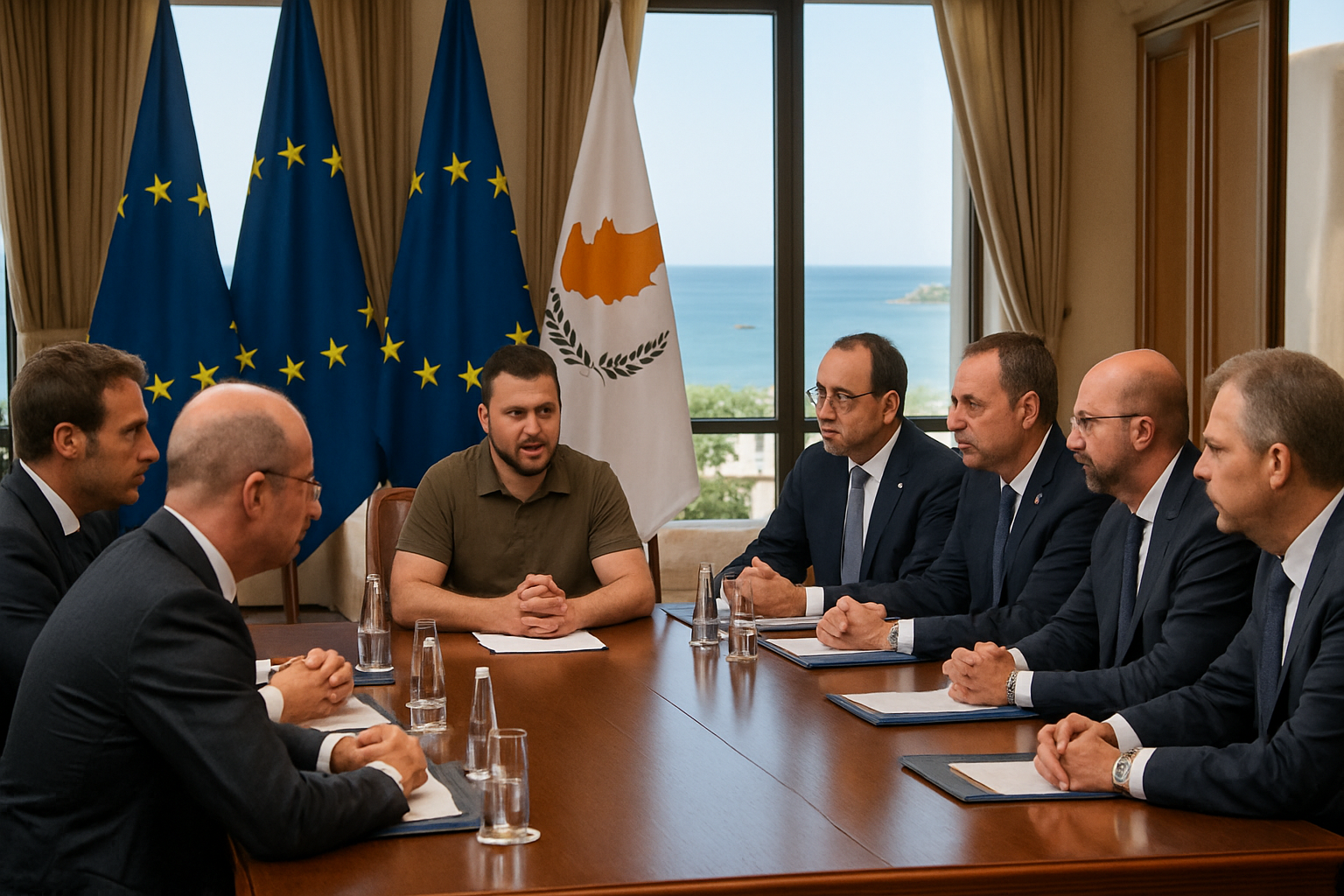
Cyprus hosts its first-ever EU leaders' summit this week, with Ukrainian President Volodymyr Zelensky attending in person after European Union member states finally agreed to approve a historic €90 billion loan package for Ukraine's defense and reconstruction efforts.
The breakthrough came after Ukraine completed critical repairs to the Druzhba oil pipeline, ending months of diplomatic deadlock that had blocked the largest EU financial assistance package ever provided to a single nation. The pipeline had been offline since January 27, 2026, following Russian drone strikes, creating an energy crisis that threatened European unity.
Historic Summit in Ayia Napa
The two-day summit, taking place Thursday and Friday at Ayia Napa marina, marks a significant milestone for Cyprus, which has never before hosted an EU leaders' gathering. Twenty-seven EU heads of state and government begin arriving from 6:15 PM local time, with Zelensky's attendance representing a major diplomatic victory for Ukraine.
Originally scheduled to address the Thursday evening working dinner via video link, Zelensky changed his plans to attend in person after EU member states' permanent representatives (Coreper) agreed on Wednesday to grant Ukraine the €90 billion loan. The shift from virtual to physical attendance underscores the heightened importance of the summit and the critical nature of European support for Ukraine.
"This is precisely the signal that must be sent to the aggressor. We are grateful to all our European partners for this unwavering support,"
— President Volodymyr Zelensky
Breaking the Hungarian Blockade
The approval of the aid package represents the resolution of one of the deepest institutional crises in EU history. For months, Hungarian Prime Minister Viktor Orbán had wielded his country's veto power to block the assistance, demanding that Ukraine first restore Russian oil transit through the Druzhba pipeline.
Hungary and Slovakia, the only EU countries still dependent on Russian oil under special sanctions exemptions, had accused Ukraine of deliberately delaying pipeline repairs as "political blackmail." Ukraine consistently maintained that Russian drone attacks had damaged the infrastructure, requiring complex repairs.
The crisis had exposed fundamental vulnerabilities in EU decision-making, with Lithuania's Foreign Minister Kestutis Budrys warning that "the EU cannot become Budapest's hostage." The deadlock accelerated discussions about enhanced cooperation mechanisms that would allow willing member states to proceed without requiring unanimous consent.
Energy Security and Diplomatic Leverage
Slovakia had declared an oil emergency in February 2026, deploying 250,000 tons of strategic reserves to maintain operations at the Slovnaft refinery. The crisis demonstrated how energy infrastructure could be weaponized during wartime, affecting civilian populations across multiple countries.
Natural gas prices surged 24% across Europe during the standoff, reaching €47.32 per megawatt-hour – the highest level since February 2025. The energy vulnerability exposed the continued interdependence between EU nations and traditional Russian energy supplies, despite years of diversification efforts.
Pipeline Repairs and Resolution
Ukrainian officials confirmed that oil deliveries through the Druzhba pipeline resumed Wednesday at 12:30 local time after completing the necessary repairs. Hungarian Foreign Minister Péter Szijjártó subsequently lifted his country's veto, allowing EU ambassadors to formally approve both the €90 billion loan package and the EU's 20th sanctions package against Russia.
Unprecedented Financial Commitment
The €90 billion loan package represents the largest EU financial assistance program ever provided to a single nation, covering Ukraine's defense procurement and reconstruction needs for 2026-2027. The European Parliament had approved the measure with a decisive vote of 458 in favor, 140 against, and 44 abstentions, demonstrating broad European commitment to Ukraine's cause.
However, the package exposed persistent divisions within the EU, as Slovakia, Czech Republic, and Hungary refused to participate in the financing despite the parliamentary approval. This East-West split highlights ongoing tensions over burden-sharing and geopolitical priorities within the 27-member bloc.
The funding comes amid massive reconstruction needs estimated by the World Bank at $831 billion over the next decade – one of the largest post-conflict rebuilding requirements since World War II. The systematic destruction of Ukrainian infrastructure, including energy systems and civilian facilities, has created urgent humanitarian and economic challenges.
Diplomatic Momentum Amid Military Pressure
The Cyprus summit takes place against a backdrop of continued military escalation in Ukraine. Russian forces have accelerated territorial gains, capturing 481 square kilometers in January 2026 compared to 260 square kilometers in December 2025 – an 85% increase representing the fastest expansion in months.
Ukraine has disclosed that 55,000 soldiers have been officially confirmed killed since the conflict began, with a "large number" still classified as missing in action. International estimates suggest actual military casualties could be 2-3 times higher when including undocumented losses.
Despite the ongoing military pressure, significant diplomatic breakthroughs have been achieved. February 2026 witnessed an unprecedented 314-prisoner exchange – the first in five months – and the restoration of US-Russia military communications after a four-year suspension. These humanitarian achievements provide hope for broader diplomatic progress.
Peace Talks in Limbo
However, trilateral Ukraine-Russia-US peace negotiations remain indefinitely suspended due to the Iran crisis that has consumed American diplomatic attention since March 2026. The talks had shown "significant progress" on ceasefire monitoring mechanisms, with European "Big Five" observers participating for the first time.
The Trump administration had established a June 2026 deadline for comprehensive peace talks in Washington, potentially at the presidential level. The suspension of negotiations due to Middle Eastern developments demonstrates the interconnected nature of global conflicts in an increasingly multipolar world.
European Strategic Implications
The successful resolution of the aid package crisis and Zelensky's personal attendance at the Cyprus summit carry profound implications for European security architecture. The EU's ability to overcome internal divisions and deliver on its commitments strengthens the union's credibility as a global security actor.
Cyprus's role as host nation reflects the island's strategic positioning as a bridge between Europe and the Middle East. The country has demonstrated remarkable crisis management capabilities in recent months, including the activation of the ESTIA evacuation plan during regional conflicts, enhancing its credibility as a diplomatic venue.
"Cyprus has proven itself as a pillar of stability in the Eastern Mediterranean, capable of hosting high-stakes diplomatic initiatives while maintaining its own security and prosperity,"
— Parliamentary Speaker Annita Dimitriou
International Context and Nuclear Concerns
The summit occurs during a particularly dangerous period for global nuclear governance. The New START treaty between the United States and Russia expired on February 5, 2026 – marking the first time in over 50 years without bilateral nuclear constraints between the superpowers who control 80% of the world's nuclear weapons.
UN Secretary-General António Guterres has warned of a "grave turning point" with nuclear risks at their "highest level in decades." The restored US-Russia military communications represent the only remaining formal diplomatic channel between the nuclear superpowers, adding urgency to efforts to prevent miscalculation.
Looking Ahead: Unity and Challenges
As EU leaders gather in Cyprus, the successful resolution of the aid package crisis demonstrates both the union's resilience and its vulnerabilities. While broad European public support remains strong – with 89% of Europeans demanding greater unity according to recent polling – institutional mechanisms requiring unanimity continue to create potential chokepoints for collective action.
The enhanced cooperation discussions accelerated during the crisis may lead to lasting changes in EU decision-making procedures. These mechanisms could allow willing member states to proceed with initiatives without requiring consensus from all 27 members, fundamentally altering the balance between national sovereignty and collective action.
Ukraine's strategic evolution from aid recipient to security provider also continues, with over 200 Ukrainian military specialists deployed across Middle Eastern nations sharing expertise in combating Iranian drone attacks. This transformation demonstrates how battlefield experience can create new diplomatic leverage and strategic partnerships.
The Path Forward
The Cyprus summit represents a critical test of European unity and institutional adaptation under extraordinary circumstances. Success in delivering the promised aid while managing internal divisions will strengthen the EU's capacity for collective action in an increasingly challenging geopolitical environment.
For Ukraine, Zelensky's presence at this historic summit provides crucial face-to-face opportunities with individual EU leaders away from the formal constraints of Brussels protocols. The Mediterranean setting offers a more relaxed atmosphere for intensive bilateral discussions that could prove decisive for future support measures.
The resolution of the aid package crisis preserves momentum for potential future peace negotiations, though the fundamental territorial disputes between Ukraine and Russia remain unchanged. Eastern Ukrainian territories under Russian control continue to represent the core disagreement that must ultimately be addressed through diplomatic innovation.
As the conflict enters its fifth year, the Cyprus summit stands as a testament to European solidarity and the importance of maintaining unity in the face of authoritarian pressure. The €90 billion commitment, despite internal divisions, sends a clear message that democratic institutions can adapt and deliver even under the most challenging circumstances.