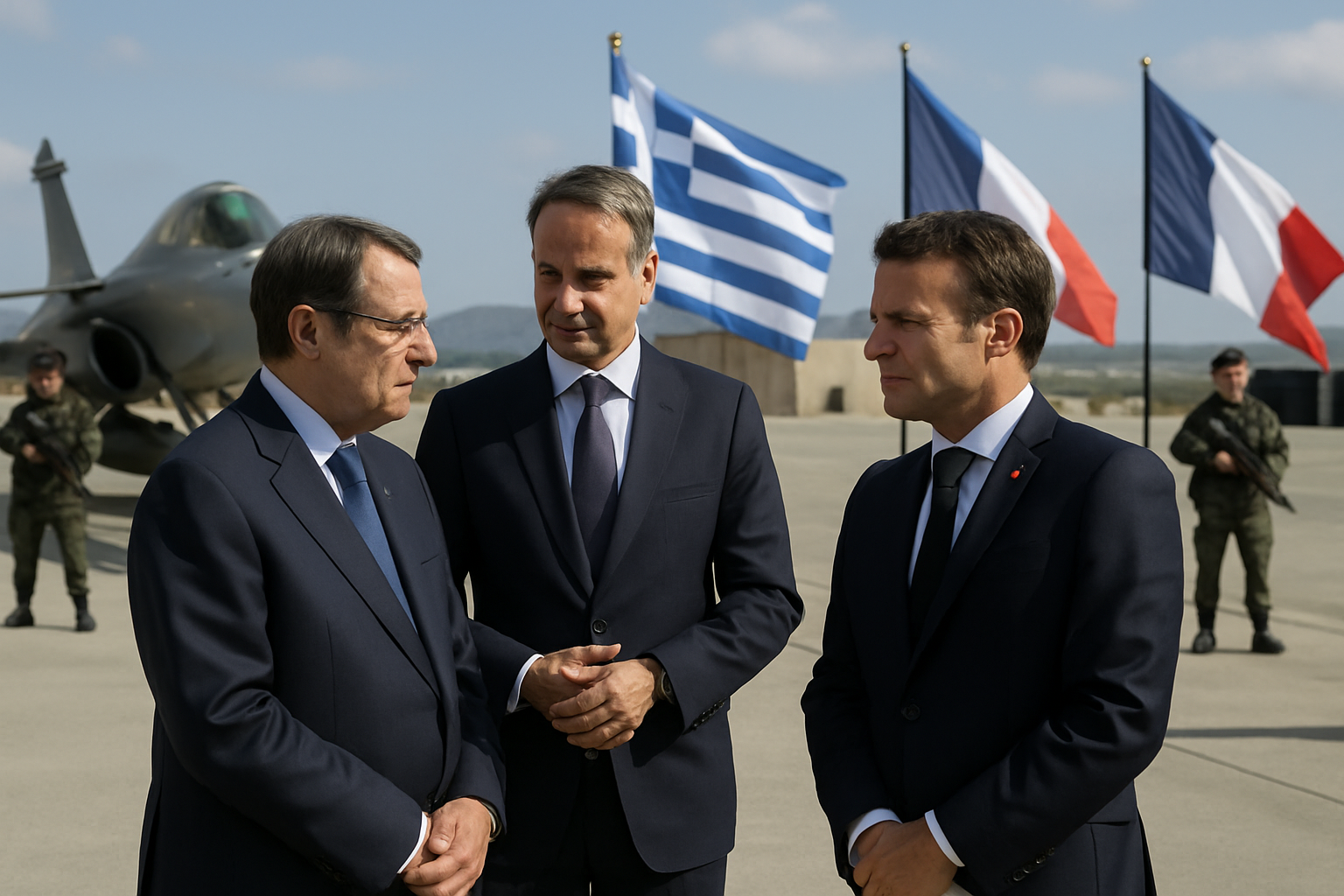
President Nikos Christodoulides of Cyprus welcomed Greek Prime Minister Kyriakos Mitsotakis and French President Emmanuel Macron at the Andreas Papandreou airbase in Paphos for a critical trilateral security summit, marking the most significant Eastern Mediterranean diplomatic gathering since the region was thrust into international crisis by Iranian attacks on European soil.
The three leaders arrived at the heavily secured Cypriot military facility shortly before 1:00 pm local time, with dozens of international media crews from across Europe and the Middle East documenting what many analysts consider a watershed moment for European strategic autonomy. The unprecedented security measures at the airbase reflected the gravity of regional tensions that have fundamentally altered the Mediterranean security landscape.
Historic Context of Crisis Response
This summit occurs against the backdrop of the most dangerous international crisis since the Cold War ended. The March 2026 Iranian drone attacks on RAF Akrotiri - the first targeting of European territory by Middle Eastern forces since World War II - triggered an unprecedented European military mobilization that demonstrated both the continent's vulnerability and its capacity for rapid coordinated response.
Cyprus activated its national ESTIA evacuation plan for the first time in its history, evacuating Akrotiri village and closing schools in the affected areas. The attacks exposed critical gaps in the island's civil defense infrastructure, with only 2,200 shelters providing protection for just 30% of the population - a vulnerability that has focused minds on the urgent need for enhanced security arrangements.
"The security of Cyprus means the security of Europe"
— President Nikos Christodoulides
President Christodoulides characterized the joint presence of the Greek Prime Minister and French President as a visit of "high symbolism and substantial significance for Cyprus." His words carry particular weight given Cyprus's strategic position just 100 miles from Lebanon and 200 miles from Syria, making it a crucial intersection point for multiple regional conflicts.
European Strategic Autonomy in Action
The response to the Cyprus crisis has become the most concrete expression of European strategic autonomy in decades. Within hours of the Iranian attacks, a four-nation coalition deployed substantial military assets to protect the island. France repositioned the aircraft carrier Charles de Gaulle from the Baltic to the Mediterranean and deployed the frigate Languedoc with advanced anti-missile and anti-drone systems. Greece committed four F-16 fighter jets and two naval frigates - the most significant military support for Cyprus since the 1974 Turkish invasion.
The United Kingdom deployed HMS Dragon, a Type 45 destroyer equipped with Sea Viper missile systems and AW159 Wildcat helicopters with counter-drone capabilities. This rapid coordination, independent of traditional NATO frameworks, represents a template-setting moment for 21st-century European defense cooperation.
Broader Regional Crisis Context
The Paphos summit takes place amid a comprehensive breakdown of regional stability. The crisis began with the collapse of US-Iran nuclear negotiations despite achieving what diplomats called "broad agreement on guiding principles" - the most progress since the JCPOA's 2018 breakdown. The subsequent Operation Epic Fury, the largest US-Israeli military campaign since 2003, and Iran's massive retaliation Operation True Promise 4, have created the most dangerous international situation since the Cold War's end.
The global implications have been staggering: over 18,000 flights cancelled worldwide, oil prices surging past $80 per barrel as Iran declared the Strait of Hormuz "unsafe," and the largest coordinated international evacuation since the Arab Spring of 2011. Dubai International Airport, the world's busiest with over 86 million passengers annually, remains shut down from missile damage.
Turkey's Response and Regional Balance
Adding complexity to the security equation, Turkey's Ministry of National Defense confirmed the deployment of six F-16 fighter jets and advanced air defense systems to Northern Cyprus, expanding from the originally planned four aircraft. The Turkish statement warned that "additional measures will continue to be taken based on further developments, if deemed necessary," reflecting the gravity of the deteriorating regional security environment.
This development underscores the delicate balance of forces in the Eastern Mediterranean, where competing interests and historical tensions intersect with contemporary security challenges. The presence of Turkish forces in Northern Cyprus adds another layer of complexity to the security calculations being discussed by the three leaders at Paphos.
Economic and Energy Security Dimensions
The crisis has exposed fundamental vulnerabilities in global energy architecture. Iran's effective closure of the Strait of Hormuz, through which 40% of global seaborne oil transit passes, has created the most severe energy crisis in decades. Natural gas prices have exploded by 24% in Europe and 78% in the United States, while Qatar's halt of LNG production has eliminated approximately 20% of global exports.
For Cyprus, positioned at the intersection of these trade routes, the implications extend far beyond immediate security concerns to long-term economic viability. The island's role as a bridge between Europe, Asia, and Africa has been both an asset and a vulnerability, as current events demonstrate.
Nuclear Governance Crisis
The security discussions at Paphos must also address the broader nuclear governance crisis that forms the backdrop to current regional tensions. The New START treaty expired on February 5, marking the first time in over 50 years without US-Russia nuclear constraints. Combined with China's nuclear expansion and Iran's uranium enrichment program reaching 60% purity with over 400kg of weapons-grade material, the international community faces what UN Secretary-General António Guterres has described as nuclear risks at their "highest level in decades."
This context gives particular urgency to European efforts to develop independent strategic capabilities and coordination mechanisms that can respond to crises without relying solely on superpower frameworks that are themselves under strain.
Template for Future Crisis Response
The European response to the Cyprus crisis has established important precedents for future security cooperation. The rapid deployment of multi-national forces, the coordination of intelligence sharing, and the activation of evacuation protocols demonstrate capabilities that could be applied to other regional crises. The success of these mechanisms provides a framework for European diplomatic engagement in future Middle Eastern developments.
However, the challenges remain immense. Extended operations require sustained political commitment across electoral cycles, coordination of command structures among multiple nations, and the delicate task of maintaining European decision-making autonomy while managing relationships with non-European allies.
Looking Forward: Strategic Implications
As the three leaders conclude their discussions at Paphos, the outcomes will likely influence European defense planning for decades to come. The crisis has demonstrated both the necessity of enhanced coordination and the continent's capacity for rapid response when territorial integrity is threatened. It has also shown that geographic boundaries no longer effectively contain regional conflicts in an interconnected world.
The summit represents a critical test of European crisis management capabilities in the multipolar era. Success in containing the current escalation while providing effective humanitarian assistance could demonstrate European global security relevance and influence future approaches to international crisis management.
The stakes extend beyond immediate military considerations to fundamental questions about the international order. The events of March 2026 have highlighted how rapidly diplomatic breakthroughs can transform into military confrontations, demonstrating the fragility of modern crisis management in a multipolar world. The European response to these challenges will provide a template for addressing future crises in an increasingly volatile international environment.
As the leaders departed Paphos, the success or failure of European coordination efforts will reverberate through international relations for decades, affecting approaches to conflict resolution, energy security architecture, and the credibility of diplomatic versus military solutions in the 21st century. The summit marks not just a response to immediate crisis, but a potential turning point in European integration on security matters and the continent's role in global stability mechanisms.