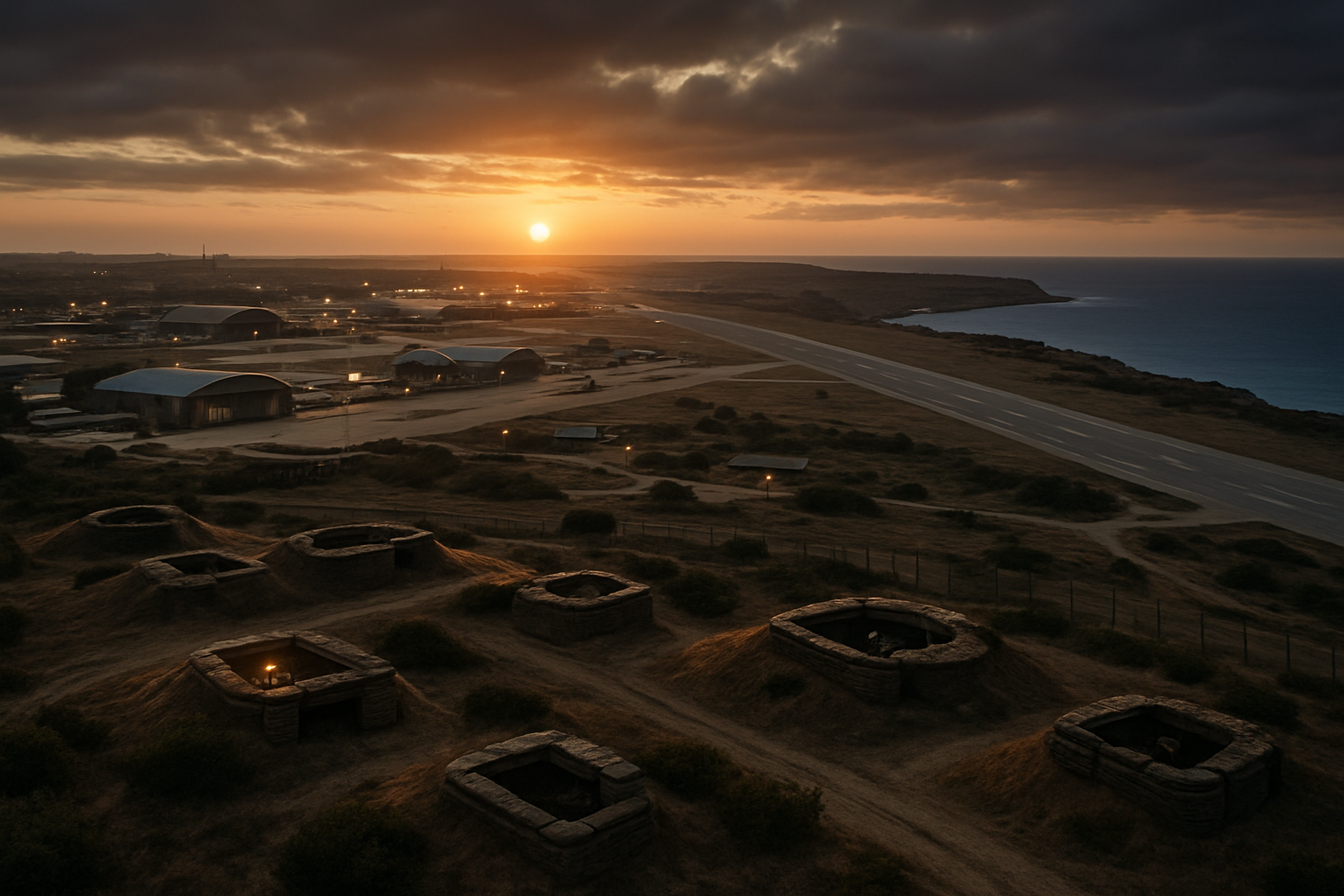
A suspected drone strike on RAF Akrotiri, the British sovereign military base in Cyprus, has forced authorities to order shelter-in-place measures for residents and placed the facility on maximum alert, marking the first time Middle Eastern conflict has directly threatened British military installations on European soil since World War II.
The incident occurred shortly after midnight on Monday, March 2, 2026, when an unmanned aerial vehicle reportedly struck the airfield at the British Sovereign Base Area, prompting immediate security protocols as the Cyprus government convened its National Security Council under President Nikos Christodoulides.
Official Response and Immediate Aftermath
The British Sovereign Base Areas Administration (SBA) issued an urgent announcement stating: "Following a suspected drone impact at RAF Akrotiri, the Sovereign Base Areas Administration is advising residents of Akrotiri village to shelter in place until further notice." The statement added that "the force protection in the region is at the highest level and the base has responded to defend our people."
Cyprus government spokesman Konstantinos Letymbiotis confirmed the incident, reporting that "an unmanned drone which caused limited damage" had struck the base. He emphasized that "competent authorities immediately activated the prescribed security protocols" and are monitoring the situation "in continuous coordination with the British government and the administration of the British Bases."
Regional Context and Escalating Tensions
The attack on RAF Akrotiri comes amid the most severe Middle Eastern crisis since the Cold War, following the massive Iranian retaliation campaign known as "Operation True Promise 4" launched in response to the US-Israeli "Operation Epic Fury" strikes. The regional conflict has now expanded beyond traditional Middle Eastern boundaries, with Cyprus becoming the latest European territory affected by the escalating violence.
According to memory archives, the current crisis stems from the complete breakdown of nuclear negotiations between the United States and Iran, despite achieving a "broad agreement on guiding principles" in Geneva talks—the most significant diplomatic progress since the JCPOA collapse in 2018. The fundamental disagreement over Iran's ballistic missile program and regional proxy activities proved insurmountable, leading to the largest military operation in the Middle East since the 2003 Iraq invasion.
Strategic Significance of Cyprus Location
RAF Akrotiri, one of Britain's two sovereign base areas in Cyprus alongside Dhekelia, houses approximately 3,000 UK military personnel and serves as a critical strategic hub for British operations in the Eastern Mediterranean and Middle East. The base's location, roughly 100 miles from the Lebanese coast and 200 miles from Syria, has made it an essential staging point for intelligence gathering and rapid response capabilities.
The facility's significance extends beyond its immediate military function—it represents one of the last remnants of British colonial presence in the Eastern Mediterranean and serves as a crucial link between NATO's southern flank and Middle Eastern operations. The attack marks an unprecedented escalation in which regional conflicts have directly targeted European military installations.
International Implications
The strike on RAF Akrotiri occurs within the context of the most comprehensive international crisis since the Cuban Missile Crisis. As documented in intelligence reports, Iran's Islamic Revolutionary Guard Corps (IRGC) declared that "no red lines remain" following the death of Supreme Leader Ali Khamenei in Operation Epic Fury, with all US and Israeli assets considered "legitimate targets."
While there has been no official claim of responsibility for the Cyprus attack, the timing suggests it may be part of Iran's broader retaliation strategy that has already targeted multiple Gulf states, resulting in civilian casualties in the UAE, Kuwait, Qatar, and Bahrain, as well as the complete shutdown of Dubai International Airport.
Aviation and Energy Security Crisis
The Cyprus incident adds another layer to an unprecedented global aviation crisis, with over 18,000 flights canceled worldwide as Iran, Iraq, Israel, UAE, Qatar, Syria, Kuwait, and Bahrain simultaneously closed their airspace. This represents the most extensive aviation disruption since the COVID-19 pandemic, affecting hundreds of thousands of passengers globally.
Energy markets have reacted sharply to the expanding conflict, with oil prices surging as Iran threatens to close the Strait of Hormuz, through which 40% of global oil transit flows. Natural gas prices have increased by 24% in Europe and 78% in the United States, highlighting the global economic implications of the regional crisis.
Government Response and National Security
The Cyprus National Security Council has been in continuous session since the attack, with President Christodoulides coordinating with both the British government and the SBA administration. The Cypriot government has activated its national ESTIA evacuation plan for European and third-country nationals—the first implementation since the protocol was established.
Cyprus Foreign Minister Constantinos Kombos has briefed EU counterparts on the situation, expressing "full support" for Gulf partners affected by Iranian retaliatory strikes while condemning attacks against Bahrain, Iraq, Jordan, Kuwait, Qatar, Oman, Saudi Arabia, and the UAE.
Nuclear Governance Crisis Context
The attack occurs against the backdrop of a broader nuclear governance crisis. The New START treaty between the United States and Russia expired on February 5, 2026, marking the first time in over 50 years without US-Russia nuclear constraints. Combined with China's nuclear expansion, UN Secretary-General António Guterres has warned that nuclear risks are at their "highest in decades."
The collapse of Iranian nuclear negotiations, despite achieving the most significant progress since 2018, raises fundamental questions about the viability of diplomatic solutions to modern nuclear crises. Iran's continued uranium enrichment at 60% purity, approaching weapons-grade levels with sufficient material for multiple weapons if weaponized, has created an urgent proliferation risk.
European Security Architecture Under Threat
The Cyprus attack represents a concerning expansion of Middle Eastern conflicts into European territory, challenging the continent's security assumptions. European Commission President Ursula von der Leyen and European Council President António Costa have issued joint statements demanding "maximum restraint" from all parties, warning that the "risk of escalation threatens Europe's security architecture."
Swedish terrorism researcher Magnus Ranstorp has noted that strikes against Iran significantly increase retaliation threats against Western Europe, as Iran's weakened position may lead to increased asymmetric attacks to demonstrate continued capability.
Template-Setting Moment for 21st Century
The events unfolding in Cyprus and across the Middle East represent what experts are calling a "template-setting moment" for 21st-century conflict resolution. The rapid breakdown from diplomatic breakthrough to military escalation demonstrates the fragility of modern crisis management mechanisms in a multipolar world order.
The stakes extend far beyond the immediate region, encompassing regional war prevention, global energy security, nuclear governance credibility, and international law enforcement mechanisms. The success or failure of containing this crisis could provide either a diplomatic template for future nuclear disputes or accelerate military solutions, reshaping global geopolitics for decades.
Looking Forward
As RAF Akrotiri remains on highest alert and Cyprus monitors the evolving situation, the international community faces its greatest test of multilateral cooperation and crisis management in the modern era. The coming hours and days will determine whether this crisis can be contained as a regional confrontation or will escalate into a broader Middle Eastern war with worldwide implications.
The attack on British sovereign territory in Cyprus marks a watershed moment, demonstrating how 21st-century conflicts can rapidly transcend traditional geographical boundaries and threaten the fundamental principles of international security that have governed the post-World War II order.
With diplomatic channels strained and military positions hardening worldwide, the decisions made in the coming phase will reverberate through international relations for decades, affecting conflict resolution approaches, territorial sovereignty enforcement, and nuclear proliferation prevention mechanisms globally.