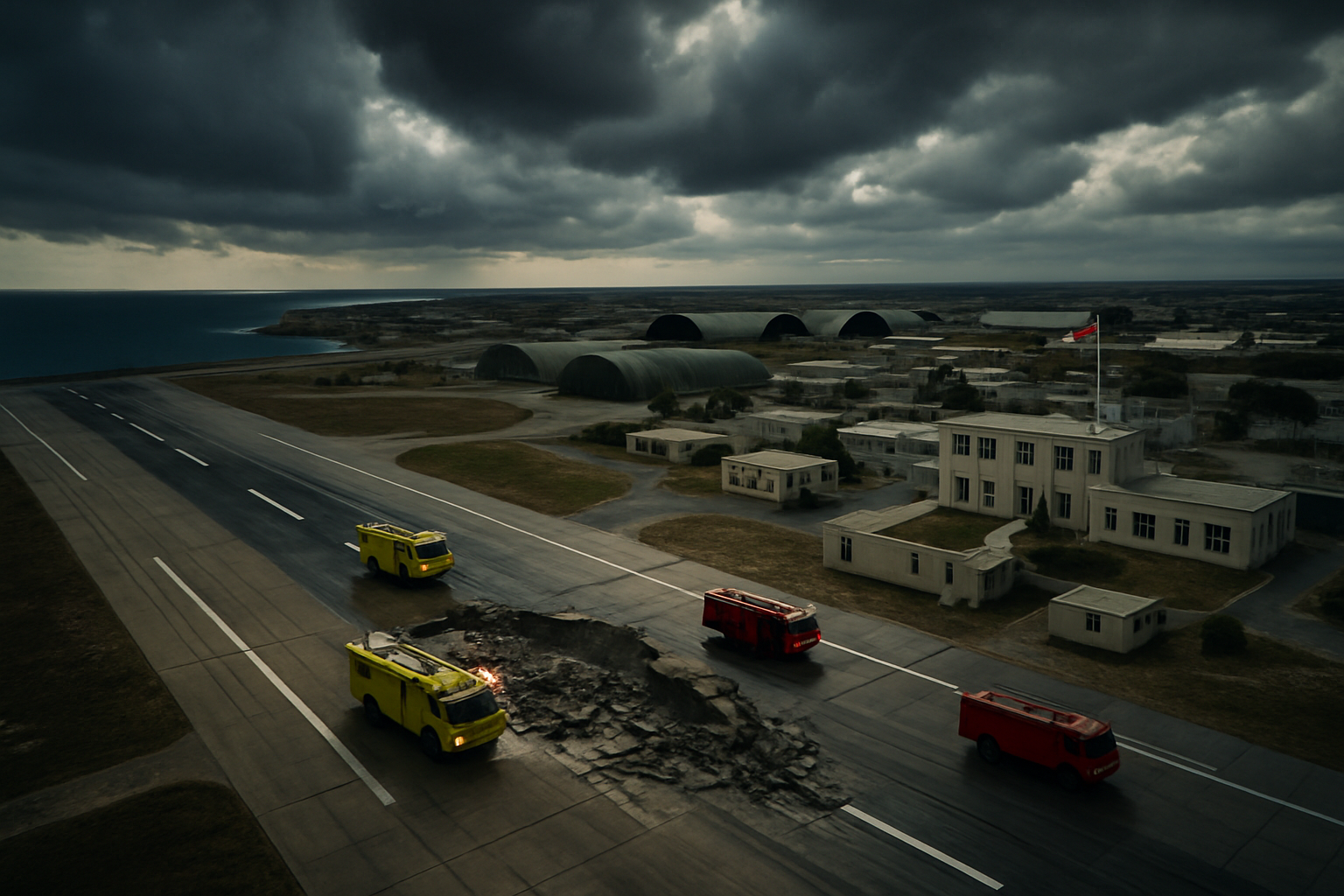
Iranian drones successfully struck RAF Akrotiri, Britain's sovereign military base in Cyprus, overnight on March 2, 2026, causing limited damage to the runway and forcing unprecedented evacuations of local communities in what marks the first direct attack on European territory during the escalating Middle East crisis.
The overnight strike on the Royal Air Force base, which houses approximately 3,000 UK personnel, represents a dramatic expansion of Iran's retaliation campaign following the US-Israeli "Operation Epic Fury" that confirmed the death of Supreme Leader Ali Khamenei. Cyprus government spokesman Konstantinos Letymbiotis confirmed that "an unmanned drone caused limited damage" to the base's runway but resulted in no casualties.
Mass Evacuations and School Closures
In an unprecedented response, Cyprus authorities ordered the evacuation of Akrotiri village and implemented the first-ever activation of the national ESTIA evacuation plan. All primary, pre-primary, and secondary schools in villages near RAF Akrotiri—including Akrotiri, Asomatos, Episcopi, and Trachoni—remained closed Tuesday as a precautionary measure.
The Ministry of Education, Sports and Youth announced the closure affects all teaching staff, pupils, and school personnel in the affected areas. The measure underscores the gravity of the situation as Cyprus faces its first direct involvement in Middle Eastern hostilities since World War II.
"What is confirmed is that the Republic of Cyprus was not a target and has never been a target — the target was the British Bases at Akrotiri,"
— Konstantinos Letymbiotis, Cyprus Government Spokesman
Second Wave Intercepted
Intelligence shared with Cypriot authorities identified two additional unmanned aerial vehicles heading toward RAF Akrotiri at approximately midday Monday, which were successfully intercepted by Cypriot forces. Government spokesman Letymbiotis confirmed the drones were shot down away from the coastline, rejecting reports that ballistic missiles had been fired at the island.
According to the latest intelligence assessments, all indications suggest the drones were launched by Hezbollah in Lebanon as part of Iran's broader retaliation campaign. The strikes represent a significant escalation in the regional conflict that began with the collapse of nuclear diplomacy and the launch of Operation Epic Fury.
British Military Response
Chief Superintendent Neil Cripps, Divisional Commander (East) of the Sovereign Base Areas Police, stated that authorities currently assess the drone threat to eastern Cyprus as "low" and confirmed there are no plans to evacuate all bases on the island. However, as a precautionary measure, non-essential personnel at RAF Akrotiri were temporarily relocated Tuesday morning.
British Prime Minister Keir Starmer told Parliament Monday that the UK had agreed to allow the United States to use British bases for destroying Iranian missile capabilities, but only for defensive purposes. He stressed that Britain was not joining offensive operations against Iran and emphasized that the base was not being used by US bombers.
Greece Deploys Military Support
In response to the unprecedented attacks, Greece immediately rushed two navy frigates and a pair of F-16 fighter jets to Cyprus to bolster the island's defense capabilities. The deployment represents the most significant military support to Cyprus since the 1974 Turkish invasion and highlights the gravity of the current crisis.
The Greek military reinforcement comes as European leaders grapple with the reality that the Middle Eastern conflict has directly reached European territory for the first time since World War II, challenging traditional assumptions about continental security.
Political Condemnation and Calls for Peace
The Cyprus Peace Council condemned the escalation and called on residents to join an anti-war demonstration in Limassol Tuesday. In a statement, the council described the British Bases in Cyprus as "an anachronistic remnant of colonialism" and a permanent danger to the island and wider region, calling for their closure.
"It would be catastrophic if Cyprus becomes a target of retaliation in a military attack foreign to its interests"
— Cyprus Peace Council Statement
Cyprus has expressed displeasure with British government actions following the drone incident, with cabinet ministers briefed on security measures and diplomatic efforts. President Nikos Christodoulides and Foreign Minister contacts are ongoing as the government navigates its most serious security crisis in decades.
Regional Context and Iranian Escalation
The attacks on Cyprus occur within the broader context of Iran's massive retaliation campaign "Operation True Promise 4," launched following the death of Supreme Leader Khamenei during coordinated US-Israeli strikes. The Iranian Revolutionary Guard Corps (IRGC) declared "no red lines remain," making all US and Israeli assets "legitimate targets."
The strikes have caused casualties across the Gulf region, including one civilian death in the UAE, damage to Kuwait International Airport, and the complete shutdown of Dubai International Airport. Over 18,000 flights have been cancelled worldwide as multiple countries closed their airspace simultaneously.
Global Aviation Crisis
The regional conflict has triggered the most extensive aviation disruption since COVID-19, with Iran, Iraq, Israel, UAE, Qatar, Syria, Kuwait, and Bahrain simultaneously closing their airspace. Major carriers including Emirates, Air France-KLM, Wizz Air, and Bulgaria Air have suspended Middle East operations, affecting hundreds of thousands of passengers globally.
The crisis highlights how rapidly regional conflicts can have global implications, with critical Europe-Asia flight connections through the Middle East now severely disrupted.
Nuclear Diplomacy Collapse
The current escalation follows the complete breakdown of nuclear negotiations that had achieved the most significant progress since the 2018 JCPOA collapse. Despite reaching a "broad agreement on guiding principles" in Geneva talks, fundamental disagreements over Iran's ballistic missile program and regional proxy activities proved insurmountable.
Iran had been enriching uranium to 60% purity with over 400kg of enriched material, approaching weapons-grade levels. The diplomatic failure has raised questions about the viability of negotiated solutions to modern nuclear crises.
Energy Security Implications
Oil prices have surged as Iran warned that shipping through the Strait of Hormuz—which handles 40% of global oil transit—would not be allowed. Natural gas prices have increased 24% in Europe and 78% in the US, with regional war risks threatening worldwide supply chains and energy security far beyond the Middle East.
The energy crisis demonstrates how regional conflicts in today's interconnected world can rapidly affect global economic stability and everyday life across continents.
Historical Significance
The attacks on Cyprus represent a watershed moment, marking the first time since World War II that Middle Eastern conflicts have directly reached European sovereign territory. The strikes challenge post-war assumptions about European security and highlight the vulnerability of Western military installations to modern asymmetric threats.
As the situation continues to develop, the international community faces critical decisions about containing the escalation while addressing the underlying issues that led to this unprecedented crisis. The stakes include regional war prevention, global energy security, nuclear governance credibility, and the enforcement of international law in the 21st century.
Looking Forward
Cyprus finds itself at the center of a crisis that began with nuclear diplomacy and has rapidly escalated to military confrontation spanning continents. The island's strategic position and hosting of British military assets has drawn it directly into a conflict that threatens to reshape Middle Eastern geopolitics for decades to come.
The coming days will be crucial in determining whether diplomatic efforts can contain the escalation or if the world is witnessing the beginning of a broader regional war with global implications extending far beyond the current crisis.