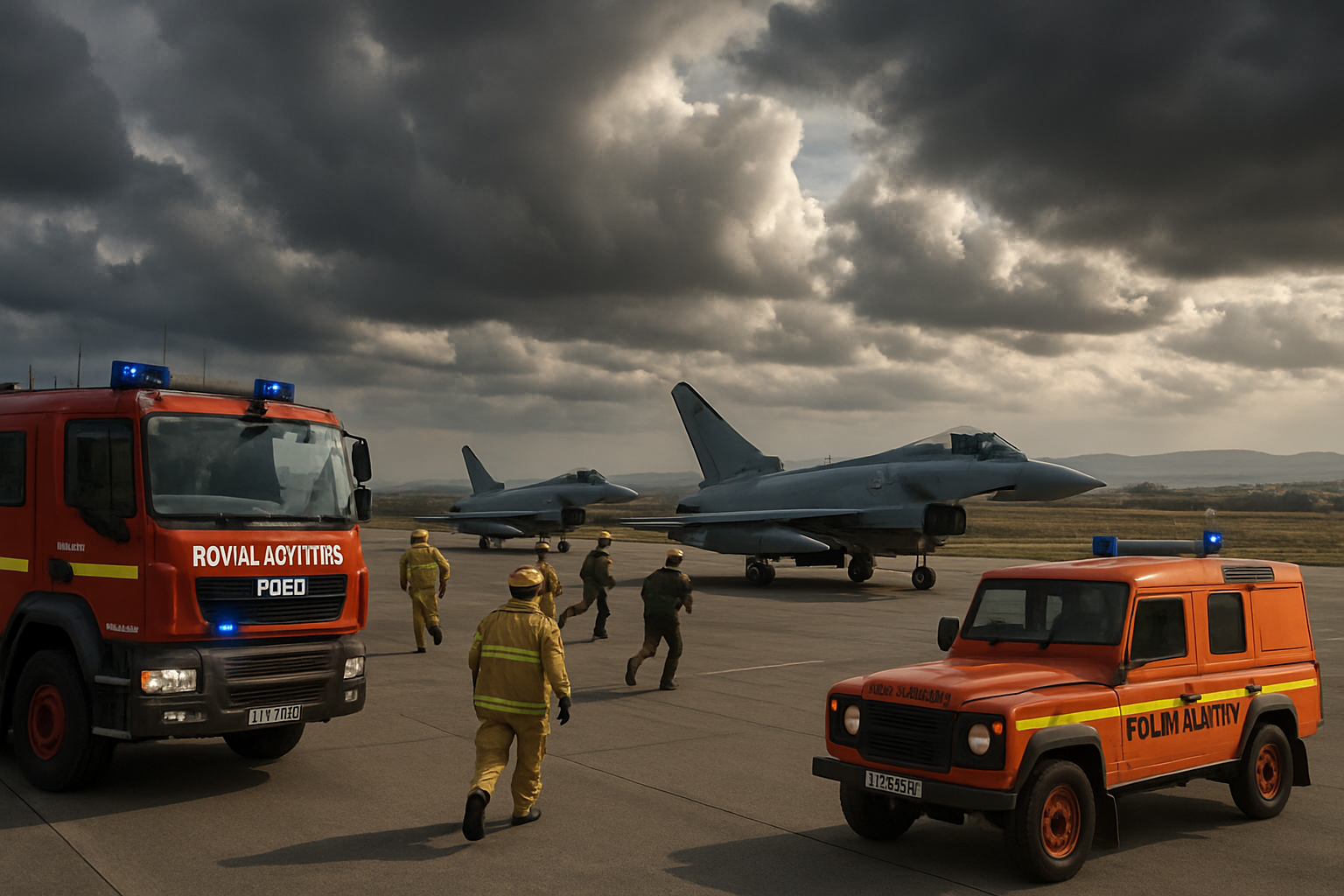
British sovereign military bases in Cyprus came under direct attack Monday as Iranian drone strikes targeted RAF Akrotiri and Dhekelia, marking the first time Middle Eastern conflict has reached European sovereign territory since World War II and forcing unprecedented evacuations across the Mediterranean island.
The attacks began shortly after midnight Monday when two unmanned aerial vehicles struck RAF Akrotiri, home to approximately 3,000 UK military personnel. Cyprus government spokesperson Konstantinos Letymbiotis confirmed the incident, stating that an "unmanned drone caused limited damage" to the base while emergency protocols placed the facility under its highest alert level.
Escalating Crisis Forces Mass Evacuations
By Monday afternoon, the crisis had escalated dramatically. The British Sovereign Base Areas (SBA) Administration ordered complete evacuation of both Akrotiri and Dhekelia bases following reports of an imminent "live air threat." The Cyprus Interior Ministry simultaneously ordered mandatory evacuation of Akrotiri village at 12:33 PM, with many residents fleeing as air raid sirens echoed across the district.
"Following a direct instruction from the Interior Minister to the Mayor of Kouris, residents were told to abandon their homes immediately," according to official reports. The evacuation represented the first implementation of Cyprus's national ESTIA evacuation plan since its establishment.
The situation deteriorated further when Paphos International Airport was evacuated at 12:45 PM after security services detected an unidentified drone within the facility's restricted airspace. All passengers and staff were ordered to vacate the terminal building as the Republic remained on high alert.
Iran's "No Red Lines" Campaign Reaches Europe
The Cyprus attacks form part of Iran's "Operation True Promise 4," launched in retaliation for the massive US-Israeli "Operation Epic Fury" strikes that targeted Iranian facilities and reportedly killed Supreme Leader Ali Khamenei. The Islamic Revolutionary Guard Corps (IRGC) has declared that "no red lines remain," designating all US and Israeli assets as "legitimate targets."
Iranian state media affiliated with the IRGC claimed that ballistic missiles had been launched against British military assets on the island, marking an unprecedented expansion of Middle Eastern conflicts into European territory. The strikes occurred amid a broader Iranian retaliation campaign that has targeted US military bases and civilian infrastructure across the Gulf region.
"Two unmanned aerial vehicles that were moving toward the direction of the British Sovereign Bases at Akrotiri were dealt with in a timely manner."
— Konstantinos Letymbiotis, Cyprus Government Spokesperson
Strategic Significance and Regional Impact
The attacks on Cyprus represent a watershed moment in post-WWII European security. RAF Akrotiri serves as a critical Eastern Mediterranean hub, positioned just 100 miles from Lebanon and 200 miles from Syria. The base has historically served as a staging ground for British operations in the Middle East and houses sophisticated intelligence gathering capabilities.
The targeting of British sovereign territory demonstrates Iran's willingness to expand the conflict beyond traditional Middle Eastern boundaries, bringing the consequences of regional warfare directly to European soil. This marks the first time since World War II that a European sovereign military installation has been attacked during a Middle Eastern crisis.
Cyprus Foreign Minister Constantinos Kombos briefed EU counterparts on the high-level regional contacts and expressed "full support" for Gulf partners affected by Iranian retaliatory strikes. The island nation has activated unprecedented coordination with British authorities and the SBA administration while maintaining its traditional role as a bridge between East and West.
Civil Defense Exposed: Cyprus's Shelter Crisis
The drone strikes have brought Cyprus's civil protection infrastructure into sharp focus, revealing significant gaps in shelter capacity and emergency systems. Currently, Cyprus has approximately 2,200 registered shelters, but they can only protect about 30% of the population (roughly 250,000 people).
Interior Minister Constantinos Ioannou confirmed that these spaces are not "territorially balanced," with a surplus in coastal hotel areas but a severe lack in older urban centers where basements are rare. A major concern is that the number of available shelters is actually decreasing, as many property owners have requested to declassify these spaces for storage or rental purposes.
Aviation Crisis Spreads Globally
The Cyprus attacks occurred amid an unprecedented global aviation crisis, with over 18,000 flights cancelled worldwide as Iran, Iraq, Israel, UAE, Qatar, Syria, Kuwait, and Bahrain simultaneously closed their airspace. This represents the most extensive aviation disruption since the COVID-19 pandemic.
Major carriers including Emirates, Air France-KLM, Wizz Air, and Bulgaria Air have suspended Middle East operations, affecting hundreds of thousands of passengers globally. The simultaneous closure of multiple strategic airspaces has severed the critical Europe-Asia aviation hub, forcing complex international rerouting with Russian and Ukrainian airspace already restricted.
Nuclear Diplomacy's Complete Collapse
The attacks on Cyprus follow the complete breakdown of US-Iran nuclear negotiations, despite recent diplomatic breakthroughs. Geneva talks had achieved "broad agreement on guiding principles" – the most significant progress since the JCPOA collapse in 2018. However, fundamental disagreements proved insurmountable.
Iran maintained that ballistic missiles and regional proxy activities were "red lines" to be excluded from nuclear-only talks, while the US demanded a comprehensive agreement including missiles, armed groups, and human rights issues. Iran continues enriching uranium at 60% purity, approaching the 90% weapons-grade threshold, with sufficient material for multiple weapons if weaponized.
International Response and Strategic Implications
The UN Security Council has convened emergency sessions, with Secretary-General António Guterres warning that military actions pose a "serious threat to international peace and security" that could "trigger a chain of events no one can control."
European Union leaders have issued joint statements demanding "maximum restraint" while Cyprus has activated its national evacuation procedures. Multiple European governments have issued travel warnings and ordered embassy evacuations, with Sweden and Serbia advising immediate departure from Iran citing "extremely uncertain" security conditions.
The crisis occurs against the backdrop of broader nuclear governance breakdown, with the New START treaty having expired on February 5 – the first time in over 50 years without US-Russia nuclear constraints. China's nuclear expansion and rising global tensions have created what UN officials describe as nuclear risks at their "highest level in decades."
"This represents the unprecedented escalation bringing Middle Eastern conflicts directly to European military installations for the first time since World War II."
— Security Analysis, International Observers
Energy Security and Economic Impact
The regional crisis has created severe energy security concerns, with oil prices surging as Iran threatens closure of the Strait of Hormuz, through which 40% of global seaborne oil transits. Natural gas prices have jumped 24% in Europe and 78% in the United States amid fears of supply disruptions.
Major shipping companies including Maersk and MSC have suspended Persian Gulf operations, with over 150 oil and LNG tankers stranded and representing billions in cargo value. The regional conflict risks disrupting worldwide supply chains far beyond the Middle East, affecting global economic stability.
Greece Pledges Military Support
In a show of regional solidarity, Greece has announced it will send two frigates and F-16 fighter jets to support Cyprus during the crisis. This deployment underscores the broader European concern about the spillover effects of Middle Eastern conflicts reaching EU territory.
The Greek response reflects growing recognition among European allies that the traditional geographic boundaries containing Middle Eastern conflicts have been breached, requiring coordinated European security responses to protect sovereign territory and civilian populations.
Template for 21st Century Conflict
The Cyprus attacks represent a template-setting moment for 21st-century conflict management in the multipolar era. The rapid transition from promising diplomatic breakthrough to military escalation demonstrates the fragility of modern crisis management mechanisms when dealing with nuclear-capable states.
Success in containing this escalation could provide a framework for future nuclear crisis resolution, while failure may accelerate the preference for military solutions over diplomatic ones, potentially reshaping Middle Eastern geopolitics for decades and encouraging nuclear proliferation globally.
The attacks mark March 2026 as a watershed moment in international relations, with implications extending far beyond the current crisis. The stakes include regional war prevention, global energy security, nuclear governance credibility, and the enforcement of international law in the post-WWII order.
Looking Forward
As Cyprus implements emergency protocols for the first time since their establishment, the international community faces its greatest test of multilateral cooperation and crisis management in the modern era. The coming days and weeks will determine whether this represents a contained regional confrontation or the beginning of a broader Middle Eastern war with worldwide implications for energy markets, supply chains, and the fundamental principles of international stability.
The transformation of Cyprus from a peaceful Mediterranean island to the front line of Middle Eastern conflict exemplifies how rapidly modern geopolitical crises can transcend traditional boundaries, bringing the consequences of distant conflicts directly to European soil and civilian populations previously insulated from regional warfare.