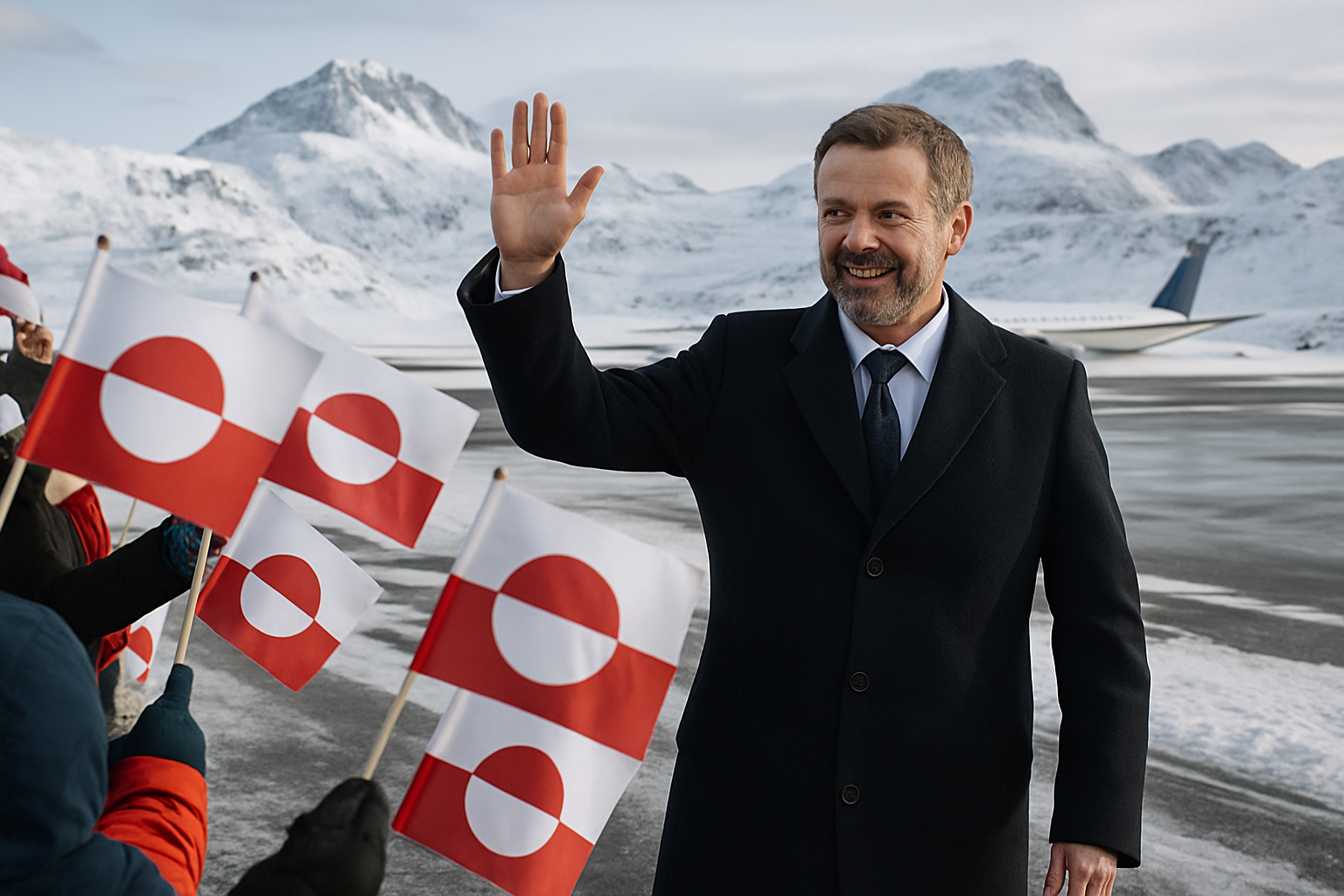
Denmark's King Frederik X arrived in Greenland on Wednesday for a three-day symbolic visit to the autonomous Danish territory, as international tensions over the island's sovereignty continue to escalate amid persistent US territorial ambitions under President Trump.
The 57-year-old monarch waved to well-wishers brandishing Greenlandic flags at Nuuk airport, where he was greeted by Prime Minister Jens-Frederik Nielsen in a carefully choreographed display of Danish solidarity with the Arctic territory. The visit comes as sources confirm EU Commission President Ursula von der Leyen is planning a March trip to Greenland to announce a substantial support package.
Royal Visit Amid Territorial Tensions
King Frederik's presence in Greenland represents the highest-level Danish diplomatic response to mounting US pressure for territorial control. The timing is particularly significant given ongoing working group meetings between US and Greenlandic representatives that began January 28, 2026, despite repeated rejections of American acquisition proposals.
The royal visit serves as a powerful symbol of Danish sovereignty over the territory, which has been under increasing scrutiny since President Trump's renewed interest in acquiring Greenland. Prime Minister Nielsen has consistently maintained that "Greenland is neither for sale nor for purchase" while engaging cautiously with US representatives.
Sources familiar with the diplomatic situation describe the king's visit as a "show of support" for Greenlandic autonomy under Danish sovereignty, reinforcing legal and constitutional ties that have governed the relationship since Greenland gained self-rule in 1979.
EU Commission President's Strategic Response
In a parallel diplomatic development, sources tell media outlets that EU Commission President Ursula von der Leyen will visit Greenland in March to announce a comprehensive support package. This unprecedented European Union initiative represents the most significant EU engagement with Greenland in decades and signals Brussels' commitment to supporting Danish territorial integrity.
The planned EU support package comes amid a broader pattern of international solidarity with Greenlandic sovereignty. In February 2026, France and Canada simultaneously opened their first consulates in Nuuk in a coordinated diplomatic move opposing Trump administration territorial pressure. Canadian Foreign Minister Anita Anand attended the ceremony alongside Indigenous Governor General Mary Simon, while an Inuit delegation from Canada delivered a message to Trump to "back off."
Greenland's Strategic Importance
Greenland's significance extends far beyond its 56,000 inhabitants, encompassing critical strategic assets that have attracted international attention. The territory controls vital Arctic shipping routes increasingly accessible due to climate change, contains substantial rare earth mineral deposits essential for modern technology, and provides military positioning in a region of growing competition between Russia, China, and Western powers.
The island's strategic value has intensified as climate change opens new possibilities for resource extraction and navigation, making it a focal point for great power competition in the 21st century. Danish and Greenlandic authorities have expressed determination to maintain sovereign control over these assets while engaging in international cooperation frameworks.
"We are in a better position regarding US territorial claims over Greenland, but we are not out of the crisis, and we do not have a solution yet."
— Lars Løkke Rasmussen, Danish Foreign Minister
International Law and Sovereignty Principles
The coordinated European-Canadian response to US territorial pressure has established important precedents for collective diplomatic action in defense of sovereignty principles. Legal experts note that the systematic international support for Danish-Greenlandic autonomy reinforces established international law regarding territorial integrity and self-determination.
The crisis represents a multilateral test of international law's ability to constrain major power territorial ambitions against smaller territories. The response has demonstrated that traditional alliance relationships can adapt to address internal pressures while maintaining collective defense principles.
NATO's Arctic Sentry mission, launched in February 2026 with European leadership, has provided additional security assurance through enhanced Arctic defense capabilities. The UK is doubling its troop presence in Norway to 2,000 over three years, while Sweden has deployed Gripen jets for Greenland exercises, and Finland contributes operational planning expertise.
Local Opposition and Cultural Identity
Polling among Greenland's population shows overwhelming support for maintaining autonomous status under Danish sovereignty versus American acquisition. The strong cultural connections with Canadian Inuit communities, demonstrated through the February consulate opening, highlight Indigenous solidarity against external territorial pressures.
Greenlandic authorities have issued behavioral recommendations to residents as territorial tensions persist, though no immediate military threats have materialized. The local response reflects anxiety about external pressures despite confidence in international legal protections and diplomatic support.
Broader Arctic Governance Framework
The Greenland sovereignty crisis occurs within a broader context of Arctic governance challenges as the region becomes increasingly accessible and strategically valuable. Climate change is fundamentally altering the geopolitical landscape, opening new shipping routes and making resource extraction more feasible.
The resolution of the Greenland territorial dispute will likely establish precedents for future climate change-related territorial disputes in strategically valuable regions. The international community's response demonstrates evolving mechanisms for addressing 21st-century sovereignty challenges that combine traditional diplomatic tools with innovative multilateral approaches.
Looking Ahead
King Frederik's visit and the planned EU Commission President's March trip represent escalating diplomatic engagement designed to reinforce Greenlandic sovereignty while addressing legitimate security concerns. The working group meetings with US representatives continue, though fundamental positions remain unchanged regarding territorial control.
The crisis has strengthened international solidarity around sovereignty defense principles while testing whether democratic institutions can effectively respond to territorial pressures from major powers. The outcome will influence Arctic governance frameworks and establish important precedents for territorial dispute resolution in an era of climate change and resource competition.
As King Frederik concludes his symbolic visit, the international community watches carefully for developments that could either resolve the territorial tensions through diplomatic innovation or escalate into a more serious challenge to established international order principles governing territorial sovereignty in the Arctic and beyond.