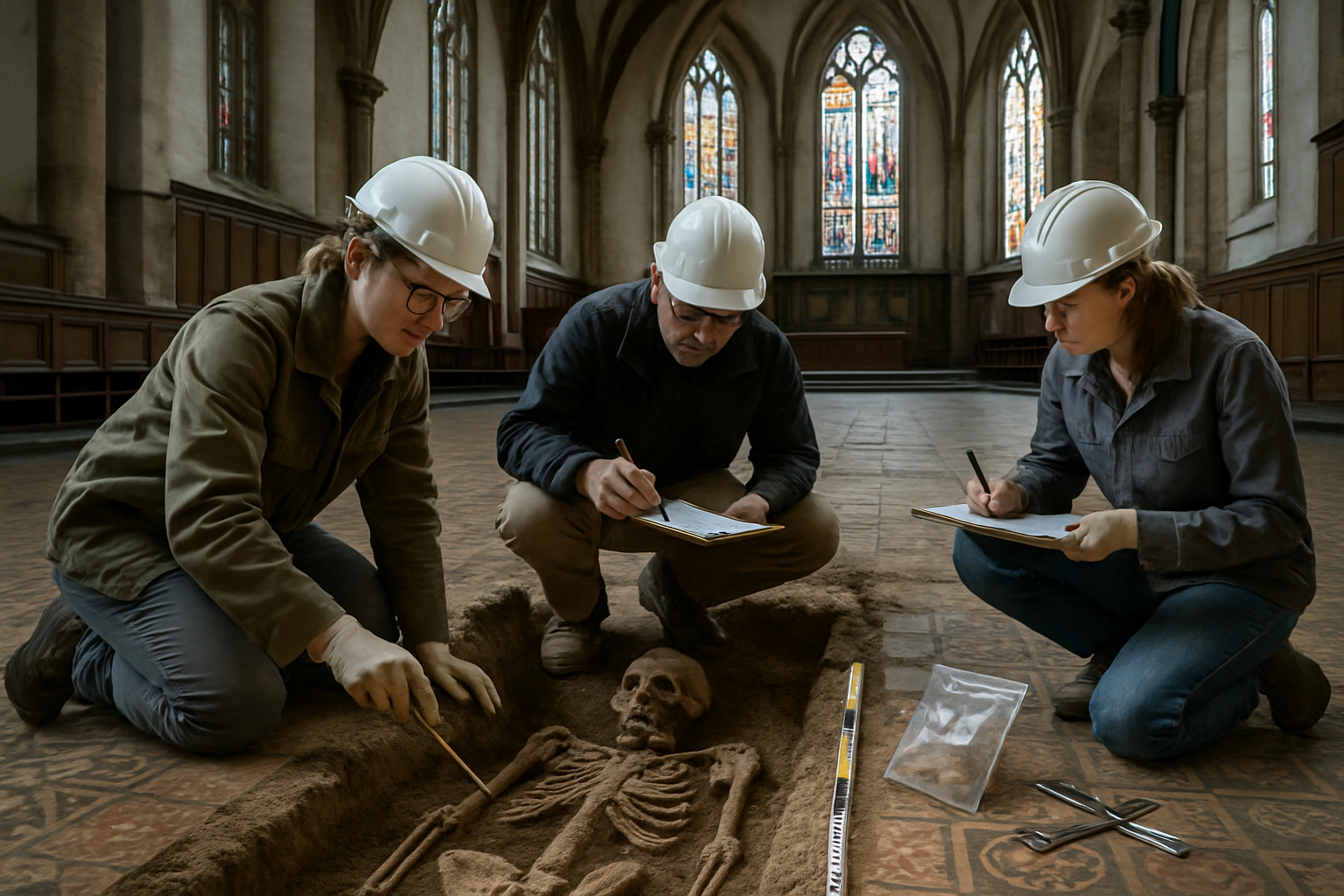
In a discovery that could solve one of history's most enduring literary mysteries, archaeologists in the Dutch city of Maastricht have uncovered human remains that may belong to Charles de Batz de Castelmore d'Artagnan, the legendary French musketeer who inspired Alexandre Dumas' immortal character in "The Three Musketeers."
The remarkable find occurred when workers discovered a grave containing human remains beneath floor tiles at St Peter and Paul Church after part of the church floor subsided in February. What began as routine maintenance work has evolved into what archaeologists are calling "a top-level investigation" involving cutting-edge DNA testing and international collaboration.
The Discovery That Sparked Global Interest
Church officials and archaeologists announced Wednesday that the skeleton, found positioned prominently in front of the church altar, could potentially be that of the famous musketeer who died in Maastricht over 350 years ago during the 1673 siege of the city. The location of the remains—directly before the altar in one of Maastricht's most significant religious buildings—suggests the burial site of a person of considerable importance.
"This has truly become a top-level investigation, in which we want to be absolutely certain of our findings before making any definitive claims," stated a church spokesman, emphasizing the scientific rigor being applied to the authentication process.
Historical Context and Literary Legacy
Charles de Batz de Castelmore d'Artagnan was a real French musketeer who served under King Louis XIV and died during the siege of Maastricht on June 25, 1673. His exploits and character traits provided the inspiration for Alexandre Dumas père's 1844 masterpiece "The Three Musketeers," though Dumas took considerable literary license in crafting his fictional version of the historical figure.
The nobleman's death in the Dutch city has been historically documented, but the exact location of his burial site had remained one of history's unsolved puzzles. Various theories and legends had circulated about where the famous musketeer's remains might rest, making this potential discovery all the more significant for both historians and literature enthusiasts worldwide.
"The mystery of d'Artagnan's final resting place has captivated historians for centuries. If confirmed, this discovery would provide a tangible connection to one of literature's most beloved characters."
— Historical Research Team
Advanced Archaeological Methodology
The investigation exemplifies the sophisticated archaeological techniques characterizing what experts are calling the "2026 Archaeological Renaissance." The research team is employing a comprehensive array of modern analytical methods including DNA testing, carbon dating, isotope analysis, and environmental reconstruction to verify the identity of the remains.
Digital documentation techniques are creating permanent records of the find, ensuring that all evidence is preserved for future research while respecting the sacred nature of the church environment. Ground-penetrating radar and advanced chemical analysis are being used to understand the burial context and historical timeline of the interment.
International cooperation has proved essential, with Dutch institutions collaborating with French historical societies and European universities to access comparative historical records and genealogical data that could confirm or refute the identification.
The Challenge of Historical Authentication
Authenticating 17th-century remains presents significant scientific challenges. Researchers must carefully cross-reference physical evidence with historical records, examining factors such as age at death, potential injuries consistent with military service, and burial practices typical of the period.
The investigation team is particularly interested in any evidence of battle wounds or injuries that might correspond to d'Artagnan's known military career. Historical accounts suggest he sustained various injuries during his service as a musketeer, and forensic analysis of the skeletal remains could potentially reveal evidence consistent with such a military background.
Broader Archaeological Renaissance
This discovery occurs within a broader context of remarkable archaeological breakthroughs throughout 2026. From ancient Egyptian drilling machines challenging technological timelines to sophisticated medieval urban planning discoveries across Europe, the year has witnessed unprecedented international cooperation in historical research.
The convergence of advanced analytical techniques with traditional archaeological expertise has enabled researchers to unlock secrets that previous generations of scholars could never have accessed. Digital preservation methods ensure that findings contribute to global knowledge while respecting local cultural heritage.
Climate Change and Archaeological Urgency
The timing of this discovery carries additional significance given the mounting threats that climate change poses to archaeological sites worldwide. January 2026 marked the 18th consecutive month that global temperatures exceeded 1.5°C above pre-industrial levels, creating unprecedented risks for historical preservation.
Archaeological sites across Europe face increasing threats from extreme weather, flooding, and environmental degradation, making systematic documentation and preservation efforts more critical than ever. The Maastricht discovery underscores the importance of rapid, thorough investigation before potential climate-related damage can compromise historical evidence.
Cultural and Economic Impact
If confirmed, the discovery would generate substantial cultural tourism benefits for Maastricht and the Netherlands more broadly. The city would likely become a pilgrimage site for literature enthusiasts, history buffs, and tourists interested in connecting with the legendary musketeer's legacy.
Educational institutions worldwide are expected to develop programs exploring the intersection of historical reality and literary fiction represented by d'Artagnan's story. Museums and cultural centers are already expressing interest in exhibitions that could explore the relationship between Dumas' literary creation and the historical figure who inspired it.
International Cooperation and Future Research
The investigation has fostered enhanced cooperation between Dutch and French cultural institutions, with both countries recognizing the shared heritage significance of the potential discovery. French experts in 17th-century history and literature are collaborating with Dutch archaeologists to ensure comprehensive analysis.
Future research phases will likely involve years of detailed study, including comparative analysis with other 17th-century burial sites, genealogical research into d'Artagnan's family lineage, and continued technological analysis using ever-improving archaeological methodologies.
Challenges and Skepticism
Despite the excitement surrounding the discovery, researchers maintain appropriate scholarly caution. Definitively proving the identity of centuries-old remains requires meeting extremely high evidentiary standards, and the scientific community emphasizes that conclusive identification may prove impossible despite advanced techniques.
Alternative explanations for the prominent burial location exist, including the possibility that the remains belong to other notable figures from Maastricht's rich historical period. The church has served as a burial site for various important individuals throughout its centuries-long history.
Looking Forward
As DNA testing and other analytical procedures continue, the archaeological team expects results within the coming months. Regardless of the ultimate identification outcome, the discovery has already contributed significantly to understanding 17th-century burial practices in the Netherlands and has demonstrated the power of modern archaeological techniques to unlock historical mysteries.
The investigation represents a perfect example of how contemporary science can illuminate the past, potentially bridging the gap between historical reality and literary legend in ways that would have seemed impossible just decades ago.
Whether or not these remains ultimately prove to be those of the legendary d'Artagnan, the discovery has already enriched our understanding of Maastricht's historical significance and demonstrated the continued potential for remarkable archaeological discoveries in unexpected places across Europe.