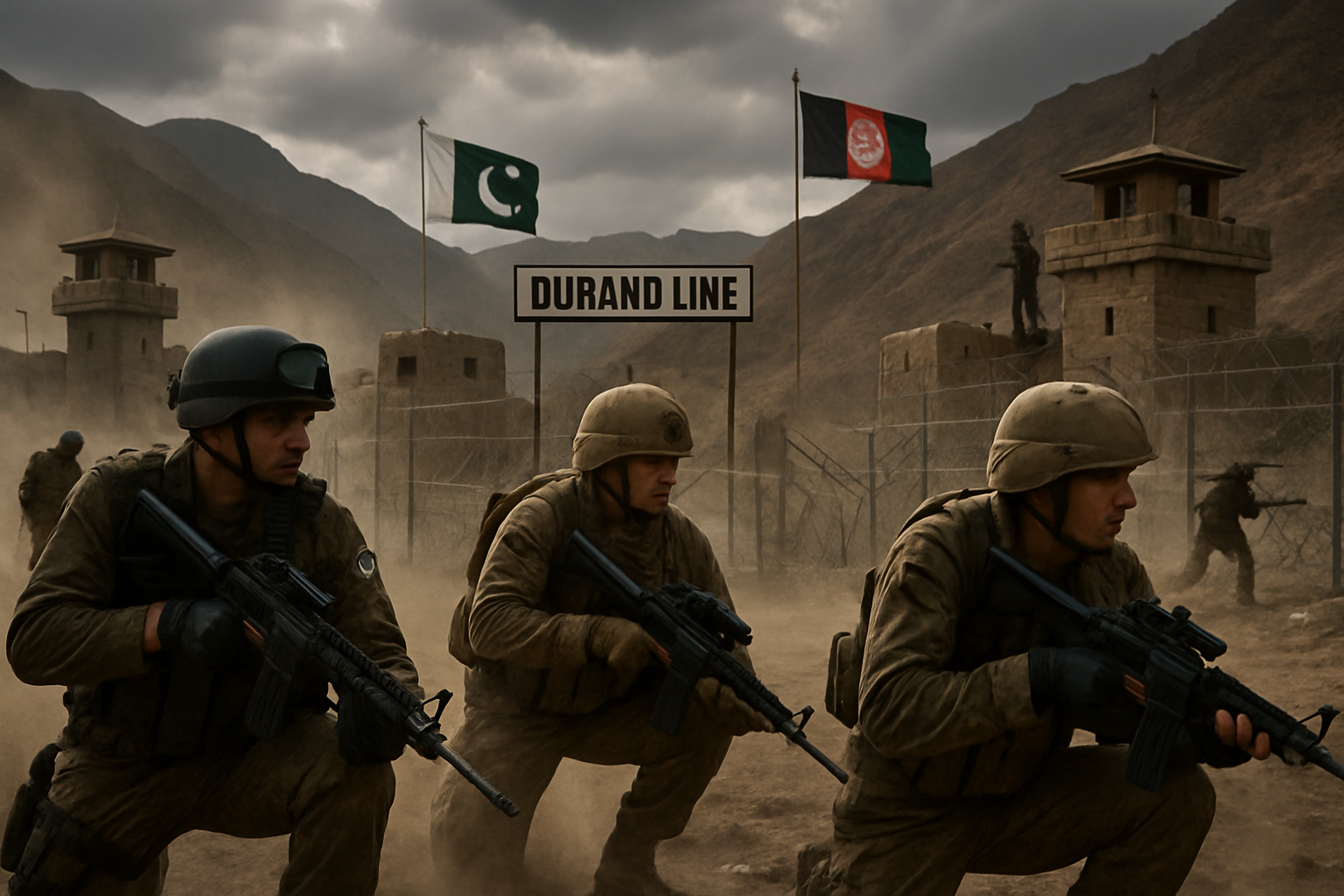
The Afghanistan-Pakistan border crisis has reached new heights of violence with fresh clashes erupting along the disputed Durand Line, as Taliban forces claim to have killed 30 Pakistani soldiers while UN officials report thousands more displaced civilians in what has become the most serious military confrontation between the neighbors since the Taliban's 2021 return to power.
According to Taliban Defense Ministry spokesman Enayatullah Khwarazmi, the latest clashes occurred in Shorabak district of Kandahar province, where Afghan fighters allegedly captured and subsequently destroyed a Pakistani military outpost. The spokesman claimed that 30 Pakistani soldiers were killed in the engagement, marking a significant escalation in the deadly border confrontation that has been raging since February.
Simultaneously, the 201 Khalid bin Walid Corps reported that Afghan forces killed eight Pakistani soldiers during operations along the Durand Line in Kunar province. Spokesperson Wahidullah Mohammadi stated that three soldiers were killed by precision laser strikes in Monawara district, while another was killed in Sarkani district, adding to the mounting casualties in this unprecedented crisis.
Humanitarian Crisis Deepens
The United Nations Office for the Coordination of Humanitarian Affairs (OCHA) released alarming new figures showing the conflict's devastating impact on civilian populations. The violence, which has occurred between February 26 and March 3, has affected at least 10 provinces including Kabul, Kandahar, Khost, Kunar, Laghman, Nangarhar, Nuristan, Parwan, Paktia, and Paktika.
OCHA estimates that 16,370 families have been newly displaced by the fighting, with the heaviest displacement in Paktia province (7,000 families), followed by Kunar (3,500 families), Khost (2,500 families), and Nangarhar (2,500 families). The displacement adds to an already dire humanitarian situation, with approximately 7,000 families still displaced from the August 2025 earthquake in eastern Afghanistan.
The civilian toll has been devastating, with at least 56 civilians killed and 129 others injured according to UN documentation. The fighting continues to rage in five provinces: Nangarhar, Kunar, Khost, Paktia, and Paktika, where hostilities remain ongoing as of March 4.
Escalation Timeline: From Diplomatic Tensions to "Open War"
The current crisis traces its roots to February 16, when a suicide attack by the Tehreek-i-Taliban Pakistan (TTP) killed 11 Pakistani soldiers in Bajaur district. This triggered a dangerous escalation cycle that has fundamentally altered the regional security landscape.
Pakistan responded on February 22 with airstrikes targeting seven alleged terrorist camps in Afghanistan's Nangarhar and Paktika provinces. While Pakistan claimed to have killed over 80 militants, the strikes also resulted in significant civilian casualties, including eight schoolchildren aged 5-15 in Behsud district during the holy month of Ramadan.
The crisis reached its most dangerous point on February 27 when Pakistani Defense Minister Khawaja Asif formally declared "open war" against Afghanistan's Taliban government – the first such declaration between the neighbors and the most serious military confrontation since the Taliban's return to power.
The Durand Line: Historical Root of Conflict
At the heart of this crisis lies the disputed Durand Line, a 2,640-kilometer colonial-era border established in 1893 by British administrator Sir Mortimer Durand. No Afghan government has ever formally recognized this boundary, viewing it as an artificial division that separates Pashtun tribal communities across both sides of the border.
The porous, mountainous terrain along much of the border has long provided sanctuary for militant groups, complicating efforts by both governments to control cross-border movement. Pakistan maintains that the TTP operates "with impunity from Afghan soil," while the Taliban denies providing sanctuary to any armed groups.
Economic Devastation Compounds Crisis
The military confrontation has triggered a catastrophic economic collapse between the two countries. Bilateral trade has plummeted by 59%, with Pakistan's exports to Afghanistan dropping from over $550 million to just $228 million in the first seven months of the current fiscal year.
Traditional trade routes through Chaman-Spin Boldak and Torkham crossing have faced repeated closures, devastating border communities that depend on cross-border commerce. This economic dimension compounds Afghanistan's already severe humanitarian crisis, where 88% of female-headed households are unable to meet minimum living requirements according to UN data.
International Mediation Efforts Falter
Despite intensive diplomatic efforts by regional powers, mediation attempts have largely failed to address the underlying security challenges. Saudi Arabia facilitated a prisoner exchange in February 2026, releasing three Pakistani soldiers captured during October 2025 border clashes, but this confidence-building measure proved insufficient to prevent the escalation.
Iran has offered mediation services, warning of broader regional destabilization risks. Turkey's Foreign Minister Hakan Fidan launched diplomatic initiatives, contacting counterparts in both countries as well as Qatar and Saudi Arabia. Russian Special Envoy Zamir Kabulov has also stressed that disputes should be resolved through dialogue and diplomacy.
However, Pakistan acknowledges that its traditional influence over Afghanistan has diminished significantly compared to wealthier regional powers including Turkey, the UAE, Qatar, Saudi Arabia, and China, reducing its diplomatic leverage and increasing reliance on military solutions.
Nuclear Dimension Raises Global Stakes
The involvement of nuclear-armed Pakistan adds a dangerous dimension to this crisis that extends far beyond the bilateral relationship. The most serious confrontation between the neighbors in decades tests the post-2021 South Asian security architecture and requires careful international monitoring to prevent escalation beyond conventional military operations.
Chinese officials have warned the UN Security Council about the presence of ISIS-K, al-Qaeda, and the East Turkestan Islamic Movement (ETIM) in Afghanistan, contradicting Taliban claims of having defeated terrorism. This international dimension demonstrates how the bilateral crisis intersects with broader global security concerns.
Civilian Protection Under International Law
The pattern of civilian casualties has raised serious questions about compliance with international humanitarian law. Strikes on residential areas, educational institutions, and religious sites during Ramadan have prompted calls from UN observers and human rights organizations for immediate protection of non-combatants.
The targeting of civilian infrastructure, including the reported strikes on Bagram Airfield and military facilities in both countries' capitals, represents an unprecedented expansion of the conflict beyond traditional border regions into strategic installations and populated centers.
Regional Security Architecture Under Stress
This crisis represents a critical test of the Taliban's governance capabilities in controlling militant groups operating from Afghan territory, while simultaneously challenging Pakistan's resolve to balance security imperatives with diplomatic engagement.
The success or failure of efforts to contain this conflict will likely influence how similar territorial sovereignty versus transnational terrorism challenges are managed in the 21st century, providing a potential template for conflict resolution mechanisms globally.
Path Forward Uncertain
As fighting continues across multiple provinces and diplomatic initiatives struggle to gain traction, the international community faces mounting pressure to develop effective conflict prevention mechanisms before the crisis escalates into a broader regional confrontation.
The coming days and weeks will be decisive in determining whether innovative diplomatic frameworks can overcome the cycle of violence and retaliation, or if the region faces the prospect of sustained warfare between nuclear-armed neighbors with implications extending far beyond South Asia.
The crisis underscores the complexity of modern conflicts where historical territorial disputes, cross-border terrorism, humanitarian concerns, and great power competition intersect, requiring unprecedented international cooperation and innovative approaches to prevent regional destabilization.